
A top Japanese Unification Church leader who left, Yoshikazu Soejima, wrote a long article and was interviewed by The Washington Post in 1984
Updated December 17, 2025
Contents:
1. “This is the secret side of the ‘Unification Church’
– Accusations from those ‘expelled’ in the Sekai Nippo ‘World Daily News’ scandal” – Bungei Shunjū
This is an edited computer translation from the Japanese. It may be improved in the future.
2. Moon’s Japanese Profits Bolster Efforts in U.S. – The Washington Post
1.
“This is the secret side of the ‘Unification Church’
– Accusations from those ‘expelled’ in the Sekai Nippo ‘World Daily News’ scandal”
『文藝春秋』 1984年7月号に
「これが『統一教会』の秘部だ―世界日報事件で『追放』された側の告発」
‘Bungei Shunjū’ July 1984 issue
“Former editor-in-chief Yoshikazu Soejima and sales director Hiroaki Inoue jointly wrote this article for the July 1984 issue of the ‘Bungei Shunjū’”
副島嘉和 Soejima Yoshikazu (Editor-in-chief and Publisher )
井上博明 Inoue Hiroaki (Sales Director)
暴カをふるって占拠
The Violent Occupation [of the newspaper offices in Japan]
Approximately 100 men, including karate practitioners, entered the back entrance of a nine-story building in Shibuya, Tokyo. The time was noon on October 1, 1983. A modest newspaper called Sekai Nippo occupied four floors above the third floor of the building. The intruders violently occupied the newspaper, imprisoning executives for extended periods and injuring approximately 10 employees. This incident was reported in some newspapers, so some readers may be familiar with the story.
Sekai Nippo is a daily newsletter published by the Unification Church (the Holy Spirit Association for the Unification of World Christianity), which has raised a variety of public topics. At the time, I (Soejima) served as its editor-in-chief. Until the year before, I had also served as the Public Relations Director at the Unification Church headquarters and was one of the twelve members of the Council of Directors, the church’s highest decision-making body. My colleague, Inoue Hiroaki, had previously served as the Shikoku Block Chief of the Unification Church (responsible for the entire Shikoku region) and was then serving in the important position of Sales Director at the Sekai Nippo.
It might be easier to understand if we refer to it as the “Principle Movement” rather than the Unification Church (the Principle Movement refers to the student organization of the Unification Church). In any case, it was the “Principle Movement,” i.e., men from the Unification Church, who invaded and committed the violence. Kajikuri Gentarō, chairman of the International Federation for Victory over Communism, a political organization of the Unification Church, and his colleagues attacked the newspaper that published the Unification Church’s daily newspaper. The reason for this was our attempt to make the Sekai Nippo a newspaper that would be readable by the general public.
On January 1, 1974, at the direction of the Unification Church’s founder, the Korean Sun Myung Moon, the Sekai Nippo was founded with funding from the Unification Church and the Federation for Victory over Communism, with the goal of becoming a general-purpose newspaper. However, it is not that easy to establish a daily newspaper, and in the six years since its founding, the Sekai Nippo has been unable to evolve beyond being just an organ of the religious organization, the Unification Church. In fact, all of the employees were members of the Unification Church, and the Unification Church had long been responsible for covering all financial losses.
When Hiroaki Inoue and I joined the company in October 1980, six years after the newspaper’s founding, the newspaper had a paid subscription of only about 7,000 copies, and it was unable to survive without the Unification Church covering a monthly loss of 600,000 yen. Because the newspaper was backed by the Unification Church and the Federation for Victory over Communism, it did not receive contributions from generally respected scholars or intellectuals. Naturally, the number of writers was limited, and we relied on members of the Professors World Peace Academy, an academic organization of the Unification Church, such as Masatoshi Matsushita, Nobuyuki Fukuda, and Michimasa Irie, as well as consultants for the Federation for Victory over Communism, such as Yoji Hirota and Kyosuke Hirotsu.
なぜ訣別したのか
Why Did We Part Ways?
We were faced with a difficult decision. Since we were aiming to create a general-purpose newspaper rather than a sectarian propaganda paper, we had to maintain editorial and management independence and create a paper that was not biased toward any particular sect or political group. To achieve this, we had to adopt the following policies:
Sekai Nippo’s pages would not be used to proselytize or promote the Unification Church or the Federation for Victory over Communism. In principle, we would cover the Unification Church, the Federation for Victory over Communism, and related organizations to the same extent as other newspapers. In certain circumstances, we would cover them more modestly than other newspapers. However, our editorial tone would be more strongly anti-communist and patriotic than the Sankei Shimbun. This would indirectly contribute to our investors, the Unification Church and the Federation for Victory over Communism, by defending the liberal camp and preventing Japan becoming communist.
I made this basic stance clear to all employees and worked to persuade scholars and intellectuals who had not previously appeared in Sekai Nippo. Over time, these efforts bore fruit, with numerous prominent intellectuals, including Muto Mitsuaki, Katsuta Yoshitaro, Hayashi Kentaro, Tanaka Michitaro, Kusayanagi Taizo, Kato Hiroshi, Takeyama Michio, and Ozaki Kazuo, beginning to contribute. Additionally, powerful serialized novels, such as Genda Minoru’s “Kaze Nari Yamasu” (Wind Never Ends) and Murakami Genzo’s “Tanuma Okitsugu,” which had previously been unsuccessful, continued to appear, providing a major boost to circulation.
Meanwhile, in terms of reporting, in 1982, the magazine was the first to point out the misreporting of the textbook approval scandal, sounding the alarm about the nature of media reporting, and in its campaign against the misuse of photographs in “The Devil’s Gluttony,” it questioned the ethics of media outlets. Furthermore, in 1983, the magazine’s coverage of the Levchenko Affair yielded a scoop that quickly identified KGB agents, putting it at the forefront of uncovering international espionage. The success of these reports led to Sekai Nippo being cited in other weekly and monthly magazines, dramatically increasing its name recognition. Furthermore, when Kenichi Takemura and Shoichi Watanabe introduced Sekai Nippo on television, subscriptions flooded in from across the country.
The increase in paid subscriptions and internal streamlining made it possible to normalize operations. Sales Director Hiroaki Inoue expanded the number of retail outlets from the initial 10 to 74 within three years, raising paid subscriptions from 7,000 to 35,000. In addition, a drastic reduction of over 200 employees and the collection of over 200 million yen in accounts receivable took two years to complete. As a result of these management efforts, Sekai Nippo’s subsidies from the Unification Church and the Federation for Victory over Communism were completely halted. The next step was to correct the abnormal employee structure, in which Unification Church members made up the majority of the staff. This was a condition for Sekai Nippo to join the Newspaper Publishers & Editors Association. So, starting in fiscal year 1984, we made the bold decision to begin open recruitment for employees.
However, the Unification Church and Federation for Victory over Communism, dissatisfied with our ideal of a free media organization, suddenly thoroughly intervened in Sekai Nippo.
A lawsuit is currently being filed with Shibuya Police Station regarding the violent incidents and the injuries and assaults against employees that occurred during the Sekai Nippo intrusion and occupation. However, the perpetrator of the violence, Federation for Victory over Communism Chairman Kajikuri, has now become Sekai Nippo’s president.
We left the company in despair at the way those claiming to represent religious organizations were attempting to occupy and privatize Sekai Nippo for their own gain, but looking at the new executive team, it is clear that officials from the Unification Church and Federation for Victory over Communism dominate Sekai Nippo’s executive ranks, clearly demonstrating the intention to turn the paper into an “official newspaper” for the purposes of promoting the political organization the International Federation for Victory over Communism and the religious corporation, the Unification Church.
I had served as Director of Public Relations at the Unification Church headquarters until the year before the incident, and was a senior church leader. I was subsequently expelled from the church along with Hiroaki Inoue. However, it was actually us who were rapidly losing the trust we had long held in the Unification Church. What made us feel this way more than anything was our growing disappointment and suspicion toward “Sun Myung Moon,” whom we had so revered, and the head of the Unification Church in Japan, Osami Kuboki (now known as Ryoko). In particular, regarding the violent incident at the Sekai Nippo newspaper, it was “Sun Myung Moon” himself who ordered Chairman Kajikuri and others to use violence, while Chairman Kuboki turned a blind eye to it. This was the decisive factor in our decision to break away from the Unification Church.
「愛のマグロ釣り研修」とは
What is the “Love Tuna Fishing Training?”
There is evidence that the Sekai Nippo violence was based on instructions from “Sun Myung Moon.” Two days after the incident, the church headquarters issued a directive titled “Response to the Sekai Nippo Incident” to all organization leaders nationwide.
“When Chairman Kajikuri visited the United States in late September, he received orders from Heaven to thoroughly clean up Sekai Nippo and overhaul its personnel. Heaven’s sorrow and indignation are immense, and He stated, ‘Anything that destroys the traditional standards of faith cannot be tolerated. Even if the newspaper were to be suspended for a month or even three months, establishing Heaven’s traditions outweighs any loss.’ Chairman Kajikuri was appointed as Sekai Nippo’s new president… Chairman Kuboki was then instructed to thoroughly sort out the Sekai Nippo issue and make new personnel changes.”
Heaven, of course, refers to Sun Myung Moon. Kajikuri, the perpetrator of the violence, also acknowledges that it was an order from Sun Myung Moon. On October 5th, four days after the incident, Kajikuri gathered all the Sekai Nippo employees at the Unification Church headquarters and gave the following speech:
“Why did I use force to occupy the Sekai Nippo…? At 10:25 on September 23rd, in front of Father (meaning “Sun Myung Moon”) at East Garden (Sun Myung Moon’s private residence in upstate New York), personnel changes were made to the Sekai Nippo. I would like to inform you of these personnel changes. Co-presidents Ishii Mitsuharu (a responsible officer of the Unification Church), Kajikuri Gentaro (chairman of the Federation for Victory over Communism),… Vice-president Kunitoki Akihiko (former editor-in-chief of “Thought News,” the official newspaper of the International Federation for Victory over Communism),… On the 27th, a meeting regarding the Sekai Nippo was held. There, (by “Sun Myung Moon”), all responsibility for resolving the issues at the Sekai Nippo was entrusted to Presidents Ishii and Kajikuri. …arrived at Narita Airport at 5:00 PM on the 28th…a meeting was held at 9:00 AM, centered around the chairman (Kuboki Akimitsu)…
“On the 30th, when the president and vice president were absent, this meeting was held without notice, and what they called an executive meeting was a conspiracy organised by two people (Soejima and Inoue)… Without Father’s (Sun Myung Moon’s) permission and without his knowledge, they dismissed him and made themselves (Soejima) the representative director… This company (The Sekai Nippo) has separated from the Unification Church and is now an independent, separate company. The Unification Church will now lose the entire company (The Sekai Nippo). These criminal facts have become clear. We can no longer wait…” And so they attacked the Sekai Nippo.
For religious organizations, the leader is absolute, wielding immense power over followers. However, despite the leader’s apex and firm adherence to his teachings, the Unification Church, with branches around the world, has continued to operate as a single organization with its own president, adapting to the circumstances of each country. However, before we knew it, the activities of the Unification Church in Japan gradually began to be carried out entirely under the direct orders of “Sun Myung Moon” in the United States, rather than being decided by the Unification Church Japan headed by Chairman Kuboki.
In the instructions for “Response to the Sekai Nippo Incident,” in the section on our “acts of rebellion,” it states that “failure to respond to Heavenly calling, information control, and the Word of God not reaching the lowest levels,” thus “destroying the tradition of faith.” Specific examples of “failure to respond to Heavenly calling” include “recent boycotts of the Love Tuna Fishing Training.”
The “Love Tuna Fishing Training” is an unusual leadership training program in which “Sun Myung Moon” takes turns having leaders board a tuna fishing boat off the coast of Boston every year, with three or four leaders taking turns fishing for tuna, and then drills them with sermons on board and at camps. This unique training program kills two birds with one stone and is also practical (the tuna caught is donated to a church-affiliated fishing company). Based on how the tuna fishing went, personnel changes were also made. “Sun Myung Moon” explains this as personnel decisions made with spiritual insight.
Last year, from July to August, approximately 70 executives from Japan went to the United States to participate in this tuna fishing training, and 20 of them were ordered to be transferred to the United States. I imagine these people are now struggling, having been suddenly thrust into America, where they struggle to speak the language, and having to engage in economic activities at church-affiliated companies and Japanese restaurants.
Indeed, I was on the list of participants in the tuna fishing training. However, as editor-in-chief of the daily newspaper Sekai Nippo, I felt that taking 10 days off work for tuna fishing training would disrupt the production of the newspaper.
As a senior member of the Unification Church in Japan, I have followed the organization’s decisions. I previously served as Director of Public Relations at the Unification Church headquarters, and as Secretary General of the International Cultural Foundation, also headed by Sun Myung Moon (the academic and cultural organization established with the support of this foundation is the Professors World Peace Academy). Since becoming Editor-in-Chief of the Sekai Nippo, I have worked tirelessly to ensure that the paper’s success as a public service, fulfilling its role as a public institution, will strengthen and contribute to the church. Therefore, I have always placed the highest priority on maintaining the newspaper’s principles as a media outlet. Although the majority of the newspaper staff is made up of Unification Church members, I have boldly instructed employees not to engage in religious worship within the newspaper, and I have made sure that this is adhered to. Before I joined the company, everyone would pray together in honor of Sun Myung Moon before and after executive and editorial meetings. This may have also sparked resentment among senior Japanese church leaders loyal to Sun Myung Moon.
日本語版から削除された個所
Sections Deleted From the Japanese Version [of the Divine Principle]
At the end of December last year, the Asahi Shimbun published an article about the Sekai Nippo incident and my criticism of the Unification Church, headlined “Strongly Korean Rituals”. The article included a statement by me to the effect that, “The Unification Church is supposed to be a world religion that aims to perfect Christianity. However, in Reverend Moon’s view, the ceremonial dress, bows, and terminology are too strongly Korean. In the West, personnel positions are also over-represented by Koreans. As a Japanese person, I felt the need for improvement.” My feelings about this situation have become even stronger now.
For example, in the instructions quoted above, “Response to the Sekai Nippo Incident,” it states, “Make sure these facts (such as our acts of rebellion) are thoroughly communicated to all members,” using the Korean word “jikku” (members). “Jikku” means “family” in Korean, and is how members are referred to in the Unification Church.
Furthermore, the “Children’s Day Special Instructions” issued on November 5th of last year state, “Take this day as an opportunity for all members to learn Korean!” As the Asahi Shimbun article also notes, the Unification Church defines Korean as the future “mother tongue” and the mother tongue of its faith. However, this is the first time that such a specific instruction has been issued requiring all members to study Korean.
It goes without saying that the Unification Church was born in Korea and is founded by a Korean, Sun Myung Moon. Therefore, while it is inevitable that some Korean customs are incorporated into its religious ceremonies and rituals, the problem goes beyond that. The church also preaches that the “Korean people” are the chosen people and are superior to other ethnic groups. This idea denies Christianity’s true character as a world religion. It is the very idea of the chosen people that distinguishes ethnic religions from world religions.
From this perspective, the idea that the “Korean people” are the chosen people or that Korea is the center of the world clearly contradicts the principle of the Unification Church as a world religion that inherits the orthodox Christian tradition. However, the Korean version of the Unification Church’s scripture, “The Divine Principle,” makes this clear.
However, this section has been intentionally deleted from the Japanese version of the Divine Principle. The following passage in Chapter 6, Section 2, “Where Will Jesus Return?” of the Korean version of the Divine Principle states that the “Korean people” are the chosen people, and that Korean is the mother tongue and [is to be the] universal language, making it a Korean-centrist, ethnic Korean religion distinct from world religions.
“Since ancient times, the term ‘Eastern Countries’ has referred to the three Eastern nations of Korea, Japan, and China. Of these, Japan has been a nation that has worshipped Amaterasu Omikami for generations. Furthermore, it is currently undergoing a period of resurgence as a totalitarian state, having brutally persecuted Christianity in Korea. And China has become a communist nation, so both of these nations are on Satan’s side. Therefore, simply put, the Eastern country to which Jesus will return is none other than Korea… If Jesus were to return to Korea, the Korean people would become the third chosen Israel.”
“All civilizations must bear fruit in this country (Korea). Since the dawn of history, religion and science—that is, spiritual and material civilizations—have developed throughout the world. They must all be absorbed and integrated under one truth, centered on Korea, and must bear fruit as the ideal world desired by God” …“This must take place in Korea, where all civilizations must bear fruit.”
“In which country will languages be unified? The answer to that question is clear: it is customary for children to learn the language of their parents. If Jesus, who became the Parent of humankind, is indeed to return to Korea, He will undoubtedly speak Korean, and Korean will become the native language. Consequently, all peoples will have no choice but to use this native language.”
The section about the Second Advent, deleted from the Japanese version, can be said to be the conclusion of the Divine Principle. What it is saying is that the Lord of the Second Advent is Sun Myung Moon, who is Korean, and because the Korean people are the chosen people, the world will be unified through Sun Myung Moon, Korea will inevitably become the center of the world, and Korean will become the global lingua franca, common language. Furthermore, Sun Myung Moon and his wife will become the “True Parents,” reverently addressed as “Father” and “Mother” by all humanity.
This doctrine likely reflects the historically twisted mentality of Koreans toward the Japanese. This manifests itself in Sun Myung Moon’s strong distrust of the Unification Church of Japan and its leaders. The true character of Mr. Moon and the true nature of the Unification Church were revealed in the instructions for Children’s Day, particularly in the item he instructed those in charge to pray for, “May Oishi [Seong-jin Moon] and the Eve nation [Japan] be one in heart.”
敬礼式の奇怪な儀式
A Bizarre Bowing Ceremony
“Oishi-sama” is the Japanese name of Seong-jin Moon, the son of the first wife of “Sun Myung Moon,” who graduated from Tokai University and is currently residing in Japan. It’s a combination of the first characters of the surnames of two Japanese church leaders who are serving as his “guardians” during his stay in Japan. “Eve Kingdom” is a Unification Church term referring to Japan. So what does it mean when “Oishi-sama” and “Eve Kingdom” say, “Be one in heart”? It means that the Unification Church of Japan should cherish and respect Seong-jin Moon above all others. Therefore, it means that President Kuboki of the Unification Church of Japan must obey Seong-jin Moon.
I should also point out that the Unification Church of Japan has a symbolic and unpleasant ritual that regards “Sun Myung Moon” as the “Messiah” and “King of Kings.” On the four major anniversaries, the Unification Church holds a 5:00 a.m. Bowing Ceremony, during which key Unification Church leaders bow three times to “Mr. Moon” and his family as they sit at the altar. The ceremony typically takes place at East Garden in upstate New York, Moon’s private residence. Each representative of a major country, including the Emperor, President Reagan, President Chun Doo-hwan, and other heads of state, is represented by a church leader from that country. They kneel before Founder Moon and his family, performing a ceremony that represents the sovereigns of the world bowing to Founder Moon.
The representative of the Japanese Emperor is none other than Unification Church Japan President Kuboki. It’s a strange scene, and one that the Japanese people, who cherish the Emperor as their national symbol, cannot overlook. Furthermore, representatives of major religions, such as Jesus Christ, Buddha, Confucius, and Muhammad, are also represented, and they similarly prostrate themselves before “Mr. Sun Myung Moon” and his family. This is an important ceremony that demonstrates that Mr. Moon has authority over all religions.
As can be seen from this, the religious activities and patriotic movements carried out by the Unification Church and the International Federation for Victory over Communism are merely expedients aimed at realizing Mr. Sun Myung Moon’s ambitions.
What’s even more noteworthy is that Mr. Sun Myung Moon decided on “Founding the Fatherland” as the slogan for 1984. “Founding the Fatherland” literally means that the Unification Church will create a nation. This “homeland” refers, of course, to Korea. It is said that in order to “found the fatherland” in Korea, personnel transfers have been issued for 150 Japanese Church members, who are allegedly assigned to the Victory over Communism Movement in Korea.
It appears that Mr. Sun Myung Moon and Korean Unification Church executives are wary of anyone taking pride in being Japanese within the Unification Church in Japan. They are particularly arrogant toward Japanese people. At the root of “Sun Myung Moon’s” deep distrust of the Unification Church of Japan and its leaders, and the resulting coercive attitude, is, as Koreans, his repeated anti-Japanese sentiment towards the Japanese people. When “Moon” instructs Japanese leaders on fundraising and donations through economic activities, he always uses the same argument: Japan’s recovery was due to the special procurement boom caused by the Korean War, and Japan’s prosperity is built on the sacrifices of Koreans. Therefore, the founder asserts that he feels no remorse for taking enormous amounts of money out of Japan or for the hardships his Japanese members endure as a result.
The Unification Church is a new religious movement founded just over 20 years ago, but it has now grown into a major religious organization with affiliated organizations in over 130 countries around the world. However, in reality, the church has 8,000 members in Japan, where it boasts the largest number of members, 2,000 in the United States, and several hundred throughout Europe, while in Korea, where it originated, the majority are nominal members, with only about 2,000 people fully engaged in church activities. Nevertheless, the impression of it being a huge organization is due to the promotional effect of various events, competitions, businesses, facilities, etc., which are made possible by its abundant financial resources.
金集めに狂奔
A Frenzy Over Collecting Money
A major factor behind the Sekai Nippo incident and my subsequent departure from the Unification Church was my criticism of the economic activities, such as the sales of product by Unification Church members, particularly those associated with Happy World, a key Unification Church company – put simply, their frenzied fundraising. We decided to publish this memoir, fully anticipating being branded as “traitors”. We wanted the public to fully understand the true nature of the Unification Church and the true character of “Sun Myung Moon,” as well as the horrific economic activities such as the sophisticated tax evasion and the deceptive sales of overpriced goods.
In fact, the frenzied fundraising of the Unification Church members through fundraising drives, year-end charity drives, and the sale of name seals, marble vases, and miniature pagodas far exceeds the religious activities of a [regular] religious corporation. Over the past year, Sekai Nippo employees have also been conducting street fundraising campaigns for Indochina refugee relief, but it’s safe to say that the true purpose of these campaigns is to raise funds for themselves.
Last October, the Asahi Shimbun newspaper ran an article stating that the Unification Church is planning to dig a “Japan-Korea Tunnel” between Kyushu and Korea. It is conducting geological surveys by drilling in Saga Prefecture, Iki Island, and the Tsushima Strait, as well as using a research vessel to do marine layer surveys. The Unification Church is covering all of the costs, totaling tens of billions of yen. In fact, this “Japan-Korea Tunnel” plan is a major project proposed by Sun Myung Moon. However, while the scholars and engineers involved in the survey acknowledge that the survey itself is significant, they view it as an “unrealizable pipe dream,” and even those associated with the Unification Church themselves believe this to be the case.
But even so, because it’s Mr. Moon’s proposal, they are lavishly pouring tens of billions of yen into the project and working hard on it. This is where the strangeness of a religious organization lies, but the real question is, where is the money coming from?
The Unification Church has expanded its facilities in the United States, including the purchase of the former New Yorker Hotel and a newspaper office [The Tiffany Building], which are now centers of evangelism. It also hosts various conferences and conducts business activities. Recently, the French newspaper Le Matin reported that the Unification Church took control of a bank in Uruguay, acquired a monthly newspaper, a publishing company and the largest hotel in Montevideo, and opened a radio station. I heard about Uruguay directly from Sun Myung Moon at a leadership meeting at the Jeju Grand Hotel in Jeju last May, when I was ordered to visit Korea. During the meeting, Mr. Moon instructed, “Seize the Four Powers for World Restoration.” [These are ideology, economy, science and technology, and journalism.] He also mentioned that, in relation to one of the four powers, economy, he is already acquiring a bank in Uruguay, a resource-rich country, in order to establish a foundation.
As for the other three of the four powers, in terms of ideology, the Professors World Peace Academy, an organization for scholars and cultural figures, will be established in 70 countries. The Professors World Peace Academy was established in Japan in 1974 and continues to operate. In terms of science and technology, the plan is to use the [Wanderer Maschinen GmbH (Munich) and Gebrüder Honsberg GmbH (Remscheid)] Companies acquired in West Germany as a base to bring the technology of Tong-Il Industries (a Unification Church-affiliated company in Korea) up to world-class standards. In terms of freedom of speech [and journalism], the plan is to establish a Times Group in five locations across the United States, centered around the previously established Washington Times. In Japan, the plan calls for the acquisition of one of the Asahi, Mainichi, or Yomiuri newspapers. Hard to believe, but specific talks are currently underway regarding the acquisition of a major Japanese newspaper, with work to begin within two years.
Every year, the Unification Church holds events such as the “International Conference for the Unity of the Sciences,” which brings together scholars, and the “World Media Association,” which brings together media professionals. Preparations are underway to hold the sixth “World Media Association” conference in October of this year, and the “International Conference for the Unity of the Sciences” in November, both in Tokyo.
The Japanese branch of this “Professors Peace Academy” is led by former Rikkyo University President Masatoshi Matsushita and current University of Tsukuba President Nobuyuki Fukuda. In fact, the Unification Church designated these two scholars, as well as four others, as important contributors to the church and paid them regular allowances. When the budget allocation was reported at the Unification Church headquarters directors’ meeting, the amounts paid to each of them were recorded. As far as I can remember, the amounts were 600,000 yen per month for two and 400,000 yen for the other two.
In any case, it goes without saying that a considerable amount of funding was required. It is precisely this abundance of funds that has led many people to view the Unification Church with suspicion, not only in Japan but around the world. What’s important here is that the funds for establishing and maintaining these American facilities, Korean companies, and church missionaries in South America and Africa were generated by Unification Church members in Japan through donations and fundraising, as well as the sale of ginseng tea, name seals, jars and vases, and miniature pagodas, all of which were fraudulently sold at high prices and using clever tax evasion schemes.
It is not only the Japanese church members who provide the funds, but also those engaged in missionary activities in the United States, Europe, South America, Africa, and elsewhere. It can be said that the driving force behind the expansion of the Unification Church network around the world was the charisma of “Sun Myung Moon,” and it was the Unification Church of Japan. The Japanese people’s characteristics of gentleness and hard work, combined with their unique fascination with the Unification Principle, have generated great energy for the Unification Church of Japan. Despite an inherent distrust and resentment toward the Japanese, “Sun Myung Moon” has not given up hope for the Japanese church and continues to issue instructions regarding personnel and organization, because finances and funds cannot be raised without the activities of the members of the Unification Church of Japan.
「ハッピ一ワ一ルド」社とは?
What is the “Happy World” company?
The “Children’s Day” instruction issued on November 5th of last year read, “Aiming for a Great Victory on the 120-Day Course.” This “120-Day Course” is church-speak for a fundraising period. This crucial period, from November 16th to January 21st was designated by “Sun Myung Moon” for fundraising. Therefore it was instructed that the Unification Church and all affiliated organizations cease all their activities and focus their efforts on “economic restoration”—fundraising. The Sekai Nippo incident had caused confusion not only within the Sekai Nippo but also among Unification Church members, resulting in a significant halt in economic activity. The losses from the Sekai Nippo, which had been suspended for 20 days, had to be covered. And more importantly, payments to “Sun Myung Moon,” who had been sent 2 billion yen every month since the July 1975 remittance order, had also fallen behind. The “120-Day Course” order was intended to resolve this financial crisis.
As mentioned above, the problems with the Unification Church include the sophisticated tax evasion and fraudulent sales of products in its economic and sales activities. There have been many cases of fraudulent sales that have been reported in the newspapers, such as the arrest of a salesman for fraud after he sold an elderly woman a marble jar at a high price, telling her that “the spirit of Buddha resides in the jar and that buying it will bring happiness” (April 1982, Otsuka Police Station, Tokyo); the arrest of a consumer center in Fukushima, where a customer was sold a total of 44 million yen worth of items, including a seal, jar, pagoda, and Korean ginseng, and the return of the items (February 1983, Fukushima); and the lawsuit filed by housewives seeking refunds after being tricked into buying jars and pagodas at high prices through persistent sales tactics that promised they would go to paradise if they stroked the jar and prayed (November 1983). In January of this year, the Aomori District Court handed down a suspended sentence to two salesmen who lured a woman they met through sales into a hotel, telling her she was “possessed by an evil spirit,” and then performed an exorcism ritual and defrauded her of 12 million yen in prayer fees.
In these cases, Unification Church, its business division Happy World, and the business parties involved completely deny that the people involved are Unification Church members or Happy World salesmen. However, since it is Happy World headquarters staff and their legal counsel who are handling disputes such as repayment, they cannot deny a connection. The police are also fully aware of this. There is also ample evidence to support the ties with the business division that the church vigorously denies.
In November 1982, the National Consumer Affairs Center of Japan, an external organization of the Economic Planning Agency, conducted a survey of inquiries received since 1976 at 247 consumer centers and National Consumer Affairs Centers nationwide. The survey revealed a total of 2,633 cases of fraudulent sales involving seals, marble vases, and pagodas, totaling approximately 1.7 billion yen.
The report states, “There are numerous cases in which the same person has been victimized multiple times, such as when someone is first tricked into purchasing a seal and then, using more malicious tactics, is tricked into purchasing a marble vase because, for example, they are still suffering from a curse.” “Consumers are not only solicited verbally, but also through slides and videotapes of cases in which they actually suffered misfortune because they did not purchase the product. Some solicitations are elaborate, involving offering the product after praying for it and then requesting a prayer fee.”
The mastermind behind these sales of goods by Unification Church members is Happy World, headquartered in Jinnan, Shibuya Ward, Tokyo. A large sign hangs on the building across the street from Shibuya Parco. Although the company denies any connection to the Unification Church to outside parties, its president, Motoo Furuta, serves as the Unification Church’s vice president for finances and is the person who controls all financial transfers to Sun Myung Moon in the United States.
He currently spends most of his time at the mission headquarters in the former New Yorker Hotel, receiving instructions from Sun Myung Moon and managing the Japanese staff, including transferring personnel from Japan and assigning duties to executives and church members.
Under Furuta’s Happy World, the country has been divided into ten regions, and a four-tiered sales network has been organized, consisting of sales companies, authorized dealers and retail stores. Unification Church members engaged in sales are affiliated with retail stores, but are registered solely as individual commissioned salespeople.
Therefore, any trouble caused by unskilled salesmen is contained by retail stores and authorized dealers, and the salesmen themselves are instructed never to reveal that they are members of the Unification Church during questioning, so a solid system has been put in place to ensure that the names of Happy World, the head office, and the Unification Church never come to light in connection with any trouble.
脱税の手ロ
Methods of Tax Evasion
What I would like to reveal here is the method of tax evasion in sales activities. There are some surprising documents instructing subordinate salespeople and Unification Church members on how to do this. One example is a speech given by Shizu Mizoguchi, accounting manager at Happy World headquarters, at an accounting meeting in October 1980.
“Each product handled by Happy World is sold through three or four wholesale stages. However, accounting departments should not consider these wholesale companies as separate entities, but rather as a single, unified organization. This accounting system is based on the idea of returning everything to heaven (Happy World) rather than handing it over to this world (the tax office). The original idea of dividing the wholesale companies into several stages was to diversify profits, i.e., for tax purposes… We avoided making profits to the distributors (sales companies) that appear on the surface through registrations, etc., and instead focused on individual commissioned salespeople (Unification Church members). We give 70% of the final retail price to commissioned salespeople (members) as profit. This method will cause personal income tax issues, so please select commissioned salespeople (members) who have high incomes and give them priority during regular personnel transfers at Happy Head Office, or follow instructions such as distributing their residence registrations to the provinces. We must use our divine wisdom to avoid the eyes of the tax office. Furthermore, the 70% profit given to commissioned salespeople (members) is fully refunded to Happy Head Office, excluding personal living expenses. Since each store is integrated, this is just a bookkeeping transaction and no actual cash moves between stores… except for salespeople, of course. For employees (members), the company records three to five times their actual salary, with the difference being a donation (slush fund) to Heaven. As an example of how this slush fund is managed, the headquarters deposits it in fixed-term deposits under the Maruyū system in the names of the brothers (members). The individuals themselves are not required to be informed of this.
In essence, to evade taxes by creating slush funds for Heaven, the wholesale company is divided into several tiers, and 70% of profits are deducted as income from individual salesmen (church members), thereby avoiding tax on distributors and agents. Furthermore, these salesmen regularly change addresses to avoid taxes, and the 70% of their income, minus the minimum living expenses, is returned to the headquarters. This is a very clever method.
There is a company called “Wacom” in Shinjuku 2-chome, Tokyo. Founded in November 1981 with funds from the Unification Church, this computer company houses all of the 3,000-plus salespeople across the country, recording each person’s sales and accounts receivable. Based on their performance, the company manipulates employee transfers to evade income tax every three to six months. This is the use of computers in personnel management for tax evasion.
The document explaining the tax evasion method mentioned above includes a table (see the next page) listing the cost rate and retail price multiplier for each item sold, as well as the wholesale price and profit at each stage.
As is clear from this, a seal costing 11,300 yen was sold for 1.2 million yen, several dozen times the original price; ginseng extract costing 10,000 yen, eight times the original price, for 80,000 yen; vases costing 5,000 yen, a whopping 2 million yen, four hundred times the original price; and a pagoda costing 100,000 yen, five hundred times the original price, for 500,000 yen.
What extortionate profits! According to the results of a survey conducted by the National Consumer Affairs Center of Japan, seals were sold for up to 1.6 million yen, vases for 8.5 million yen, and pagodas for up to 23 million yen.
セ一ルスマン用の手引書
Handbook for Salespeople
To pull off such exorbitant sales, ordinary methods would be impossible. Therefore, they resort to what’s commonly known as “spiritual sales,” a sophisticated method using “psychics” or “teacher-like figures” to skillfully lure customers. As in all of the criminal cases mentioned above, salesmen bring in people playing the role of psychics or teachers, exploiting the customer’s weaknesses and emotional pain, leading them to believe in the miraculous powers of the product and convince them to buy it. To accomplish this, salesmen have prepared a guide called “Your Honey Talk.”
Before going to welcome the “teacher,” he first records, “The teacher is a very spiritual person. He has a good understanding of the invisible world… Many people have received his guidance, followed his instructions, been guided, and become happy.” When the teacher comes in, he “signals with his hand to indicate that it is the teacher, gets off his cushion, looks up, and then bows deeply.” Then, depending on the content of the teacher’s talk, he “nods! ‘That’s right. I see!’ He is moved! ‘Really? That’s frightening!’” When the Master left the room, he said, “You really care about your customers, don’t you?” And when he left to pray, he said, “Through this vase, your ancestors and descendants will be rewarded, so it’s worth the effort. There may be various financial circumstances, but it would be good if you made this decision while praying for the repose of your ancestors and the prosperity of your descendants. Perhaps you had prepared for this day, for example, with a fixed-term deposit, insurance, or a successful stock investment.”
“Your Honey Talk” also lists 22 criteria for selecting customers, including “1) Have there been any suicides? 2) Has there been any mental illnesses? 12) Is there a thread in the family of people dying young? 22) Are there any elderly single people?”
The Unification Church became particularly committed to fundraising around 1978, and from 1978 to 1979 it instructed its members to go on “financial paths or journeys” of 21, 120, 50, and 80 days. During this time, the target donation amount was 10,000 yen per person per day, amounting to 2.7 million yen per year. This quota continued to rise, and even the most junior members were now being asked to donate as much as one million yen per month.
It would be difficult for average church members to raise this much money through normal means. The only way to achieve this was to resort to aggressive sales tactics, using any means necessary. It was only natural that sales methods became more extreme and fraudulent, and the products offered became increasingly expensive.
Writing this much means that we have made the decision to completely deny our youth and are prepared to put our lives in danger. It is hard to believe, but most of the churches that were previously local organizations of the religious corporation, the Unification Church, have now been transformed into sales branches. Apparently, the only place where the sign of the religious corporation, the Holy Spirit Association for the Unification of World Christianity, hangs is at its headquarters church in Shoto-cho, Shibuya Ward, Tokyo.
When confronted about this, both Unification Church and Happy World, the business headquarters, protest that the two are completely separate organizations with no connection to each other. It’s true that the same person never appears as an officer in both organizations, including on corporate registration. However, avoiding duplication of registered officer names for tax purposes is a common practice among corporate organizations, not just Unification Church and Happy World.
However, the fact that Unification Church and Happy World are a single organization used to raise funds for Unification Church is clear from the fact that Happy World’s president, Motoo Furuta, is Unification Church’s vice president in charge of finances. Furthermore, allocations of contributions and revenue reports were made at Unification Church headquarters director meetings. Furthermore, the following is clearly stated in confidential church documents, as a confirmation between sales companies and Unification Church:
“Each church should appoint a person to serve as the liaison with the Business Division, and that person should handle all matters.”
“If a church is holding its own vase exhibition, please notify the Director of the Art and Crafts Department (World Happiness Co., Ltd., a subsidiary of Happy World) of your plans in advance.”
“If a complaint is received, be sure to report it to the sales company’s Managing Director and receive instructions for handling it.” “Japan’s future economic path will be centered around Chairman Kuboki, with all Japanese members united, and our overall victory will be the achievement of the Eve Kingdom.”
“The collected economic funds will be handled by the Chairman and Director Furuta (President of Happy World and current Vice Chairman for Economic Affairs), and no one else will be involved.”
“The divine providence (referring to instructions from “Sun Myung Moon”) of becoming an economic organization is to demonstrate Japan’s achievement of establishing an external economic standard of heart, the foundation of the global economy, and of establishing an external economic foundation as a united nation around the world. Furthermore, with Chairman Kuboki as Happy World’s chairman, all members will become employees, and the sale of our own products is a fundamental premise. This will create an economic foundation for the world as a global Happy World. Furthermore, within Japan, I believe it will serve as the foundation for realizing God’s will to integrate the Unification Church and the economy in the future.” (Instructions from Mr. Sun Myung Moon to the Directors’ Meeting)
The important thing to note here is that the Japanese Church was forced to shift to this economy-first philosophy entirely due to the orders and pressure of Mr. Moon.
In 1972, Mr. Sun Myung Moon separated Happy World, originally the business division of the Unification Church of Japan, from the Japanese Church. The pretext was that Happy World should work for the world, not Japan. After this, donations from the business division to the Unification Church of Japan ceased, and all profits were to be paid directly to Mr. Moon. As a result, the Japanese Church was forced to collect all expenses from its local organizations. He encouraged each local church to sell ginseng tea and conduct fundraising activities, and instructed them to establish new business divisions.
In 1975, a policy of economic unification was announced. All economically active members of local churches were to be absorbed into Happy World. The reasoning was that Happy World offered a higher rate of profit than the church’s business divisions.
As I’ve already mentioned, from 1978 to 1979, a period during which all Unification Church-related organizations were to focus solely on fundraising activities — an “economic path” — was established. The following year, in 1980, Mr. Moon issued an order completely transforming the Unification Church’s structure. This included the establishment of an Economic Bureau and the appointment of Happy World President Motoo Furuta as its director. Some of the instructions submitted to the aforementioned directors’ meeting were included in this order.
The most important point of these instructions was that Setsuo Sakurai, director of the Evangelism Bureau and in charge of Unification Church’s local organizations, became a subordinate of Happy World’s President Furuta. Mr. Moon’s order at this time reversed the hierarchical relationship between Unification Church and Happy World. As a result, Unification Church President Kuboki was completely demoted and lost all control of the organization’s operations. The Unification Church and all related organizations essentially became subsidiaries of Happy World, frantically pursuing financial fundraising activities, creating the current situation.
I felt that this transformation of the Unification Church into an economy-first organization was dangerous, and I repeatedly spoke out for revisions at director meetings. When the aforementioned instructions were issued, I could no longer bear it and submitted a document titled “Proposals for the Economic System” to headquarters. In it, I wrote, “The intention is for the economic authorities to control the spiritual and lifestyle aspects of the entire organization,” and “Happy World is in charge of one department of the Unification Church of Japan movement: the economy. … Because we are in an economic journey period, or because economics are being prioritized, the existence of each individual department (such as evangelism, victory over communism, and external relations) is being destroyed with a word of magic. If this continues, the entire Unification Church of Japan organization will become one that exists solely to raise money, and will eventually become isolated from society.”
At a meeting of executives held at the Grand Hotel on Jeju Island in May 1983, Sun Myung Moon said that after four years, the unification of the church and Happy World was finally complete. His satisfaction was evident, as he had been able to accomplish what he had wanted.
米国における脱税裁判
Tax Evasion Trial in the United States
For approximately eight months since the Sekai Nippo scandal, Mr. Sun Myung Moon and his blindly devoted Unification Church leaders have been praying fervently for and working behind the scenes to achieve two goals. One was for Mr. Sun Myung Moon to be acquitted in his appeal after being found guilty in the first and second trials of tax evasion [and document forgery] in the United States. The other was for Mr. Sun Myung Moon to obtain a Japanese visa to attend the World Media Congress, scheduled to be held in Tokyo in November.
In his “Children’s Day” instructions, which celebrated the victory of the 120-day fundraising journey, he commanded those in charge to pray specially for “victory in the trial,” in addition to the aforementioned “May Oishi [Seong-jin Moon] and the Eve Nation be united in heart.” However, the prayers of Mr. Moon and Unification Church leaders were shamelessly betrayed. On May 14, the U.S. Supreme Court accepted the Department of Justice’s request to dismiss the appeal and dismissed Mr. Sun Myung Moon’s appeal. As a result, Mr. Moon must serve the one-and-a-half-year prison sentence imposed by the lower court.
Mr. Moon was indicted on charges of conspiring to evade taxes between 1973 and 1975 by earning approximately $112,000 in interest on bank deposits in his personal name, and of filing false income tax returns by failing to report the transfer of stocks worth $50,000. On July 16, 1982, the U.S. District Court in New York sentenced him to 18 months in prison and a fine of $25,000. Moon’s lawyers immediately appealed the decision, and he was released on $250,000 bail, avoiding imprisonment. However, on September 13, 1983, the New York Superior Court upheld the guilty verdict, upholding the decision of the first trial.
The defense appealed to the U.S. Supreme Court on January 26th, citing the two-to-one split in the appellate court’s decision and the fact that the minority opinion clearly asserted the “religious persecution” nature of the trial. The U.S. Supreme Court was scheduled to review the documents and make a decision on whether to grant permission for the appeal, with its decision expected to be released around June when the trial schedule is announced. However, the U.S. Supreme Court handed down a harsh ruling for “Moon”, one month earlier than expected. In response, a Department of Justice spokesman stated, “Moon has been notified that he will begin serving his sentence on June 18th.” (Asahi Shimbun, May 15th), making Mr. Moon’s imprisonment inevitable. However, Mr. Moon could avoid imprisonment by deporting himself during the grace period before his sentence is executed, so attention will be focused on whether he chooses to serve his sentence or flee the country. In any case, having to leave the United States, his base for the past decade, will undoubtedly be a major blow to Mr. Moon and the Unification Church.
Since last November, Sun Myung Moon has returned to South Korea on bail and is reportedly touring the country under the guise of the Victory over Communism Support Group. This year’s New Year’s slogan, “Establishing the Fatherland,” can also be interpreted as a way to create a base in South Korea in anticipation of the possibility of him having to leave the United States. The large-scale establishment of a base in Uruguay can also be seen as a move to establish a second base after South Korea, or as a new area of activity for U.S. and Japanese troops, with an eye on South America.
In connection with Moon’s tax evasion trial, it is also important to note that since last year, the Unification Church in Japan has been planning to send 1,000 to 2,000 young men and women to the United States. In fact, at the “Conference to Protect Japan’s Peace and Security,” held on March 4th at the Mitaka Public Hall in Mitaka, Tokyo, and hosted by the Mitaka branch of the International Federation for Victory over Communism, Tetsuo Kawanishi, Secretary General of the Federation for Victory over Communism, emphasized, “If the Democratic Party candidate is elected, Japan-U.S. relations will be in danger. We must absolutely ensure President Reagan is re-elected,” and announced that “1,500 young activists are being sent to the United States in support of Reagan’s re-election.” During the US presidential election four years ago, activists from the Federation for Victory over Communism also traveled to the United States to support President Reagan, but there is no doubt that the recent large-scale deployment of members was intended to curry favor with President Reagan and thereby favor Mr. Moon’s trial.
In addition, the deployment of these large numbers of young male and female believers to the United States was also intended to compensate for the decline in economic activity in the US, such as selling roses and paintings, due to a decline in members, especially young ones, by recruiting hard-working young male and female Japanese members. On January 31st, approximately 80 parents, alarmed by their children’s attempts to obtain passports and visas, went to the US Embassy in Japan and handed over a petition requesting the suspension of entry visa issuance.
The World Media Congress has been held annually since 1977 at the direction of Sun Myung Moon. The main reason for the decision to hold the Seventh Party Conference in Tokyo this year seems to be an attempt to somehow restore the Unification Church’s social standing, which has been tarnished following the Sekai Nippo incident, and which has caused previously cooperative scholars, cultural figures, and journalists to abandon it.
Another reason is to get the Japanese government to issue an entry visa to “Sun Myung Moon” for this conference, even though he has never been issued one before, and to have the Japanese government publicly and officially “recognize” the Unification Church and “Sun Myung Moon.”
The Unification Church has applied to the Japanese government for an entry visa for “Sun Myung Moon” three times since 1979, but the Japanese government has not issued one. This is apparently the reason for subsequent denials of visas, based on the fact that when “Mr. Moon” entered Japan in February 1975, despite being on a transit visa, he gave a missionary lecture at the Budokan, and when he entered Japan on a transit visa in September 1977, he held a joint engagement ceremony for 1,610 couples in Kamikawa Village, Saitama Prefecture, which violated the Immigration Control Act, which prohibits religious and political activities within Japan.
The first time was in June 1979, when “Mr. Moon” applied for a 10-day transit visa on his way back to South Korea, and the Ministry of Justice was reluctant to issue it. In July of that year, in response to a question from Socialist Party member Yokoyama Toshiaki at the House of Representatives’ Judicial Affairs Committee, the Director-General of the Immigration Bureau of the Ministry of Justice replied, “Entry will be permitted for simple transit purposes,” but “However, due to various past issues, we are requiring him to submit a pledge not to attend any rallies or meetings of the Unification Church, the Principle Movement, or the Federation for Victory over Communism.” Given the Ministry of Justice’s strong stance, Moon’s visa negotiations with LDP member Takejiro Yamazaki and others proved unsuccessful, and he ultimately gave up on entering the country.
The second time was in 1981, when “Mr. Moon” instructed the Unification Church to negotiate for the issuance of visas to hold a mass wedding in Japan. The church asked LDP representatives Komura Masahiko and Yamazaki Takesaburo, who were legal advisors for the church and Happy World and who had supported the election with the combined efforts of the church, Victory over Communism, and Happy World, to handle the secret negotiations. The Ministry of Justice attempted to issue transit visas on the pretext of a visit to his ex-wife’s eldest son, Moon Seong-jin, who was studying at Tokai University Graduate School. However, this time it was “Mr. Moon” who got the Ministry of Justice to approve the mass wedding and demanded that he be granted a visa for the purpose of religious activities, but this also fell through.
The third time involved the largest mass wedding in history, with 5,837 couples, held in Seoul, South Korea on October 14, 1982. Three months earlier, in July, a mass wedding ceremony for 2,075 couples was held in New York, and “Sun Myung Moon” announced a subsequent mass wedding ceremony in Japan in October and directed preparations for it. As a result, the Unification Church of Japan again mobilized the Liberal Democratic Party and Democratic Socialist Party members of parliament to lobby the then-Justice Minister Sakata for visa issuance, while also renting the Nagoya City Gymnasium under the pretext of a UC members’ convention. However, Minister Sakata and the Ministry of Justice again refused to issue visas.
As for “Mr. Moon’s” entry into Japan for the “World Media Congress” in November of this year, the Unification Church of Japan, as with the previous two times, negotiated visa issuance with the Ministry of Justice under the pretext of visiting his eldest son, Seong-jin Moon, who was currently in Japan. However, these negotiations were all for naught with the U.S. Supreme Court’s recent decision to dismiss the appeal. At the April 11th meeting of the House of Representatives’ Committee on Judicial Affairs, the Director-General of the Immigration Bureau of the Ministry of Justice cited Article 5 of the Immigration Control Act, stating that “anyone who has been sentenced to one year or more in prison or barred entry for violating the laws of Japan or a country other than Japan will be denied entry.” This effectively makes it virtually permanently impossible for “Sun Myung Moon” to enter Japan.
Sun Myung Moon’s ultimate goal is to become the “king” of a country. He has long referred to North Korea’s Kim Il-sung as Satan’s Adam (Lord of the Second Advent) and has described himself as God’s Adam (Lord of the Second Advent). He has stated that ultimately, both Adams on God’s and Satan’s sides must fight and defeat Kim Il-sung. To achieve this, he must first become Korea’s Kim Il-sung, and thus establish a Moon dynasty in Korea. Until a dozen years ago, this was merely religious fantasizing and a slogan. However, it is now becoming a concrete ambition for “Sun Myung Moon.” What made “Mr. Moon” so excited was the more than 200 billion yen in contributions made by Japanese members. It also bought the organization credibility with scholars, intellectuals, journalists, politicians, and others with that money.
Conscientious liberals and patriots should clearly recognize this for what it is and expel the Unification Church and Federation for Victory over Communism as poison from their stomachs. They approach us under various guises, such as the Professors Peace Academy [Professors World Peace Academy], the Interdisciplinary Conference, the International Conference for the Unity of Sciences, the World Media Association, Knowledge, and the Sekai Nippo. Our current sentiment is that we want to protect Japan’s common sense and traditional spirit, as well as many young men and women from this Unification Church and Federation for Victory over Communism.
The Japanese text:
See below for links to related articles
2.
Moon’s Japanese Profits Bolster Efforts in U.S.
The Washington Post
By John Burgess and Michael Isikoff – Washington Post Staff Writers
September 16, 1984
https://www.washingtonpost.com/wp-srv/national/longterm/cult/unification/profit.htm

▲ Ronald Reagan holding a copy of the (UC owned) News World paper.
The Japanese branch of the Rev. Sun Myung Moon’s Unification Church has transferred at least $800 million over the past nine years into the United States to finance the church’s political activities and business operations, including The Washington Times newspaper, according to two former high-ranking church officials.
This money is generated in Japan, primarily through a Tokyo-based business operation that uses church members to sell marble vases, miniature treasure pagodas and other religious icons that are represented as having supernatural powers, the former officials said.
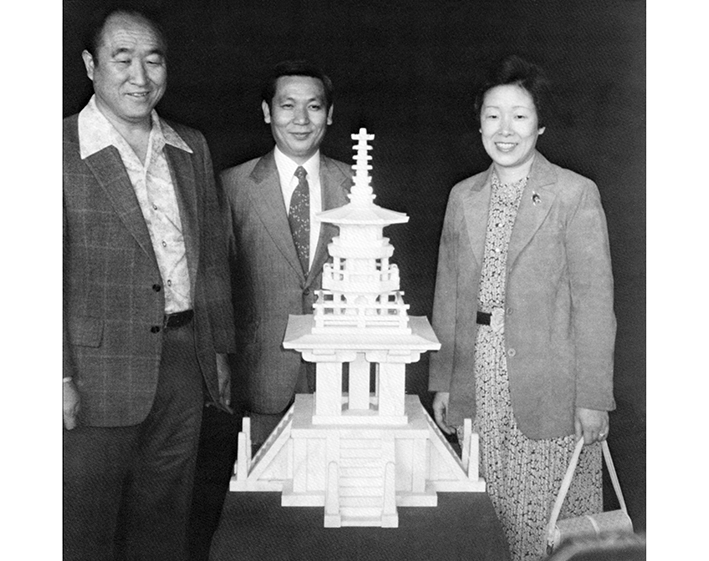
▲ Sun Myung Moon and Hak Ja Han with a pagoda made by a Korean church business, Il Shin Stoneworks. These were sold in Japan for $50,000 or more. (Link to SCAM)
The sale of these items has been the principal source of capital for an international network of Unification Church operations, said the former officials, Yoshikazu Soejima and Hiroaki Inoue.
These operations range from Gloucester, Mass., tuna fleets to the anticommunist political lobbying of CAUSA International in Latin America and the United States.
Their accounts could explain how the Unification Church – with fewer than 5,000 U.S. members by some estimates – has been able to support a major Washington newspaper that has lost an estimated $150 million during its first 2 1/2 years of operations.
The Times, showcase of the church’s business network, is seen by Moon as an important source of political influence here, according to Soejima, the former chief of Unification Church public relations in Japan. Exhorted by pep talks to meet “the respected father’s” needs, Japanese church members have worked in recent years under sales quotas requiring them to transfer to the United States roughly $2.5 million a month earmarked for The Times, Soejima said.
“The Washington Times was the top priority of the entire Unification Church worldwide,” said Soejima, who was editor of Sekai Nippo (World Daily News), a church-controlled Tokyo newspaper, before being fired last October following a dispute with church officials over control of the paper.
Soejima and Inoue said the religious icons were distributed by Happy World Inc., an importing firm based in Tokyo that they said is church-controlled. But a senior Unification Church official denied in an interview last week that the church had any relationship with Happy World.
“Our view is that the Unification Church has nothing to do with sales activities,” said Hiroshi Sakazume, the Japanese church’s director general of public relations. “We don’t know what each church member is doing. But as a church, we don’t do any sales . . . . Happy World is a different company, a totally separate organization.”
Sakazume said, however, that the Japanese church is transferring money overseas. In church theology, he said, it is Japan’s duty to play the mystical role of Eve, giving succor to the church’s children in other countries.
“I cannot say exactly what the amount of money is, but I can tell you that we are doing it legally,” he said.
Soejima, 37, is the highest-level church official to break with Moon and publicly discuss the church’s operations. In five lengthy interviews with The Washington Post in Tokyo, he provided details about church finances that were supported by hand-written notes he said he had made after monthly meetings of top church financial officials in 1981 and 1982.
His statements also were supported by Inoue, who headed church operations on Shikoku Island before being fired by the church and who sat in on four of the interviews with Soejima.
Soejima and Inoue now publish a small Tokyo newspaper that has printed several articles critical of the Unification Church.
Soejima said he joined the Unification Church as an idealistic university student nearly 20 years ago and that he continues to believe in its public objectives of uniting world Christianity and eradicating communism.
But, he charged, Moon had betrayed his followers and distorted the church’s lofty goals by turning his movement into a huge money-making machine.
“By the end of 1975, the main activity of the church was collecting money, buying lots of real estate in Korea and the United States and starting a lot of businesses,” Soejima said. Moon “is not working for the world, but for himself,” he said.
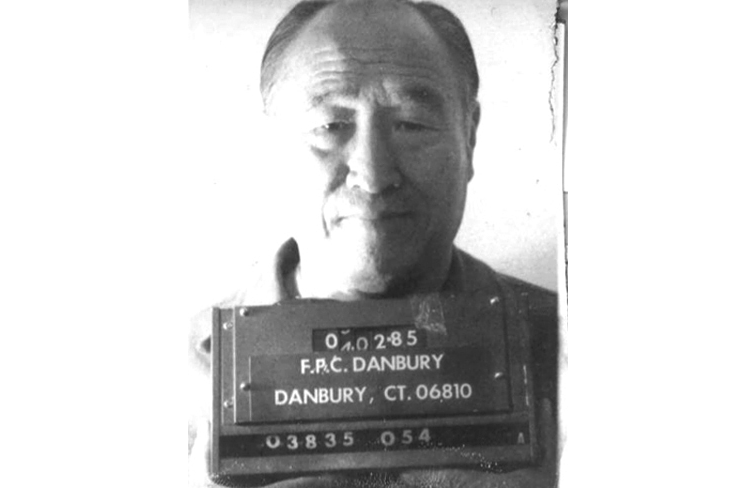
▲ Sun Myung Moon in Danbury prison
Moon, who is serving an 18-month sentence for income tax fraud [and document forgery] in federal prison in Danbury, Conn., declined a written request to be interviewed for this story. The 64-year-old evangelist, who said in July that he was moving the worldwide Unification Church headquarters to his prison cell, works in the facility’s kitchen and has been receiving a stream of visitors from around the world, according to church officials and others who have visited him there.
Founded by Moon in South Korea in 1954, the Unification Church has grown into a multinational conglomerate of business, political and cultural organizations. Causa International, a church-financed political group headed by Moon deputy Bo Hi Pak, has spent millions of dollars in recent years on anticommunist lobbying in Latin America and the United States.
The diversity of church businesses is enormous: the church has invested more than $60 million in Uruguay in recent years, buying the country’s largest luxury hotel, its fourth-largest bank, a publishing company and large tracts of farm land.
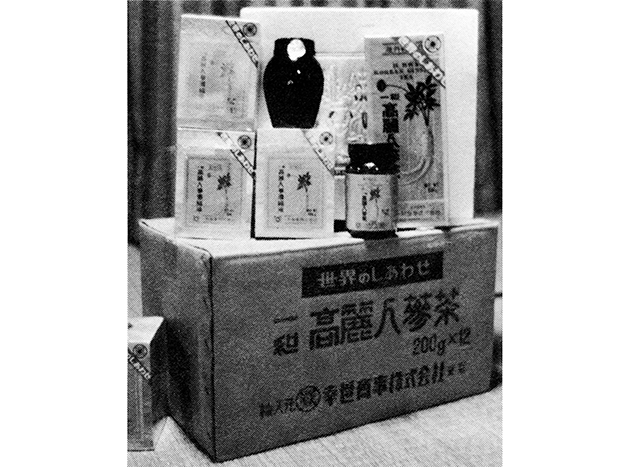
▲ Ginseng tea is manufactured by a church company, Il-Hwa. Ginseng has NOT been proven have any significant health benefits. For Sun Myung Moon it generated $millions, much of that from Japan.
It owns four South Korean manufacturing companies, including a ginseng tea company, a titanium firm and a machine-tool and weapons manufacturer, that had estimated total assets of $198 million last year, according to figures published in the Maeil Economic Daily newspaper in Seoul. It also operates tuna fleets and fish-processing plants in Gloucester, Mass., Norfolk and Alaska and owns newspapers in Montevideo, Cyprus, Tokyo, New York and Washington.
In the Washington area alone, besides The Times, the church owns a downtown construction firm, Monumental Construction and Moulding Co.; an Alexandria television production firm, Tele-Color Studio, and a number of McLean-based companies, including Unification Church International (UCI), which was incorporated in 1977 by Bo Hi Pak, and has been described by federal investigators as the ultimate church holding company in the United States.
UCI owns One Up Enterprises, which in turn owns News World Communications, which in turn owns The Washington Times, according to interviews with former church members and corporate records on file in the District and in Fairfax.
Another McLean-based UCI subsidiary, U.S. Foods Corp., collects $497,310 a year from the D.C. government for office space it rents to the Department of Human Services and other city agencies at 605 G St. NW, according to city records.
The source and scope of the church’s investments in this country have long puzzled outsiders, including congressional and federal investigators. Soejima and some former church members in the United States said they believe most American church businesses, such as the tuna fleets and fish-processing plants, are run by inexperienced managers and lose money or, at best, break even. “They lose their shirt constantly,” said Jeremiah S. Gutman, a New York lawyer who represents the Unification Church in this country.
The church’s ability to finance these ventures has been especially puzzling in light of the relatively small number of church members here.
The church claims 2 million to 3 million followers around the world, including 300,000 in Japan and 30,000 to 40,000 in the United States, of which about 8,000 are described as full-time members. Three former U.S. church members interviewed recently and researchers who study the church have said that these numbers are highly exaggerated and that the church has been losing membership rapidly, especially in the United States, where recruitment is believed to have slowed to a trickle several years ago.
Soejima estimated the number of Japanese members at 8,000 and quotes Moon as saying in 1982 that he was disappointed because there were only 2,000 members in the United States – a number that is slightly lower than the estimates of about 3,000 members supplied by former church members and a figure of 5,000 cited by Gutman.
A House subcommittee, which investigated ties between the church and the Korean Central Intelligence Agency, concluded in a 1978 report that the church’s funds came from domestic businesses, church fund-raising and “funds from outside the United States, the ultimate source of which was undetermined.”
Based on their former access to internal church documents and Soejima’s attendance at numerous top-level meetings of church financial officials, Soejima and Inoue said their conservative estimate is that the church has transferred at least $800 million to the United States in the past nine years. Starting in 1975, they said, the church mobilized its Japanese members for a massive fund-raising effort that has used high-pressure sales techniques to take advantage of the religious superstitions of Japanese consumers.
Handwritten notes that Soejima made at some church finance meetings indicate that the Japanese church was taking in more than $100 million a year during 1981 and 1982, most of which was transferred to church headquarters in New York.
One set of notes, based on a church financial report from June 10 to Sept. 10, 1981, states that the Japanese church raised about $54 million during the three-month period (based on 1981 exchange rates), of which about $38 million was sent “out” – a term that Soejima said meant abroad. That figure was representative of the year’s other three quarters, he said.
Soejima said that sales revenues tailed off the following year but were substantial. His notes say that from January through August 1982, the church earned monthly profits of between $6.8 million and $14.2 million for a total of $81.4 million. He said similar amounts were earned during the last four months of the year. That would mean the church earned about $122 million in 1982, of which 90 percent was shipped abroad, according to Soejima.
He said these transactions were usually made through international bank transfers, but large amounts of cash were carried into the United States by church members because “sometimes Moon wants money right away. Getting permission to send it by bank transfer takes time,” Soejima said.
When Moon conducted a “mass wedding” of 2,075 couples in Madison Square Garden in 1982, 400 Japanese men and women were flown over for the event. “Each person took, I think, about $2,000,” Soejima said.
According to Soejima, a confidential financial statement would be distributed to 10 to 12 top Japanese church officials each month. These statements would show roughly $2.5 million earmarked for The Washington Times.
Each month figures on actual spending would show the previous month’s target had been met. Senior officials would then deliver pep talks on “the respected father’s” needs for a better showing next time, he said.
“Always, it ended with a statement that this is where we stand now, so go out and fight harder,” Soejima said.
According to his account, the ability of the church to generate these funds is based on its control of Happy World Inc., a company that is headquartered in a utilitarian fifth-floor office in a Tokyo business district and whose president, Motoo Furuta, is chief of the Japanese church’s financial bureau, according to Soejima. Church spokesman Sakazume said Furuta is not a church official.
In a recent interview, executive manager Sanji Nakada described Happy World as a diversified company that, among other activities, distributes computer equipment and runs a canning factory on Hokkaido Island and a health-drink factory near Tokyo. Nakada said Happy World is not a church organization but that some employees may be church members.
Happy World’s main activity is importing of consumer goods, such as marble vases, miniature treasure pagodas and ginseng teas from church-owned companies in South Korea, including Il Shin Stoneworks, Tong Il Co. Ltd. and Il Hwa Co. Ltd., according to Nakada and the company’s sales brochures.
The vases, pagodas, ginseng and other consumer items are distributed to about 10 wholesale and retail outlets throughout Japan that, according to Soejima and Inoue, are controlled by the church and use church members as door-to-door salesmen.

▲ Marble vases and other items manufactured in Korea by Il Shin Stoneworks and sold in Japan by the Unification Church for very high prices. A statue of Buddha can be seen top right.
More than 2,600 complaints about the sale of marble vases, ivory seals and miniature pagodas of the kind that are often sold by church members were lodged with the Japan Consumer Information Center between 1976 and 1982, according to a report made by the government-funded agency.
Hundreds of these complaints involved reported cases of intimidation, threats or misrepresentations in which salesmen preyed on the “religious anxieties” of consumers, according to the center’s report. The small objects often were portrayed as having mystical powers that could save unhappy marriages, cure illnesses or purge the evil spirits of samurai ancestors, the report said.
[By 2020, as ordered by courts all over Japan, more than $1billion had been paid out in compensation to victims of Unification Church scams. This chart only covers 1987-2016]
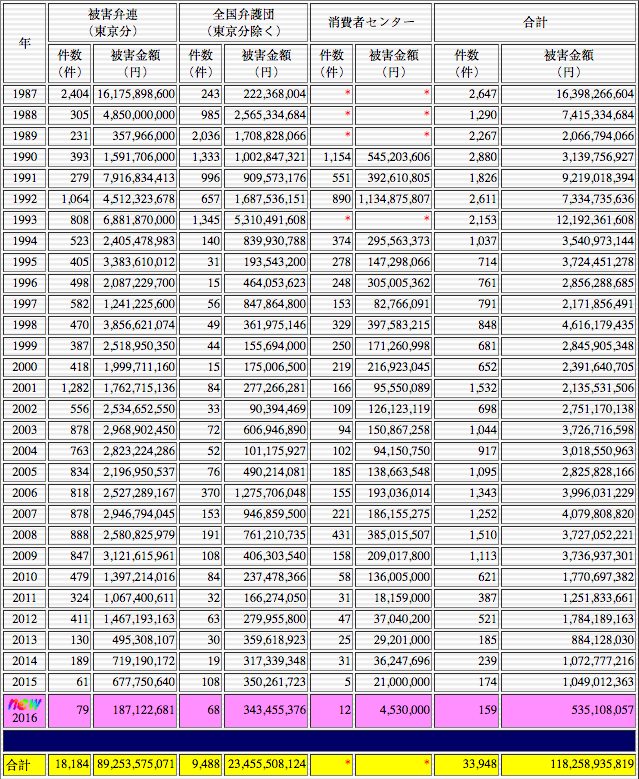
The center has published pamphlets to warn consumers about the sales of these items. In one case cited in a center pamphlet, a woman whose husband had just died in an auto accident was being sold one of the objects. The salesman told her the evil spirit of a samurai ancestor who had killed with his sword was tormenting the family. The sale would solve that. “If you don’t buy it, the same evil spirit will continue with your children and they will meet the same fate,” the salesmen said, according to the pamphlet.
Consumer Center officials cannot directly link such incidents with the church’s operations here. The salesmen, Soejima and Inoue said, are instructed never to identify themselves as being with the Unification Church or Happy World.
“We had orders that, when engaging in economic activity, never say you are a member of the church,” Inoue said.
Nevertheless, Consumer Center officials say they have sometimes been contacted by low-level distribution companies – which Soejima says are church fronts – and told to refer consumer complaints about the items to them. “We can presume that behind the scenes these sales groups have a systematic link,” according to the Consumer Center report.
According to Soejima and others, the profits from sales of these items can be enormous. In an extreme case, he said, a vase that cost about $21 was sold for $8,300. A quantity of ginseng worth about $42 sold for eight times that amount. One salesmen can raise about $4,000 per month, he said.
The salesmen’s expenses are minimal. During his years in the church, Soejima said, he often visited church members at grimy group houses where they slept half a dozen to a room. The members receive no salary from the church and immediately hand over all their sales proceeds to the house “leader.” Once a month, Soejima said, a church official comes to the house and “they collect it in cash and bring it to Tokyo.”
In a two-hour interview in Tokyo, four former church members told of being assigned to sales soon after joining. Church officials conducted sales-training lectures using films and stressed the need for money to finance “the restoration” under way in the United States.
All four members, who asked not to be identified, said they were told of Happy World’s role soon after joining. “I was told it was the economic department of the Unification Church,” said a 24-year-old woman who had sold ivory seals door-to-door.
▲ Ivory name seals
The primary role of The Washington Times within Moon’s global organization was underscored in ways other than the financial support it received from Japan, Soejima said. He cited a series of meetings in February 1983 that began at church headquarters at the New Yorker Hotel, where about 70 church officials from round the world gathered to celebrate Moon’s birthday.
With Moon and his family standing before them in ceremonial Korean dress, selected church officials played different religious and political leaders, such as Christ, Mohammed, Buddha, President Reagan and Japanese Emperor Hirohito. Each one prostrated himself before Moon, bowing his forehead to the floor three times, Soejima said.
“The meaning is that Moon is higher than all of them,” Soejima said. In church theology, “Sun Myung Moon is the father and his wife is the mother of the whole human race.”
The next day, with the church officials assembled at Moon’s estate in Tarrytown, N.Y., Moon expressed disappointment with his inability to win more converts in the United States.
But he spoke with pride of The Washington Times, bragging of important officials who had attended its opening ceremonies. Moon said that James Whelan, then publisher of The Washington Times, “listens to what I say and makes the newspaper as I tell him,” according to Soejima.
Soejima added that Bo Hi Pak, Moon’s top deputy and chairman of News World, may not have been telling Moon the full story of Whelan’s role at the newspaper. But Soejima also said that at the same meeting, Pak remarked that there was a problem at The Times because church members were being assigned to unimportant jobs in the library and files.
According to Soejima, Moon responded: “It’s not a difficult problem. If each one of the church members does missionary work and converts three reporters, then we can have unity.”
At a later meeting in June 1983 on Korea’s Cheju Island, Moon told a church group that four things were necessary for world consolidation: ideology, economy, science and technology, and journalism.
“With journalism, we have now reached success by establishing The Washington Times,” Moon said, according to Soejima. “We now have a direct influence on Reagan through The Washington Times.”
By Soejima’s account, his break with the church followed a dispute over editorial independence. As editor of Sekai Nippo, Soejima said, he was attempting to transform the paper from a church organ into a respected journal with general appeal. At the end of last September, however, he said, he began to hear rumors that Moon had ordered his firing.
On the first of October, about 100 people – including about 30 in special karate training groups – barged into the paper’s office. They were led by members of Shokyo Rengo, an anticommunist political group affiliated with the church, Soejima said. They broke into desks, stole papers and beat up some of the employees, he said. Soejima, Inoue and a policeman that Soejima had previously summoned took shelter in an office when they arrived. “The church members kicked in the door but stopped when they saw a policeman inside,” he said.
Sekai Nippo vice president Naohiro Nada said the church fired Soejima because he was trying to seize full control of the newspaper and make himself president. Soejima filed papers at the company registry to accomplish this, Nada said. Soejima says he did so to protect his position after learning Moon planned to fire him.
On June 2, 1984, Soejima was attacked outside his home in Tokyo and stabbed repeatedly, according to police reports. When the attack occurred, he was preparing an article [This is the hidden part of the ‘Unification Church’ = これが『統一教会』の秘部だ] critical of Moon that was later published in the Japanese magazine Bungei Shunju, he said. SEE link below.
During an interview, Soejima unbuttoned his shirt to show scars on his left bicep, neck and chest, which he says he got in the attack. No one has been arrested in the case.
Shigehiko Togo of the Washington Post Tokyo Bureau and special correspondent Martin Anderson in Montevideo, Uruguay, contributed to this report.
「これが『統一教会』の秘部だ」
世界日報事件で『追放』された側の告発
“This is the secret side of the ‘Unification Church’
– Accusations from those ‘expelled’ in the Sekai Nippo ‘World Daily News’ scandal”
Sun Myung Moon makes me feel ashamed to be Korean
This story reveals Japanese recruitment techniques:
My sister was sold by the FFWPU to a Korean farmer
A huge FFWPU / Unification Church financial scam in Japan is revealed
Shocking video of UC of Japan demanding money – English transcript
Court: “Unification Church of Japan used members for profit, not religious purposes”
Moon’s activities in South America, giving background to this story
The Atsuko Kumon Hong “suicide / murder” of August 2013
Illegal, church-organized high-pressure sales scheme
6,500 women missing from FFWPU mass weddings
How Moon bought protection in Japan
“Apology marriages” made by Japanese UC members to Korean men
“Reputations: Sun Myung Moon, The Emperor of the Universe” documentary transcript