
Ms. U, a Japanese member who was married to a Korean man who beat her
Updated August 7, 2026
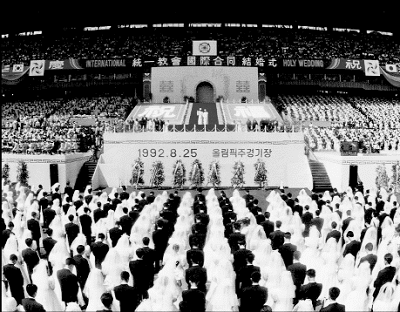
▲ Ms. U was married in this 1992 mass wedding held in Seoul.
Hello. I would like to share my personal testimony.
I was born in a rural area blessed with abundant nature. Because of the characteristics of the region, many families combined farming with other occupations, and most were ordinary households. My family consisted of my parents, my grandmother, and me, making four of us altogether. I grew up without any particular hardship, had many friends, and enjoyed sports.
After graduating from high school, I left my parents’ home and enrolled in a Christian junior college. This was in 1984. I moved into the dormitory and spent my days devoted to my studies and extracurricular club activities.
However, during the retirement match in the autumn of my second year, just as job hunting had begun, a problem occurred. Until then, my experience had taught me that the time and effort I invested were directly proportional to the results I achieved. For me, what happened was like a sudden disaster and became the first major setback of my life.
The other members of my team gradually moved on as though nothing had happened, but I alone could not forgive the person who had caused the problem.
I read books and sought advice from senior students, but I could not find peace of mind. I came to dislike myself for worrying endlessly without knowing what to do. At that time, I remembered a pamphlet that I had received after answering a questionnaire some time before. It was tucked inside my student handbook. I took it out and made a phone call.
It was a Video Center. (1)
[ 1. A facility used for proselytizing while concealing the identity of the Unification Church. Visitors were shown videos presenting its doctrines, the life of its founder, and a distorted interpretation of the history of Japan-Korea relations.]
After I began attending the Video Center, I secured a job, and I was deeply moved by Instructor Kurahara’s lecture on the Fall of Man. I felt that something good was about to happen. After that, I found employment close to my home, and while working, I attended outreach activities whenever I had free time. Before long, I even came to feel that I wanted to dedicate myself completely.
For nine months I went back and forth with my parents, telling them that I wanted to quit my job and devote myself to God’s work. Finally, my father brought out the sickle he used for cutting trees, held it to my neck, and shouted, “Are you still going to go?”
Even then, my determination did not waver.
I believed that although my parents did not understand me now, the day would surely come when they would. I thought that I must not cause grief to God, the True Parents(2), and Heaven, and my resolve only grew stronger.
[ 2. True Parents. The title used by members to refer to Sun Myung Moon and his wife, Hak Ja Han.]
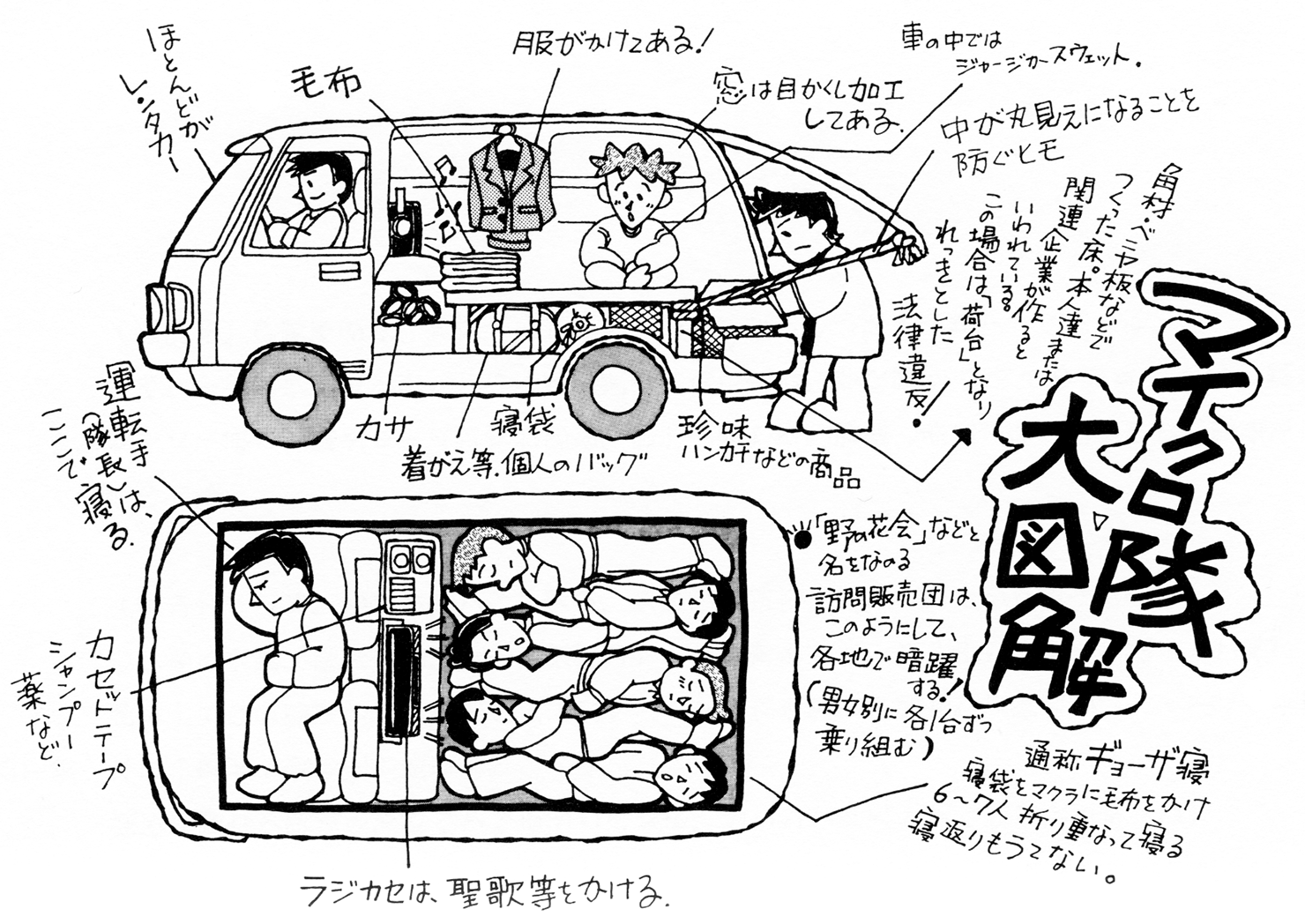
▲ 3. Japanese Microbus MFT (Mobile Fundraising Team) Economic fundraising activity in which members traveled by minibus (often living in them as well), working on the streets, or going door-door visiting businesses or residences to solicit donations.
In 1986, I dedicated myself fully to the church. I spent 21 weeks on a Mobile Fundraising Team (MFT) in a microbus(3), and then worked selling McCol(4) for periods ranging from several months to several years.

▲ 4. McCol drinks. McCol is a Korean company owned by the Unification Church that produces barley-based soft drinks. Ilhwa, which manufactures ginseng products, is also a company owned by the Unification Church.
I had only one day off each month. Every morning I got up early to fulfill indemnity conditions(5), and I spent my days engaged in fundraising activities from morning until night without rest. However, I felt a sense of responsibility, believing, “If I don’t do it, who will?” for the sake of God’s providence to establish the Kingdom of Heaven on earth. I lived each day filled with passionate zeal.
[ 5. Indemnity Conditions These are activities performed to “separate oneself from Satan” or to “purify” oneself. Examples include taking cold showers; fasting (abstaining from food and consuming only water for periods such as one, three, or seven days); praying or reading church literature for a set duration, such as 21 or 40 minutes; doing full bows to the floor before a photograph of the “True Parents” for a large number of times, or fundraising until a certain amount of money is raised, etc. Numbers hold great significance in Sun Myung Moon’s theology, with the number 40 being particularly important.]
From time to time, I saw or heard that fellow brothers and sisters had left the church. The explanations given were that they had quit because of offering-related problems(6), that they had become like Adam and Eve who had fallen, or that they had been deceived by pastors opposed to the church. Therefore, I devoted myself even more earnestly to my faith so that Satan would not gain a foothold.
[ 6. Members are strongly encouraged to make donations to atone for their sins and to save or liberate their ancestors.]
Then, in 1992, during my seventh year as a dedicated member, I participated in the 30,000 Couples Blessing Ceremony held in Seoul, South Korea, together with Ms. Hiroko Yamasaki and Ms. Junko Sakurada. For me, the greatest blessing and hope promised by the teachings of the Unification Church had been fulfilled.(7)
[ 7. Through the ‘Blessing’ original sin is supposedly cleansed and therefore any children born are claimed to be free from that sin. The fee which the Japanese members had to pay to participate in the ‘Blessing’ was $11,600. Koreans paid a small fraction of that. The mass weddings were a huge cash cow for Sun Myung Moon.]
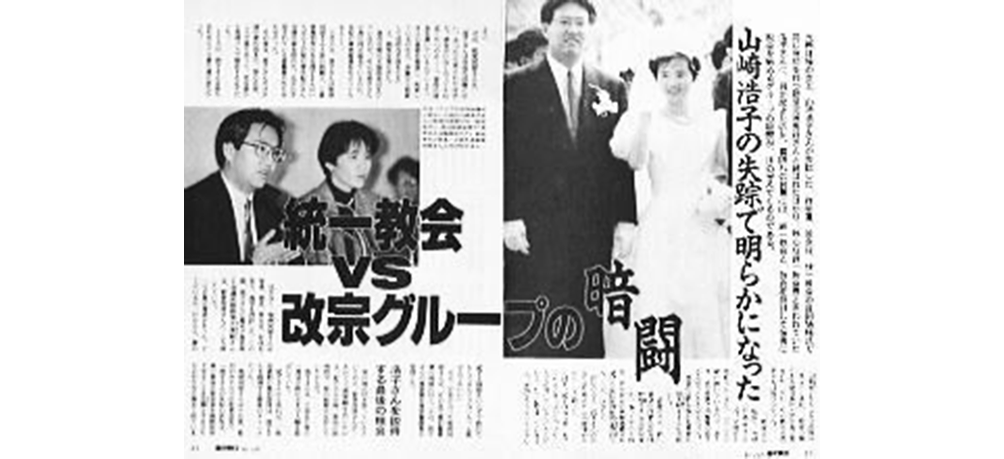
▲ Magazine article about Hiroko Yamasaki at the 1992 mass marriage. She was a very famous Olympic gymnast. After she got out of the UC she wrote a book about her experiences.
My spouse or “subject partner”(8) was a self-employed man who was the same age as I was. I was told that his older sister had been among the 124 Couples(9), that she had sewn suits for the True Parents, and that the True Parents had even visited their home for meals. Hearing this, I felt relieved, thinking that it was a deeply faithful family.
[ 8. After the Blessing ceremony, brides are told to refer to their husbands as their ‘subject partner.’ The wife, in turn, is referred to as the ‘object partner.’
9. The 124 Couples Blessing Ceremony was held in 1963. It was the third mass wedding conducted by the Unification Church, following the ceremonies for 36 couples and 72 couples.]
After the Blessing Ceremony, I returned to Japan. Until then, my work had consisted of fundraising activities to support the providence in Japan. This time, however, I took a part-time job at a sports facility to earn the living expenses I would need in order to move to Korea.
Even that income was not enough, so I asked my parents for financial help.
About four years after dedicating myself to the church, both my grandmother and my father died of illness, leaving my mother alone. She said she wished that my future husband would at least be Japanese, because she feared I would suffer. Every time I came home, I could hear her crying quietly beneath the quilt beside me.
However, my mother’s worries never touched me. Perhaps she had given up on trying to persuade a daughter who would not listen to anything she said. She gave me some money, and together with the last group departing for Korea, I arrived there six months after the Blessing.
In Korea, we stayed at a training center for several weeks until newspaper delivery assignments and other work areas were determined. During that time, my subject partner also came to visit, and arrangements were made for me to pay my respects to his family.
However, on the day I was supposed to meet his parents, I was suddenly taken to a hospital. The reason was concern over the back pain I had suffered after a traffic accident while I had been working for McCOL. Instead of simply examining me, they immediately obtained a medical certificate and told me to return to Japan.
I had worked part-time and received money from my mother just to make it to Korea, so I could not accept this decision. Unable to consult the Korean leaders because of the language barrier, I sought advice from a spiritual leader, since he was one of the 6,500 Japanese-Korean Blessings. I was told that the beginning of the marriage was especially important and that I should simply do as I was told. I was also told that there was a six-month period of sexual abstinence after the Blessing. So, after only three weeks, I returned to my parents’ home.
My mother was astonished to see me return so suddenly. Yet perhaps she sensed from my troubled expression that something was wrong, because she said nothing.
Still, I was gripped by the fear that my Blessing might break. One month later, I went back to see my subject partner.
There, we communicated by looking up words in dictionaries.
My spouse’s conclusion was that the teachings of the Unification Church were false, that he had already left the church, and that he intended to regard the Blessing as though it had never happened. He said that if he could save even one person, it would be worthwhile, and urged me to leave the Unification Church together with him.
He then began explaining why the teachings were wrong. It was an overwhelming shock.
For the first time, it felt as though a small crack had appeared in the faith that I had pursued so earnestly without ever questioning it.
However, after consulting my spiritual parent, I was given a different mission: to pretend to leave the church and then win my subject partner back to the faith.
After returning from Korea, I told my mother that I was going to Chiba, where my subject partner’s older brother lived. She had given me money because I had said I was going to Korea, and now I was telling her that my husband was coming again.
I often wonder what must have been in my mother’s heart. At that time, I cared only about my own faith and my Blessing. I had no understanding of the anguish my mother was experiencing.
Two months after I began living with my subject partner, my mother took her own life.
It was just after the third-year memorial service for my grandmother and father. I had thought that perhaps life would finally become a little easier for her. Instead, she had endured years of caring for both my grandmother and my father while also facing criticism from relatives.
I wanted to convert my mother so that she could find peace of mind, never realizing that this desire itself might have been misguided.
I had told my subject partner that I was only pretending to leave the church, but I often think that if I had at least told my mother the same lie, perhaps this tragedy would never have happened.
The thought that I had caused my mother’s death became tangled together with another feeling: that, in a sense, my mother had abandoned me. Those conflicting emotions became hopelessly intertwined.
Above all, after sacrificing everything and devoting myself to my faith, the result was the exact opposite of what I had expected. My situation had become so miserable that I could no longer even think clearly about what had happened.
After observing the 49-day memorial service(10) and consulting with my relatives, it was decided that if I left the Unification Church, they would recognize my marriage, on the condition that I return home and continue the ancestral memorial rites for my parents. I agreed and returned home.
My subject partner strongly supported returning home. However, because he did not know Japanese and found it difficult to cope with the closed atmosphere and discrimination of rural life, he became mentally unstable.
I tried in every way I could to cheer him up and help him adjust, but he began smashing things.
He broke countless items, including trash cans, radios, chairs, and televisions, throwing them violently. Eventually, he began throwing things at me as well.
At first, these outbursts happened only once every few months. But after our child was born and more of my time was devoted to childcare, the intervals became shorter, the violence more severe, and he began hitting and kicking me.
Even then, because he sometimes apologized afterward, I endured it. However, the abuse gradually became more frequent and repetitive, the atmosphere in our home became increasingly hostile, and eventually I fled the house carrying my child.
At that point, I desperately wanted to consult the Unification Church. I went to a nearby church to seek advice from my spiritual parent.
I was told that if I separated from my subject partner, I should return afterward.
For someone who had sacrificed everything to preserve the Blessing, those words were impossible to believe.
After that, I could no longer bring myself to attend church. From then on, I blamed my own lack of faith. I consulted my spiritual parent and secretly read the Divine Principle.
Whenever I did so, however, our arguments became even more violent, and eventually I became afraid even to read the Divine Principle.
Although my subject partner repeatedly told me that I was the one at fault and that I first needed to change my own habits, I continued to endure everything in order to preserve the Blessing.
Five or six years passed like this, and then our second child was born. He was a boy, and my subject partner was delighted.
Perhaps hoping this would become an opportunity to rebuild our family, he encouraged me to attend a nearby Christian church.
For me, after all those years of endurance, this became a turning point.
When I told the pastor that I had once belonged to the Unification Church, he said he would introduce me to a pastor who was knowledgeable about the movement. He was what members called an “opposition pastor.”
The thought of meeting such a pastor frightened me so much that my legs trembled. Yet my body and mind had been exhausted by the repeated violence, the constant quarrels, and my repeated attempts to flee with the children.
My children had been forced to live in continual fear, and I felt desperate enough to grasp at anything that might help.
My subject partner’s employment was also unstable, and in our rural community even those opportunities were disappearing.
We eventually moved because of his work, and for me the move created an environment in which I could begin to sort out my relationship with the Unification Church.
Even so, he continued changing jobs. Finally, saying that he wanted to fulfill his childhood dream of becoming a pastor, he asked for my support so that he could study. I agreed.
After that, over the course of the next two and a half years, we had the time to discuss everything before my subject partner eventually returned.
It was eleven years after we had received the Blessing.
Understanding the invisible effects of mind control was not something that could be accomplished easily.
Just when I thought I had finally come to understand what had happened, I realized that I had gone from being a victim to becoming someone who had harmed others. That realization caused me unbearable pain.
Even if everyone else were to forgive me, I felt that I could never forgive myself. I often wondered whether it would have been better if I had remained in the church without ever learning the truth. I also found myself asking why I had met this subject partner. I felt as though I were walking endlessly through a long, dark tunnel without ever being able to stop and rest.
I also came to understand that my relationship with my subject partner was one of domestic violence (DV). I read every book on the subject that I could find and studied through an NPO (Non-Profit Organization). Like a sponge absorbing water, I gradually learned to put my own thoughts into words through what I read. Through counseling, I organized my feelings, and by meeting former members(11) and talking with them, I repeatedly reflected on my own experiences.
The final battle was against flashbacks. With the help of a pastor, I was able to overcome them safely.
Around the time my rehabilitation was coming to an end, I received word that my subject partner had given up his dream of becoming a pastor and was returning.
Now that I had sorted out the issues surrounding the Unification Church, there was no reason for me to return to the way things had been. Looking back, I believe that if I had once again been subjected to the same domestic violence, I would certainly have been unable to defend myself physically. I imagine that I would have resisted with some kind of weapon.
In other words, I believe I could have ended up in a situation like Ms. Miyuki Park.(12)
This is not only Ms. Park’s problem. It pains me to think that, under the same circumstances, I too might have committed the same act. I believe this is one of the problems inherent in the Blessing.
Even now, I believe there are many sisters living under similar circumstances, struggling and suffering. I cannot help thinking that there must be something that can be done for Ms. Park.
At the time, I was able to confess to my domestic violence counselor that if another serious incident had occurred, I probably would have reached for a knife.
Eventually, the day came when my subject partner returned home.
When he did, encouraged by those around me who told me that our relationship could never improve and that our children did not need a father like him, I made the decision to divorce him and left the house.
I sought out a lawyer who was well acquainted with issues involving the Unification Church. My subject partner never once appeared in court, and the divorce was granted by default.
It was twenty-six years after I had dedicated myself to the church.
I still grieve over the years that can never be recovered. After emerging from the long tunnel of mind control, I was so exhausted that I could barely stand on my own feet.
Today, however, I have recovered little by little and have learned to value myself.
The person I am today exists because of the help of pastors, lawyers, supporters working on issues related to the Unification Church, former members, and many people whom I have not yet met personally but came to know through blogs.
My hope is that many more people will be rescued from the Unification Church.
NOTES
There is a term used to describe a married couple consisting of a Korean man and a Japanese female Unification Church member. In some cases, the Korean man was not a Unification Church member, or merely pretended to be one in order to obtain a wife. The Unification Church distributed leaflets in rural areas advertising that it would find wives for applicants.
This was able to succeed because many Korean women wanted to avoid a life of poverty, grueling labor, and the prospect of caring for elderly relatives. Members of the Japanese church, however, willingly endured such hardships due to the church’s brainwashing.
Records also indicate that families paid between US$2,000 and US$10,000 to obtain a wife for their son. The emergence of this ‘wife market’ was driven by a gender imbalance in South Korea, where there were at one point up to one million more men than women of marriageable age. United Nations agencies have published reports describing the cultural difficulties experienced by foreign wives married to Korean men. Today, the South Korean government screens men seeking to marry foreign wives. As part of this process, the government assesses factors such as financial stability and mental health in an effort to reduce cases of abuse by husbands in international marriages.
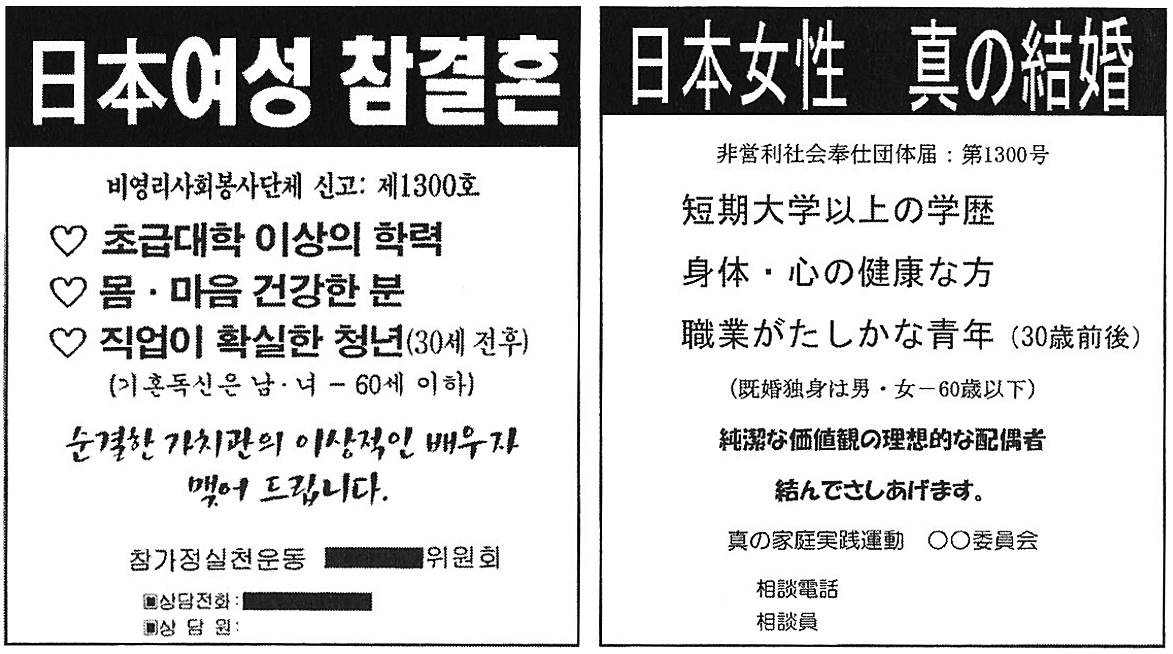
▲ A poster promoting Japanese women available for marriage. It was affixed in a South Korean farming village. Marriages were then officiated by Sun Myung Moon in a mass marriage held in Seoul.
Translation of the poster (Korean on the left and Japanese on the right):
True Marriage to a Japanese Woman
Nonprofit community service organization: Registration No. 1300
♥ Junior college or higher educational background
♥ Healthy body and mind
♥ For a young man who has stable employment (around 30 years old)
(Previously married men and women, now single, must be aged 60 or less)
Ideal spouse with a chaste sense of values.
We will match you up.
True Family Practice in conjunction with ◯◯ Committee
Consultation phone
Counselor / Consultation Staff
Notes 1-9 are embedded in the text.
10. The family of the deceased are in a period of mourning for 49 days after the funeral. Once a week they visit the grave to place fresh flowers and to burn incense. On the 3rd, 7th and 49th days they have a short memorial service at the grave, led by a Shinto priest.
11. The term, former members, used to refer to people who leave the Unification Church.
12. Miyuki Park was a Japanese Unification Church member who was matched in marriage with a Korean man through the church. Her husband was an unemployed alcoholic who perpetrated domestic violence. She sought help from her local church but received no meaningful assistance. Her husband did not work, and she was forced to take low-paying jobs while paying all of his medical expenses. According to neighbors, she was treated worse than a dog. Eventually, she suffocated her husband while he was asleep and was subsequently imprisoned in South Korea.
Japanese magazine feature covering her story:
Why did a Japanese Moon church member kill her Korean husband?
Suicide of Japanese ‘Moon money mule’ in Uruguay. Mother of three children
Japanese woman recruited by the Moon Church and sold to Korean farmer
6,500 Japanese women missing from Moon mass weddings
“Real Voices” of the Japanese Wives in Korea
Unification Church Mass Wedding August 25, 1995
Japanese member, Ms. K, was forced to marry a Korean man she did not like
Moon Church human trafficking is despicable
Hiroko Yamasaki (Olympic athlete) joined and left the Moon church
A huge Moon Church scam in Japan is revealed
“Apology marriages” made by Japanese UC members to Korean men