
The “Real Voices” of Japanese Unification Church Wives in Korea
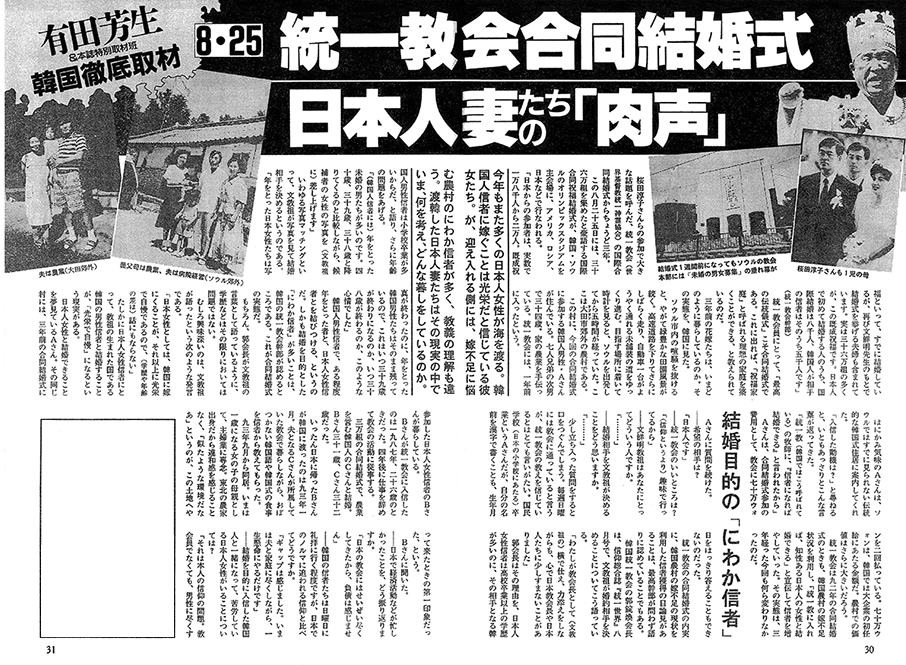
Unification Church Mass Wedding August 25, 1995
Shūkan Bunshun — August 31, 1995
by Mr. Arita, Yoshifu & Shūkan Bunshun Special Reporting Team
A thorough on-site investigation in South Korea
This year again, many Japanese women will cross the sea to Korea. They believe it is an honor to marry Korean believers. However, on the receiving side, there are many newly converted believers in rural areas troubled by a shortage of brides, and their understanding of the church teachings is very different. Amid that reality, what are the Japanese wives who have gone to Korea thinking now, and what kind of lives are they living?
It has been exactly three years since the Unification Church (Holy Spirit Association for the Unification of World Christianity) international mass wedding, which drew major attention with the participation of Junko Sakurada and others.
On August 25 of this year, the International Holy Blessing Marriage Ceremony, which boasts of gathering 360,000 couples, will be held with the Olympic Stadium in Seoul, Korea as the main venue, and also in the United States, Russia, Japan, and elsewhere. “Participants from Japan number between 18,000 and 20,000 in actual figures. This includes so-called ‘already blessed’ couples, who are already married but hold a wedding ceremony again under Rev. Sun Myung Moon. In fact, many of the 360,000 couples are these already blessed. Of the Japanese marrying for the first time, 8,000 are international marriages, and among them 5,000 are believers marrying Korean partners.”
(Unification Church executive)
For members of the Unification Church, the mass wedding ceremony is the “supreme ritual in their tradition.” They are taught that by participating, they can build an ideal family called a “Blessed Family [and raise children who are without original sin].”
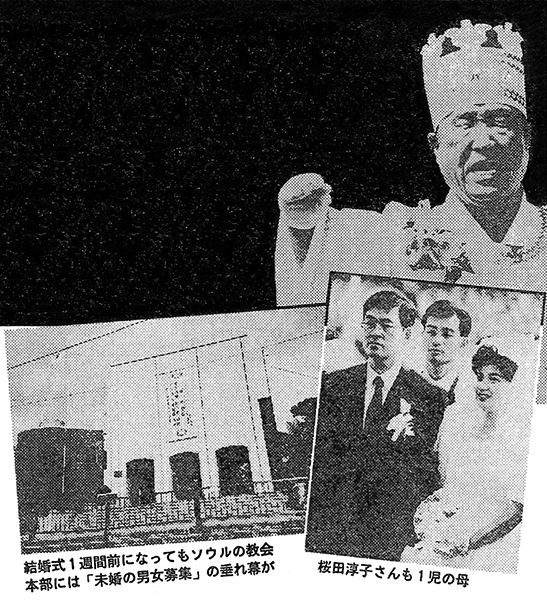
▲ page 30 photos
1: on right: Junko Sakurada is also the mother of one child
2: on left: Even one week before the wedding ceremony, a banner at the Seoul church headquarters reads “Unmarried men and women wanted”.
How are the brides of three years ago living now? We examined the reality in Korea.
Leaving behind the bustle of central Seoul, the scenery gradually turns into lush rural fields. After exiting the expressway and driving for some time, our car slowly proceeds along an unpaved road barely wide enough for a single vehicle. When we reach our destination and check the time, five hours have passed since departing Seoul. This is a farming village on the outskirts of Daejeon. In this village lives Mr. A, a Korean man participating in this mass wedding. He is 34 years old, the second of seven siblings, and helps with the family farm. He says he joined the Unification Church a year ago.
A shy Mr. A guided us into a traditional Korean-style house, which is no longer seen in Seoul.
When asked, “What motivated you to join?” he replied quite simply:
“Because a pastor of the Unification Church (as it is called in Korea) told me, ‘If you become a member, you can get married.’”
Mr. A has paid the church 700,000 won twice as participation fees for the mass wedding. Seven hundred thousand won corresponds to a starting salary at a major corporation in Korea. Its value in a rural area would be even greater.
At the time of the 1992 mass wedding as well, the Unification Church took advantage of the bride shortage in Korean rural areas, increasing membership by advertising, “If you join the Unification Church, you can marry an intelligent Japanese woman.” The reality had not changed at all even three years after this time.
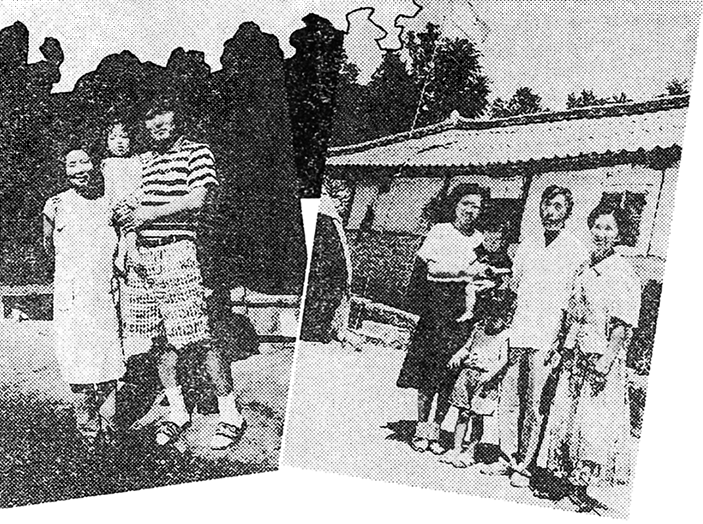
▲ page 31 photos
On right: The parents-in-law are farmers, the husband runs a hospital (suburbs of Seoul)
On left: The husband is a farmer (suburbs of Daejeon)
People Joined Recently for the Purpose of Marriage
Questions were put to Mr. A.
— What kind of partner do you hope for?
“Japanese.”
— What is good about the Unification Church?
“(Rather than faith) I go as a hobby.”
— What kind of person is founder Sun Myung Moon to you?
“…”
— What do you think about Rev. Moon deciding your marriage partner?
“…”
When asked slightly more probing questions, he fell silent. He says he attends church every Sunday, but it is difficult to say that he truly believes in the teachings of the Unification Church. Mr. A, who graduated from national school (equivalent to Japanese elementary school), cannot even write his own name in Chinese characters or clearly state his date of birth.
That there is an intention to recruit believers by taking advantage of the shortage of brides in Korean rural areas within the reality of the Unification Church’s mass wedding ceremonies is something even top executives acknowledge without being pressed.
Kwak Cheong-hwan, president of the Korean Unification Church, spoke in the August issue of the general religious magazine Unification World about Rev. Moon deciding engagement partners as follows:
“As church president, while serving at Rev. Moon’s side and assisting him, I felt somewhat sorry in my heart toward the Japanese church leaders and the Japanese people.”
Chairman Kwak explained the reason as follows: many Japanese female believers have at least a high school education, whereas many of their Korean male counterparts have only graduated from elementary school. He also mentioned the issue of age.
“(Among Korean believers) there are many older unmarried men. We compare ages, coming down from forty, thirty-nine, thirty-eight, and present photos of the female candidates (to Rev. Moon).”
This so-called photo matching means that Rev. Moon looks at photographs and decides marriage partners.
“While the older Japanese women had finished their matching, the Korean men who had grown older were still remaining. We wondered when thirty-nine would be finished, when thirty-eight would be finished; that was our feeling.”
In other words, somewhat older Korean male believers are matched with Japanese female believers. Moreover, Korean Unification Church executives admit that many are newly converted believers whose purpose is marriage. This is the reality of the mass wedding ceremony.
Of course, as Chairman Kwak relates Rev. Moon’s words, educational background in itself is not the issue.
More interesting is the following remark attributed to Rev. Moon:
“For Japanese women, coming to Korea as brides is an honor and a source of pride beyond anything else, so (differences in education or age) are not even worth discussing.”
Indeed, for Japanese female believers, there exists the reality that marrying a Korean male believer in the homeland of their founder becomes “an honor and a source of pride.”
Mr. A dreams of marrying a Japanese woman. In the same village lives Ms. B, a Japanese female believer who participated in the mass wedding three years ago.
Ms. B joined the Unification Church in 1987 at the age of 26. Four years later, she quit her job and devoted herself to church activities.
At the mass wedding of 30,000 couples, she married Mr. C, a Korean farmer. Ms. B was 31, and Mr. C was 32.
Ms. B returned once to Japan, then went to Korea in January 1993. While living at the church to which her future husband Mr. C belonged, she learned halting Korean and Korean-style cooking from fellow members.
They began living together in September 1993. Now the mother of a one-year-old girl, she devotes herself to housework. Since she comes from a farming family in the Tohoku region, she says she felt no sense of discomfort, and her first impression upon arriving in this area was, “It’s a similar kind of environment.”
We asked Ms. B:
— Looking back, how do you feel about how busy you were with economic activities in Japan?
“I devoted myself fully to the Japanese church, so I don’t feel any debt.”
— Korean believers only attend Sunday services, but how does that compare with the faith in Japan where you were pressed by quotas?
“I felt a gap. Now I just do my best while devoting myself to my husband and family.”
— What about Japanese women who are struggling after marrying Korean men who joined for the purpose of marriage?
“That’s a matter of the individual’s faith. Even if they weren’t church members, the feeling of devotion to one’s husband should be the same.”
— Then what supports you emotionally?
“My husband’s and my family’s love. As principles and rules, there are the teachings of the church.”
We also asked her gentle-looking husband Mr. C, who was holding the baby beside her. When applying to participate in the mass wedding, Korean believers were required to write their “desired country” for a marriage partner on the application form. Mr. C chose Japan.
— Why was that?
“The Japanese once did bad things in Korea. But Japanese members are carrying out activities to apologize for that. That’s why I hoped for one.”
In the Unification Church, the history of Japan’s prewar invasion of Korea is thoroughly taught. Active and former members alike uniformly emphasize that members bear Japan’s “debt” toward Korean members. That is precisely why taking the initiative to marry and serve a Korean becomes “an honor and a source of pride.”
We also asked Ms. B about the current situation of the Unification Church in Japan. When asked who the current president is, she paused and said she had “completely forgotten,” then answered, “Maybe Mr. Kuboki.”
The name she mentioned was Honorary President Osami Kuboki, who had resigned from the presidency in September 1991, four years earlier. Furthermore, Mr. Takeshi Kamiyama, who became president after Kuboki, resigned in January 1993 amid criticism of the spiritual sales that arose from the mass wedding controversy. The next president, Mr. Hishio Fujii, also resigned in May 1994. His successor, Mr. Hideo Oyamada, left the position in less than a year, and in June of this year Mr. Setsuo Sakurai, who had once led the spiritual sales campaign, assumed the presidency.
With the presidency changing once a year, it is hardly surprising that Ms. B cannot name the current president.
However, the fact that she cannot even recall the name of the president at the time of the mass wedding she herself participated in suggests just how hectic her present life is.
Not knowing the current president in Japan was something common to all four female members who were asked the same question.
In particular, the women who participated in the mass wedding three years ago have not been living in Korea for very long, and perhaps for that reason, when asked about their impressions of daily life, they gave only general answers.
“Family is important, and building an ideal family is itself faith.” (Ms. D)
“I only have the impression of being busy. Even if there are differences in understanding doctrine, that’s simply what Korea is like. My husband’s heart is sincere, so there are no problems.” (Ms. E)
Friction with Parents Who Dislike Japanese
There is probably no falsehood in such words. Yet it cannot help but seem that they are trying to “resolve” the busyness and contradictions of daily life through abstract ideals.
It was Mr. F, a Korean male member, who testified about this from his own standpoint.
He is the eldest of three brothers, joined the church around 1979, is now 33 years old, and works at a telecommunications company.
When participating in the mass wedding three years ago, Mr. F says the church told him that “only international marriages are permitted.” Therefore, in the section asking for his “desired country,” he wrote Japan as his first choice, China as his second, and Korea as his third. He wrote Korea knowing it would likely be impossible, but because he would have preferred to marry a Korean woman if possible.
About one month before the wedding ceremony, he received a phone call from the church. “You can meet your marriage partner today, so come immediately.” He was to be given a photograph of his partner. About 200 believers gathered at the church.
The district leader called each person’s name. When his turn came, he received the photograph and looked at it quietly. She was a Japanese woman, but her face was different from what he had imagined, and he was shocked. He reminded himself that she was someone chosen by the founder, yet he says he “felt a very frightening impression.”
Some men said they “didn’t like” their assigned Japanese partners and refused them.
However, when Mr. F actually met her, the bad impression from the photograph quickly disappeared. She was a devoted member who had dedicated herself to church activities for five years before the wedding. But the problem arose soon after they began married life.
The couple began living together with his parents in an apartment in the suburbs of Seoul in April of last year, one year and eight months after participating in the mass wedding.
The first issue that arose was the presence of parents who disliked Japanese people. Let us hear Mr. F’s explanation.
“Before 1945, my parents suffered greatly at the hands of the Japanese. Those memories overlap once they begin living with a Japanese person. Moreover, we cannot communicate well with each other. Small matters turn into arguments, and further misunderstandings arise. Conflicts were frequent, and my wife often ran outside and cried.”
In addition, the difference in faith between Korean members and Japanese members became an issue.
“I am simply astonished by her attitude of trying wholeheartedly to become one with the teachings, and I cannot even interject. Faith in Korea looks here and there, but I cannot keep up with the single-minded dedication of Japanese members.”
However, such friction with the parental generation is not necessarily universal. Once communication improves, many problems may be resolved.
Let us look at the case of Ms. G, a Japanese woman living in a rural area near Seoul. She participated in the mass wedding of 6,500 couples held in October 1988. She is now 31 years old.
Her husband, who became a member nine years ago, is a 36-year-old physician who runs a hospital in Seoul. They started their family in 1991 and now have two sons, aged four and one.
At first, Ms. G declined the interview, saying, “You will write something untrue anyway,” but after negotiations she invited us into her room.
On the bookshelf were Unification Church books placed alongside childcare books and Korean language textbooks.
From the atmosphere of the interview, attended by her parents-in-law, no sense of discomfort could be felt. We asked Ms. G several questions.
— After living here for four years, how do you look back on your activities in Japan?
“In the Japanese church, you just had to run for God. That is Japan’s position. Now I think I should live a natural life of faith within the community.”
— What about the spiritual sales that have long been a problem in Japan?
“I think there were excesses. We needed to understand people’s feelings more.”
— What are the differences between Japan and Korea?
“In Japan, everything moves as an organization, but in Korea one must deepen one’s faith individually.”
Participation fee for the marriage ceremony: 1.4 million yen
As Mr. G’s remarks honestly indicate, members who ended up living in Korea, though facing language barriers and family-related issues, uniformly said in effect that “it is easier than in Japan.”
That is understandable. Since the remittance order of 1975, the Unification Church in Japan has mobilized the entire organization to conduct economic activities for founder Sun Myung Moon. The most efficient of those activities was spiritual sales. Believers are constantly pressured by quotas for missionary work and economic activities. That structure has not changed to this day.
Moreover, they are indoctrinated that the mass wedding ceremony has the highest value, and that participation in it is the only path to “salvation” [liberation from original sin]. The participation fee this time is 1.4 million yen. If they cannot pay, they are required to make arrangements after the ceremony ends and they return to Japan.
Members who are forced into unreasonable economic activities end up causing social problems. This is the major issue with the Unification Church’s mass wedding ceremonies. It is not a question of values such as the form or meaning of marriage.
Among former Japanese believers who left the Unification Church, many have taken legal steps to divorce the partners they were matched with in the mass wedding ceremonies. However, twenty-six people have filed lawsuits claiming that the mass wedding ceremony itself was invalid from the outset.
Of those, sixteen have already received court judgments or rulings declaring the marriages invalid on the grounds that no substantive marital relationship existed.
The more that vaguely believing “newly converted believers” increase in number, the more social problems surrounding the mass wedding ceremonies will continue to grow.
In the previous mass wedding ceremony, a considerable number of female believers were married off from Japan to Korea.
For Mr. A, a 34-year-old Korean man from a rural area, mentioned at the beginning, who is participating in this year’s ceremony, a young woman from somewhere in Japan will soon arrive as his bride. She will be filled with faith and hope…
Japanese woman recruited by the Unification Church and sold to an older Korean farmer
Atsuko Kumon Hong “suicide / murder” 2013
6,500 Japanese women missing from Sun Myung Moon mass weddings
Japanese member, Ms. U, married to a Korean man who beat her
Why did a Japanese Moon church member kill her Korean husband?
Suicide of Japanese ‘Moon money mule’ in Uruguay. Mother of three children
Hiroko Yamasaki (Olympic athlete) joined and left the Moon church
“Apology marriages” made by Japanese UC members to Korean men