
Hiroko Yamasaki, a former Olympic athlete in rhythmic gymnastics, joined and left the Unification Church
Most of this webpage translated from Japanese, updated December 23, 2025
When love ends in deception

What can a person believe in to guide their lives?
How I became trapped in the Unification Church, and how I escaped from there….
― An honest testimony of love and conflict, written from the heart by one woman who strived to live up to her ideals!
I set foot in the religious group in January 1989. On that day I held in my hand an expensive seal. A set of three would cost me 1.2 million yen. I thought that was a very high price. However, I thought doing this would improve my fortune – which I had been told was going downhill. If the path I was going down continued, I felt the rhythmic gymnastics school that I had finally started would end up in disaster. (I didn’t care if I was being deceived.) In exchange for that enormous sum of 1.2 million yen, I was made to bear an incredibly heavy destiny.
(extract from the book)
published March 1, 1994 by Bungei Shunjū ISBN: 978-4163489001

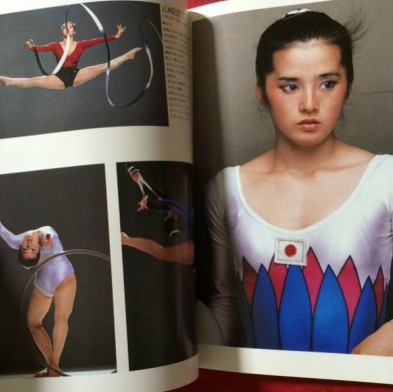
Hiroko Yamasaki, born in 1960, started rhythmic gymnastics upon entering Kagoshima Junshin Girls’ High School, a prestigious school known for its rhythmic gymnastics program. After enrolling in Tokyo Women’s College of Physical Education (later transferring to the university), she achieved five consecutive victories in the individual all-around competition at the All Japan Championships, becoming a key figure in the rhythmic gymnastics boom. She placed 8th at the 1984 Los Angeles Olympics. After retiring from competition, she became a rhythmic gymnastics instructor. She is also active as a sports writer, contributing to magazines such as “Number,” and gives lectures and appears on television. Her published works include “Hiroko Yamasaki’s Fun Rhythmic Gymnastics” (Komine Shoten) and “Lessons Called Failure” (Kodansha).
Hiroko Yamasaki vs. Mariko Hayashi: Exclusive Interview
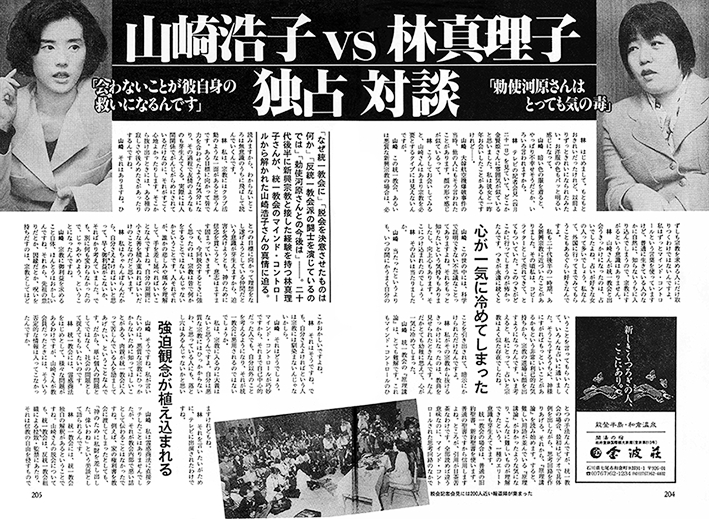
Shūkan Bunshun – May 20, 1993

▲ Nearly 200 reporters gathered on April 21st 1993 for a press conference when Hiroko Yamasaki announced her departure from the Unification Church. It was a major event that brought much scrutiny into the recruitment and retention tactics of the organization, as well as their “spiritual sales”.
— Mariko Hayashi, who had an experience with a new religious movement in her late twenties, delves into the true feelings of Hiroko Yamasaki, who was freed from the Unification Church’s mind control.
Hayashi: Nice to meet you. You were always beautiful, but you seem even more beautiful than before. The color of your clothes is also much brighter.
Yamasaki: When I wear dark-colored clothes, people tend to say things I look unhappy, and other similar comments. …
 Hayashi: Now that I’ve met you, Ms. Yamasaki, you don’t seem like the type of person who needs religion.
Yamasaki: In the case of the Unification Church, or other malicious new religious movements, they don’t necessarily only target people who are seeking religion. I’ve been using the term “mind control,” but they subtly, and without it being realized, infiltrate the lives of ordinary people, so there’s no conscious feeling of clinging to religion.
Hayashi: You first encountered the Unification Church through fortune-telling, didn’t you? Many women like fortune-telling, right? I like it so much that I even go abroad to have my fortune told.
I also approached a certain new religious movement for a period in my late twenties. At that time, I was becoming successful as a copywriter, and I was very lucky. I was afraid that this luck would disappear. I wanted someone to tell me that my luck would last forever, so I went to various fortune-tellers. Eventually, from a very selfish feeling that something even better might happen if I relied on God, I started showing up at a religious training center. Looking back now, for me, fortune-telling and religion were very similar.
Yamasaki: In this world, there are mysterious things that science can’t explain, aren’t there? I also had a desire to learn more about them, and I had a strong drive for self-improvement. I guess that’s what they took advantage of.
Hayashi: Did that fortune-telling come true?
Yamasaki: It wasn’t so much that they guessed correctly, but rather that they subtly drew out information from me and manipulated me through suggestion without me even realizing it.
My feelings suddenly went very cold.
Hayashi: What prompted me to leave that religion was when I was shown their scriptures. They seemed so childish, and my feelings cooled down instantly.
Yamasaki: The Unification Church’s “Divine Principle” is very difficult to understand. This is also a method of mind control, but in the case of the Unification Church, they first use videos to provide concrete examples and build a thought process. Then, they start reading the “Divine Principle.” As a result, you feel like you understand the “Divine Principle,” which is full of difficult terminology, and a kind of elitist consciousness grows in you, and you think you’ve understood something that is very difficult difficult.
In the case of the Unification Church, they use the regular Old and New Testaments. Since it’s a regular Bible, you trust it, right? However, the quotations are completely messed up. If you read the whole quotation in context, it has a different meaning, but because you’re reading it within a mind-controlled thought process, you unconsciously skip over the parts you don’t understand.
Hayashi: I think religion has an aspect similar to a club activity. You feel like you’re working together with everyone towards a certain goal, and a kind of friendship develops in the process. In reality, you’re just entangled in human relationships, but it feels very comfortable. When you leave, there’s a certain loneliness and guilt.
Yamasaki: That’s true. When you have a shared goal and are working together to achieve an ideal, a sense of camaraderie develops. Even if you face persecution, your resolve to uphold your beliefs for God only grows stronger.
But what I strongly felt when I left this time was that religion isn’t about doing something together as a group. It’s about each individual understanding someone else’s sadness and pain and reaching out to help them. I think it’s simply about accumulating small acts of kindness in your own surroundings.
…
Yamasaki: Bringing up things like ancestral curses, karma, or hexes is somehow wrong for a religion, isn’t it?
Hayashi: That’s true. But I wonder if people who only care about themselves are suited to religion.
Yamasaki: I’m not so sure about that. Mind control is so clever that even people who were previously self-centered start thinking about others, and that’s how the Unification Church exploits them.
I don’t think there’s any noble reason to join a religion. I think there are pitfalls even for people who think they won’t fall for a malicious religion.
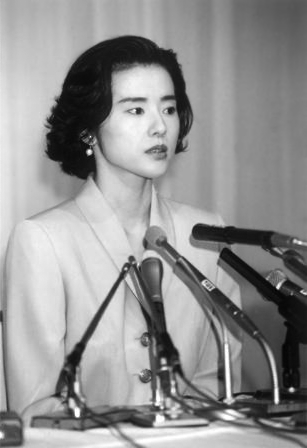
▲ 1993 press conference
Hayashi: So, you appeared on television specifically to say that, right?
Yamasaki: That’s right. What I want to say is that there are things I want people to know so they don’t fall prey to malicious religious groups, and I want to encourage those who are suffering because family members have joined the Unification Church. That’s why I want people to understand this not just a personal problem, but it’s a social problem.
Hayashi: The Unification Church has various problems, including the spiritual sales tactics, but when you were a member, didn’t you receive any of that negative information?
Yamasaki: I didn’t directly participate in the spiritual sales tactics, but it wasn’t something that was talked about negatively within the church. For example, even if someone handed over their house deed to the church, it would be told as a beautiful story, like, “They sacrificed their personal property for God, how wonderful.”
Obsessive thoughts are implanted
Hayashi: So the Unification Church has its own unique interpretations. Regarding your departure from the church, the Unification Church issued a statement saying that it was an abduction and confinement by an anti-Unification Church organization, and that it violated freedom of religion.
Yamasaki: The Unification Church talks a lot about freedom of religion, but if they’re going to so loudly proclaim freedom of religion, then there should also be freedom for people to leave.
The problem with the Unification Church is that they don’t reveal the name “Unification Church” at first, so there’s no freedom to refuse. Once you’ve listened to them to a certain extent, there are no other options, and you can’t turn back.
And yet, leaving is not so easy. People are instilled with various obsessive thoughts, such as the belief that if they leave the group and get married, they will have a child with a disability.
If a tragic fate were to befall only themselves as a result of leaving the group, they might be able to summon the courage to leave. However, they are taught that by leaving the group, they will incur the wrath of their ancestors, bring misfortune upon their descendants, and that their individual act of abandoning their faith will cause significant changes to society and even the world.
The Unification Church claims that abduction and confinement is a violation of human rights, but what about the people who have given up their previous jobs and are now selling exotic foods because they were made to believe in the Unification Principle? There is no freedom of occupation there, and since marriage is based on the Unification Principle, there is no freedom of marriage either.
Therefore, I would like to return the Unification Church’s claims of freedom of religion and human rights violations right back to them.
Hayashi: You spoke very logically and confidently just now, but have you always had this way of thinking and speaking, Ms. Yamasaki? I had the impression that you were very quiet and demure. Even at the press conference when you joined the Unification Church, you were very reserved, weren’t you?
Yamasaki: I felt I could talk about the parts I understood, but I thought that even if I talked about the Unification Principle at the press conference, people wouldn’t understand.
Hayashi: So, it was like, “What do you people know?”
Yamasaki: That’s not what I meant. I really wanted to talk about it, but I didn’t have the time to explain it through the media, and I didn’t have the means to articulate it.
Returning to my original self
Hayashi: Now, some people view you as playing the role of an anti-Unification Church activist, but do you have the confidence to say that’s not the case?
Yamasaki: Yes. I don’t know how the Unification Church interprets mind control, but what I mean by mind control here is a state where a personality desired by the Unification Church is superimposed on my own personality. Now, I’ve simply peeled off that superimposed part, and I’ve returned to my original self. I haven’t changed because of something created by the Unification Church. I don’t want people to misunderstand that point.
Hayashi: I was a little mistaken, but I thought you would be accompanied by several bodyguards today. However, you actually came with just one woman. On a TV talk show, commentator Maruo Shiota said, “If Junko Sakurada is the Madonna of the Unification Church, then Hiroko Yamasaki is now the Madonna of the opposition,” to which journalist Yoshio Arita retorted, “There is no opposition group.” I think some viewers also think that there’s a large organization behind you, Ms. Yamasaki.
Yamasaki: I’m afraid that people who are completely unaware of the situation will make careless remarks, leading to misunderstandings. I want commentators to obtain various information, then make judgments, and then express their opinions. I’m not saying you should express opinions against the Unification Church.
The Unification Church is just one group. However, there are people who recognize the negative impact the Unification Church has on society, and they are extending a helping hand to those who are suffering. So, it’s not a simple Unification Church versus anti-Unification Church scenario.
Hayashi: From my perspective, Sun Myung Moon looks like a perfectly ordinary old man, and I don’t sense any charismatic qualities of a cult leader. How did he appear to you, Ms. Yamasaki?
Yamasaki: I think he’s someone who carries a certain kind of charisma. He definitely has an attractive charm that captivates people.
Hayashi: He’s been divorced twice, hasn’t he?
Yamasaki: I don’t know for sure, but legally, it’s only once, I believe.
Hayashi: He lives in a huge mansion, doesn’t he? He’s also been accused of tax evasion [and document forgery]. So why are so many people drawn to him?
Yamasaki: Mind control includes information control. There are justifications prepared for everything—the divorces, the imprisonments, living in mansions. Even Christianity was persecuted and suppressed at first, wasn’t it? Church members believe that Sun Myung Moon is the Messiah, so no matter what his past or present is, they don’t have any doubts.
Hayashi: I heard that there were special instructions given to find you.
Yamasaki: That was a rumor, but I’ve also heard that there was a “special reward for finding Hiroko Yamasaki.” I don’t know if it’s true or not.
Hayashi: Junko Sakurada gave a speech in Hibiya Park saying, “Let’s all definitely rescue Hiroko Yamasaki,” didn’t she?
Yamasaki: That’s a natural action for a church member, and if I were in the opposite position, I would have done the same thing.
My married life with Mr. Teshigawara
Hayashi: Earlier, Ms. Yamasaki, you said, “I want this to be understood not as a personal problem, but as a social problem.” What are your thoughts on Mr. Teshigawara? I think there are quite a few wives watching on TV who sympathize with him.
Yamasaki: He’s a very good person. Everyone is a good person, the church members are all good people. That’s why it’s a problem.
Hayashi: your appeal to Mr. Teshigawara was, “If you love me, I want you to listen to what the pastor says,” sounded like an ultimatum. If it were me, I would still have lingering feelings. I wouldn’t want to cut off the last ties…
Yamasaki: That’s not the point. What I want to say to Mr. Teshigawara is what I want to say to all Unification Church members. I’m not saying this because he’s my partner.
Hayashi: During your marriage, what kind of conversations did you have? It wasn’t always about God’s teachings, was it? You must have talked nonsense and laughed while watching TV.
Yamasaki: I don’t really want to talk about that. I want the focus to be on what the problem is in this whole situation, and I don’t think what kind of married life Unification Church members have is the issue.
Hayashi: Unification Church members also have a human side, don’t they, in their lives? Do they ever get carried away by emotions outside of the church? While their married life was based on the Unification Church, I think there were also other connections, like those between an ordinary man and woman. So, you’re not feeling emotionally conflicted about that now?
Yamasaki: In terms of emotions, it’s not just towards the spouse, but towards everyone who has been kind to them, for all those who have left the church. It’s very difficult to sort through those feelings.
Hayashi: Mr. Teshigawara’s statement, “I still love her,” is something unbecoming of a church member, isn’t it?
Yamasaki: Well, everyone has their own understanding of the principles… As for what Mr. Teshigawara is saying now…
Hayashi: You’re trying not to listen.
Yamasaki: No, that’s not it. It’s not the issue. This isn’t just a personal problem for me, or Mr. Teshigawara, or Junko Sakurada.
Hayashi: If it’s dismissed as a social problem like that, I think Mr. Teshigawara would be very unfortunate…
Yamasaki: That’s why I’m saying this. I’m saying this because I feel sorry for Mr. Teshigawara. He himself is a victim. Saying that there’s no need to meet sounds very cold, and people will wonder why we’re not meeting. However, this is a statement that only someone who has left the Unification Church can understand. I’m sure neither Ms. Hayashi nor the general public will understand. But I’m saying this because I think it will be his salvation.
In my case, without my parents, my sister’s presence was very significant. But it wasn’t just my family that was so wonderful; parents who understood the seriousness of the situation rescued their children. I was only saved because of the understanding of those around me.
Hayashi: Do you think he will understand eventually? Perhaps this will be an opportunity for him to listen to the pastor’s words?
Yamasaki: I don’t know.
Hayashi: This might be a question you’ve been asked many times, but if that were to happen, is there any possibility that the two of you could reconcile?
Yamasaki: Since everything is back to square one, I don’t know whether we will meet again or not.
Hayashi: I think women watching on television are creating a kind of tragic love story image, but is that wrong?
Yamasaki: I would prefer that they didn’t think that way. I’m making these statements because I want to save him. If I didn’t care about him at all, I would meet him.
Hayashi: Do you intend to return to the world of rhythmic gymnastics in the future?
Yamasaki: I have caused a lot of trouble, so first I must apologize to those involved. I want to take my time to think about what I will do in the future.
Hayashi: You believe that you can live a normal life from now on, as an ordinary member of society, don’t you?
Yamasaki: Yes. I am now an ordinary member of society.
 The Australian
February 1999
“TWO young women – one an Olympic rhythmic gymnast, the other a famous singer-actress – found God and salvation in a church that promised to find each of them a dream man. In a blaze of glory nearly seven years ago, their arranged marriages assured the future of the Unification Church – the Moonies – in Japan.
Now the experience of one of them, 1984 Los Angeles Olympian Hiroko Yamasaki, is an example for the 4,000 Japanese Moonies married yesterday at a mass wedding in Seoul.
After the Reverend Sun Myung Moon founded the Unification Church in Seoul in 1954, the church was set up in Tokyo in 1959 and was registered 1969. But it really took off in Japan after Ms Yamasaki, then 32, and “talento” entertainer Junko Sakurada joined 20,000 others from 131 countries in the church’s mass arranged wedding in South Korea in August 1992. [Atsuko Tokuda, a Japanese world-class badminton player also attended. There was a media frenzy in Japan about these three people, especially the women.]
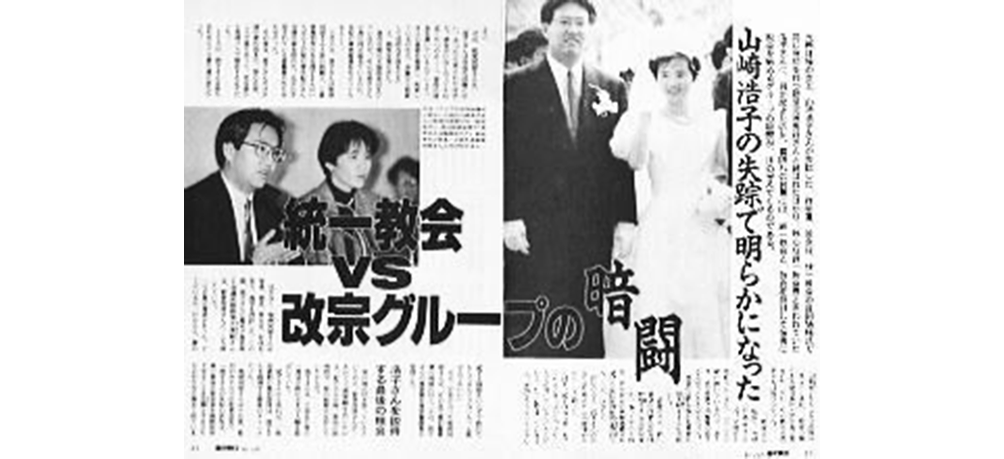 Ms Sakurada disappeared from public life soon after the ceremony. She is happily married with three children and wants to stay out of the limelight, a church spokesman says. [In 2017 she decided she wanted to make a come-back.]
Within seven months of the wedding Ms Yamasaki, too, had disappeared – but without telling her new husband Hideyuki Teshigawara, then 28. He filed a missing person’s notice on March 10, 1993. Police began a 46-day search amid rumours Ms Yamasaki had been kidnapped or run away from the church. [In response to the efforts of her family and a pastor, she decided to reconsider her membership and left.]
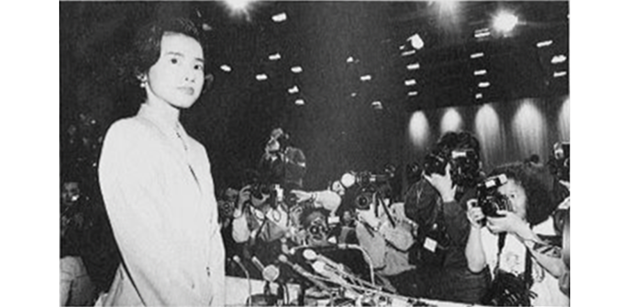
▲ Ms Yamasaki at her 1993 press conference
Then on April 21, 1993 she appeared at a dramatic nationally televised news conference attended by nearly 200 journalists. She said, “Everything was a mistake”. She announced her decision to leave her marriage and the Unification Church.
“I was placed in a world of delusion where people’s minds were being controlled,” she said later. “So I still cannot figure out to what extent the affection I felt towards Teshigawara was real.”
She has had support. “Only people who have been deeply involved in the activities of the organization can understand how serious the problem is,” a person who knows Ms Yamasaki told The Australian at the weekend. “Outside people will not understand. To persuade the people to get out is extremely difficult. It may take a whole life.”
About 40,000 couples from across the world were due to be married in the Seoul ceremony yesterday, but most were already wed and simply reaffirming their vows. The church spokesman said this mass wedding would not be as important for Japan, “without any talento.” Yet 12,000 Japanese Moonies paid their airfares and accommodation on top of a 1.4 million yen ($19,178) donation to the church to participate in a four-day festival that culminated in the ceremony.
The Moonies suffered from Ms Yamasaki’s disappearance and a backlash against cult religions following the 1995 sarin gas attack in Tokyo by the Aum Supreme Truth sect. They have been ordered to pay damages to women who were coerced by Moonies into giving donations. Yet the Unification Church still has many members in Japan.
The Ungodly Gains Of The Unification Church, The World’s Greediest Church
Sports
Translated from Japanese
Men and Women Who Shaped an Era: Where Are They Now?
Former Rhythmic Gymnast Hiroko Yamasaki
October 27, 2009 3:00 PM
Hiroko Yamasaki, who made a name for herself in rhythmic gymnastics, was born on January 3, 1960, in Kagoshima Prefecture.
She grew up on Tanegashima Island from the age of three until junior high school. She started rhythmic gymnastics upon entering Kagoshima Junshin Girls’ High School (a prestigious school for rhythmic gymnastics, affiliated with Tokyo Junshin Girls’ High School in Hachioji, Tokyo), and quickly rose to prominence, her talent becoming widely recognized throughout the country.
At Tokyo Women’s College of Physical Education, she became known as the “Queen of Rhythmic Gymnastics,” winning the All-Japan Championships in individual all-around for five consecutive years from 1979 to 1983. This record remains unbroken to this day.
This achievement sparked a new wave of interest in rhythmic gymnastics as a sport, leading to a sudden boom.
In the 1984 Los Angeles Olympics, rhythmic gymnastics became an Olympic event for the first time, and Yamasaki participated as a representative, finishing 8th in the individual all-around. This achievement transformed rhythmic gymnastics from a temporary trend into a permanently popular sport.
Yamasaki’s individual results at the World Championships were 20th at the 1979 London Games, 12th at the Munich Games two years later, and 34th at the Strasbourg Games in 1983. Those around her felt she had reached her “limit.”
However, she made a remarkable comeback with her 8th-place finish at the Los Angeles Olympics. That same year, Yamasaki retired from competitive gymnastics. She opened a rhythmic gymnastics school and also worked as a television personality, appearing on quiz shows and other programs.
However, in 1992, it was revealed that she had attended a mass wedding ceremony of the Unification Church (HSA-UWC) along with singer Junko Sakurada and badminton player Atsuko Tokuda, shocking the public. However, on April 21, 1993, Yamasaki announced at a press conference that she had annulled her marriage and left the Unification Church. Following that, she served as the deputy head of the rhythmic gymnastics strengthening committee for the Athens Olympics, and currently serves as a director of the Japan Gymnastics Association.
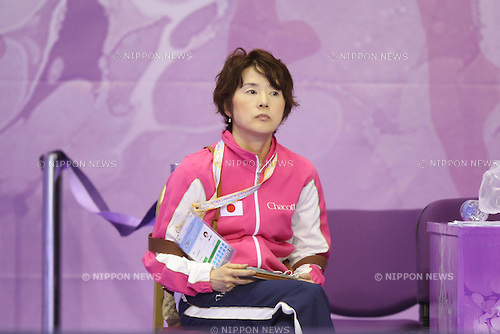
▲ In 2014 Ms Yamasaki was the national coach of the Japanese women’s rhythmic gymnastics team.