The Tragedy of the Six Marys – Sun Myung Moon is the real Satan!!
Updated February 14, 2026
page 109
Translated from the Korean in February 2026. Some information has been added. All additions are indicated. The Japanese can be found HERE. The Korean HERE.
The Women Who Were Sacrificed
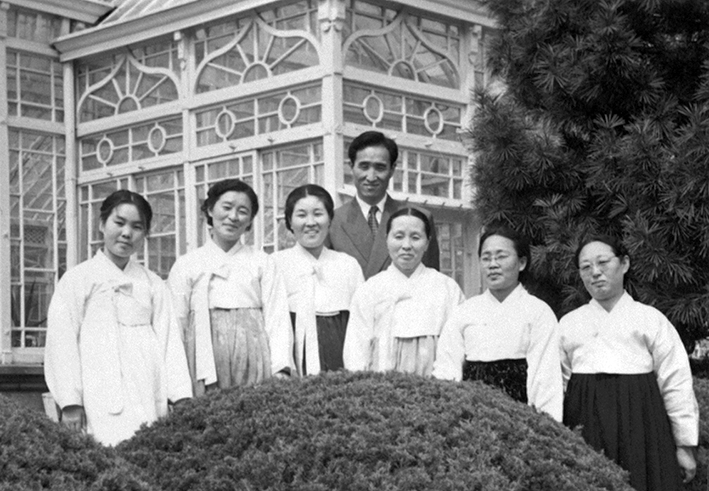
▲ Sun Myung Moon surrounded by ‘Marys’ (married women). From the left, their names are:
1. not named. She may have been given the alias of Kim An-sil.
2. Kang Hyun-shil 姜賢実
3. Park Cheong-sook 朴貞淑
4. Sun Myung Moon
5. Ok Se-hyun 玉世賢
6. Lee Deuk-sam 李得三
7. Kim Soon-cheol 金順哲
[This photo was taken at the Chang Kyung Palace arboretum in the mid 1950s.]
111
The fate of Ok Se-hyun, a meritorious contributor
Up to the previous section, I have described the facts of that time based on diaries and notes. A few volumes of diaries that I barely managed to save while evading the relentless pursuit of the police have now become valuable records.
I have written and confessed in full my foolish footsteps and state of mind, having believed in him as the Messiah of the Second Coming and blindly followed him while calling him “Teacher” even when we were both in prison. The actions of “Teacher Sun Myung Moon” that appear in this writing are all facts.
I, who had been a straightforward soldier, kept my promise to “Teacher,” and left behind my parents, my wife, and my five children in the North, and came south, striving as a faithful alter ego of “Teacher.”
However, one day, “Teacher’s” side suddenly betrayed a disciple who had no home to return to and no family. Perhaps I had become a man too well known.
I was sent away with the title of mine manager to a deep mountain far removed from any villages. For several years I did nothing but work without pay. And, as if replacing me, something of the military regime gradually built its power within the Unification Church. It gave off a strange smell that I glimpsed from the corner of my eye.
Teacher Sun Myung Moon, before I knew it, became in my heart nothing more than a mere Sun Myung Moon, no longer someone worth devoting my life to protect.
Up to the previous section, I could not bring myself to write “Mr. Moon” and therefore described him as “Teacher,” but from this section onward, I will write everything as “Moon Yong-myung” and “Sun Myung Moon.”
112
Socks knitted with hair
Now that I think back, the woman who stands out in my memory as the first woman connected with Sun Myung Moon was Ok Se-hyun. I heard about her often from Moon Yong-myung (as he was called at the time) when we were in Heungnam Prison.
[According to Kim Myung-hee’s book, “Among Hwang Guk-ju’s disciples were elderly women such as Ok Se-hyun (玉世賢), Chi Seung-do (池承道), Park Wol-yeong (朴月影) – later the mother-in-law of a chaebol named Park – and Chong Deuk-eun (丁得恩), who later became Moon’s closest disciple [in Pyongyang].” about page 313. LINK ]
At that time, merely obtaining a train ticket from Pyongyang to Heungnam was a tremendous undertaking. Tickets were sold only to those who possessed a travel permit, and even so, it seems that Ok Se-hyun endured staying in line all night to buy a ticket so that she could visit Moon Yong-myung, and after much hardship she managed to obtain a ticket.
In order to bring things to Moon Yong-myung, she carefully prepared roasted grain powder. When winter came she knitted underwear with wool yarn, added padding, and traveled that long distance to the prison camp to visit him. In summer, she made roasted grain powder and taffy, sometimes softening the taffy and mixing it into the grain powder to bring it, and at other times she brought homespun hemp clothing. It is also said that she even gave him money so that he could buy cod-liver oil for nutrition. Could one really devote oneself so earnestly to caring for someone with whom one did not even share blood? I could not comprehend it. Compared with my own situation, I had a mother and a wife, yet visits from them amounted to no more than once every three or four months at most. That she came frequently, always bringing various prepared items, left me no choice but to be astonished.
Moon Yong-myung and I discussed everything inside the prison and hid nothing from each other. One day he said to me, “Ok Se-hyun cut her own hair and brought me socks that she had knitted together with wool yarn.”
In old sayings, it is said that for someone who has received true grace, one cuts one’s own hair and makes footwear from it to repay that grace, but thinking that such a person truly existed made me bow my head in reverence.
I wondered what could make that woman be so devoted, but I did not ask Moon Yong-myung about it. I simply gratefully ate the roasted grain powder and other things she shared with us.
When the Korean War broke out and the UN forces advanced northward, Moon Yong-myung was released from prison and became a free man on October 14, 1950. Together with Moon Jeong-bin, who had been a fellow prisoner, he walked for ten days and finally arrived in Pyongyang.
[Moon Jeong-bin was a young communist party official. Many of Moon’s friends in Tokyo had been communists. Moon was arrested in Seoul in November 1944 for his association with communists.]

▲ Ok Se-hyun is now in a pathetic situation.
After that, I met Ok Se-hyun for the first time at her home. Ok Se-hyun’s residence seemed to belong to a fairly wealthy household; it had a large yard, and several buildings were arranged together. She was living together with her daughters, the sisters Woo Jeong-ae and Woo Jeong-soon. Kim Won-pil, who was a follower of Mr. Moon, was also staying there as a boarder. He said that he could not return to the house of Satan (by which he meant his own home).
In a room that Ok Se-hyun had prepared, Moon Yong-myung, myself, Moon Jeong-bin, and Kim Won-pil, the four of us, stayed overnight. After we had been there for about five days, the entire family that had evacuated to Seoul returned. Since the next day was Sunday, after finishing breakfast, Ok Se-hyun and her husband, Elder Woo Ha-seon (우하선), came to greet us carrying Bibles. Then he said, “Today is Sunday, so let us offer worship together.” We sang hymns and prayed, and Elder Woo Ha-seon read from the Bible and preached. He was an elder of Jangdaehyeon Church in Pyongyang.
113
The lament of the master of the house, Elder Woo Ha-seon
That afternoon, Elder Woo said that he had something to talk to me about, so I went to his room. He said that he was the chairman of the Pyongyang Rubber Association, and that he knew well Mr. Choi Nae-bong of Jeonghwang Rubber, who was related to me by marriage. They were close acquaintances.
The matter he wanted to talk about was none other than the issue concerning the relationship between his wife and Moon Yong-myung. He said that he was an elder of the church, and his wife Ok Se-hyun was also a deaconess who served the church diligently, but after a young man who had come from the South began giving strange sermons, his wife started attending those gatherings for several weeks.
Up to that point, they had lived harmoniously as a couple without any problems, but suddenly his wife refused to share a bed with him. The children were already grown, and since this was a Christian elder’s household, he could not openly bring up and argue over such strange matters. At first, he tried over a long period of time to persuade her, but no matter what he did, it was all in vain.
His admirable wife, whenever she had the chance, would gather money and go out for the sake of Moon Yong-myung. Since there was also some economic leeway, at first he merely thought that perhaps it was acceptable to some extent. Above all, he earnestly prayed and hoped that the couple would quickly return to living harmoniously as before, but his hope was in vain.
Then one day, that young man, along with his wife, ended up being arrested by the police. Elder Woo was well known in Pyongyang city and had social standing, so he went to the police to inquire into the reason for the arrest. He learned that the young man and a married woman named Kim Chong-hwa, who had a husband and children, were preparing for a wedding, calling it the “Marriage Supper of the Lamb,” and that neighbors, finding this strange, had reported it to the police, leading to their arrest.
Because of his social standing, Elder Woo could not step forward openly, so he asked his nephew to contact the police and arranged for the release of his wife, Ok Se-hyun.
That young man was Moon Yong-myung, and since he was in prison, Elder Woo had felt reassured. His wife had been traveling as far as the distant Heungnam prison camp to visit him, and at first he had tried to persuade her to stop, but in the end she did not listen, and he had no choice but to leave it alone.
Since you too, Mr. Pak, are a Christian who believes in Jesus, if you act together with a man like Moon Yong-myung, you will inevitably receive punishment someday, and of course living in this world will become very difficult. It would be better not to act together with a man like Moon Yong-myung.
❖ Photo added:
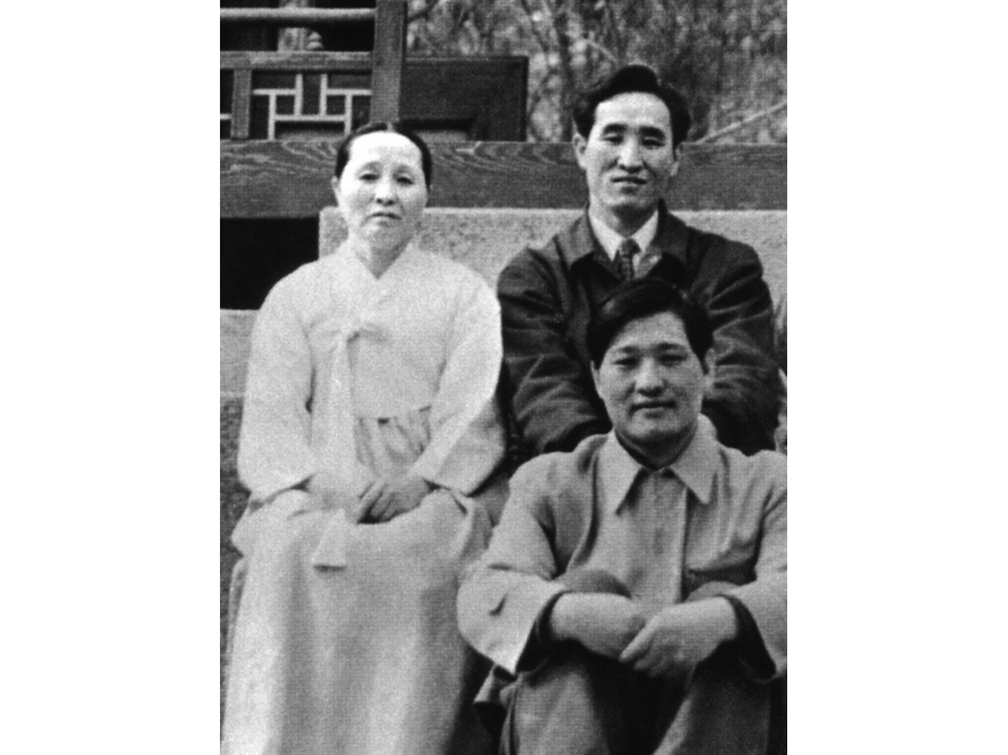 ▲ Ok Se-hyun, Moon and Kim Won-pil
115
Body, mind and property given to Sun Myung Moon
Ok Se-hyun, who had given her body, mind, and property entirely to Sun Myung Moon, fled south during the Korean War and came to Busan, there she followed Sun Myung Moon like a shadow. She established a material foundation for the starving Sun Myung Moon to live. By this time he had changed his name [from ‘yong’ which meant ‘dragon’].
What still comes to mind now is what happened after the church moved to Heungin-dong in Seoul. After succeeding in bromide photograph production, the economic situation was improving considerably, but all of the members living communally were bachelors, so Ok Se-hyun took the lead in doing the laundry.
Suits, underwear, and the like belonging to the members were kept stored, and each person would take out their own from their own box and change clothes, and there were no fewer than twenty-four such boxes. I think the hardship Ok Se-hyun endured at that time would be beyond description.
This is a much later story, but after breaking with Sun Myung Moon, I went to Busan and was engaged in a housing construction business. One day, a doctor named Kwon Chang-jeong came to see me. He said he wanted to buy a house and asked whether one could be purchased, so I accepted his application, and he paid the application fee and left. After that, Ok Se-hyun came to ask whether her second son could be employed at the construction site. Although there was no need for staff, since it was Ok Se-hyun’s request, I could not refuse. From the next day, I employed her son and there was a period of a little over one year during which we worked together.
According to what Elder Woo, who later became a pastor, said when the housing construction was nearing completion: “I told my wife, Ok Se-hyun, to change her mind, but it was in vain, and in the end there was no choice but to divorce. After that, I studied theology, became a pastor, and am now serving at a small church.”
He said that he remarried a church deaconess after divorcing his wife. He also said that Dr. Kwon Chang-jeong was his son-in-law, and that the house his son-in-law had applied for was his own house, so he asked to see it. We looked at the completed house and talked for a long time.
Sun Myung Moon’s wife, Choi Seon-gil, found it uncomfortable to remain near her husband because of his misconduct with women. Therefore, in the early days, the task of supporting Sun Myung Moon fell to Ok Se-hyun.
During the time of the Busan Sujeong-dong church, they were chased out as many as four times. This was because the legal wife, Choi Seon-gil, grew jealous of the female members who gathered where Sun Myung Moon was, sold off the household goods in the house, and drove away the people who gathered, so there was no choice but to flee and move elsewhere.
When they moved to a new place, Sun Myung Moon’s wife would again glare angrily and persistently track them down, and then came up with a clever idea. She went to the house of Ok Se-hyun’s relatives, paid the housemaid money, and when Ok Se-hyun came, had her follow behind, successfully tailing her. When that succeeded, she found the new house and once again repeated the same thing, causing a great commotion.
In the end, all the members together were taken away by the police. At that time, Mrs. Choi was released after promising that she would never again cause such a disturbance. She also promised not to interfere with the church at all thereafter, but later, at the Sujeong-dong house, Mrs. Choi Seon-gil did the same thing again. She sold off not only the household goods but even the house itself, and Sun Myung Moon fled to Seoul.
This time they moved their base to a small house in Cheongjin-dong in Seoul, but somehow Mrs. Choi found out, and she came to this house as well, once again completely wrecking not only the household goods but everything belonging to Sun Myung Moon. It was at this time that Sun Myung Moon threw away the original manuscript of the Principle and fled.
Ok Se-hyun, who had followed Sun Myung Moon like his shadow, was extremely worried because Sun Myung Moon had disappeared. When I tried to go alone to where Sun Myung Moon was, in the middle of the night, under a torrential downpour, she grabbed my sleeve and cried, saying that she wanted to go with me, but I refused.
Now that I think about it, I feel that it was truly a regrettable thing. At that time in Seoul, an arrest warrant had been issued for Sun Myung Moon, and if I had taken Ok Se-hyun with me and been questioned by the police on the way, it would have been a serious matter, so I had no choice.
Ok Se-hyun lived for a while at the Daegu church, waiting for Sun Myung Moon. When I brought Eu Hyo-won from Busan to Seoul and rented a room in Bukhak-dong, I called Ok Se-hyun, who was in Daegu, to Seoul.
From that time on, once again she took full responsibility for taking care of the living needs of Sun Myung Moon and the members.
When Sun Myung Moon was arrested by the police in the July 4 incident, Ok Se-hyun’s appearance of grief was unbearable to watch. Every day she fasted and prayed, grieving and crying from the depths of her heart, and even those of us watching beside her felt as though we should bow our heads.
Afterward, even after moving to Cheongpa-dong, she was still in charge of managing the church’s household affairs, but when I left the church for a while and later returned, Ok Se-hyun had already been driven out of the church and was no longer there.
One day I heard about Ok Se-hyun from Eu Hyo-min. It was that Ok Se-hyun had come to Eu Hyo-min and asked to borrow some money. After that, Ok Se-hyun’s daughter, Miss Woo Jeong-ae, came and again made a request to borrow as much as 1.7 million won.
The money was lent, but it was said that it was never repaid, and that after that Ok Se-hyun came several more times asking if money could be lent to her. Since it was no longer possible to lend any more, she was refused.
117
Mrs Ok discharged from hospital with nowhere to go
Ok Se-hyun met Sun Myung Moon in Pyongyang on November 6, 1946, when she was forty-eight years old. Sun Myung Moon was twenty-seven at the time, twenty-one years younger than her. Believing Sun Myung Moon’s principle of restoration, which he had brought from the North, she entered into a physical relationship with him. She was the very first Mary.
From that time on, for about forty years, she followed Sun Myung Moon, devoting her body, her mind, and her property to caring for him. It was a span of time during which even mountains and rivers would change four times over, given the saying that ten years is enough for landscapes to change. She was a person who attended Sun Myung Moon at his side throughout all those long years.
She was Ok Se-hyun, who seemed unable to live even for a single moment apart from Sun Myung Moon.
However, hearing of Ok Se-hyun’s present circumstances, it turns out that because the church decided to expel all elderly members, she too was expelled from the church she had attended for more than thirty years.
When she was expelled from the church, it is said that she received only ten million won. What could possibly be done with such money? It is not even enough to serve as capital for a small business.
It seems that she lent it as part of housing funds to her daughter and son-in-law, and because she could not attend church from a distant place, in order to attend church until the day she dies, she rented a small room near the church and is living there. It is truly an absurd and heartbreaking story.
If I had been active in society and running some kind of business, I would have liked to at least provide her with a livable house, and to send her at least enough money each month to cover living expenses. That a great contributor, now in her nineties, should have to go around borrowing money from people who have left the church—is it not such a pitiful story that it brings tears to the eyes?
On August 16, 1985, a declaration of Ilseung-il (一勝一) was proclaimed. Pastor Song Young-seok of the headquarters church was preaching that all past sins were completely forgiven, Satan was made to submit, and thereafter everything would be restored from Satan’s world to God’s world, bringing all blessings to the members of the Unification Church.
Rather than such talk, I thought that first of all, resolving matters by at least providing a house to people like Ok Se-hyun so that they would not struggle in their daily lives was what absolutely needed to be addressed first.
A long ago, in prison in Heungnam, when I heard Sun Myung Moon speak about the Principle and about the “The Garden of Peace and Harmony Ideal,” my heart swelled and I asked, “Around when will that time come?”
At that time, I clearly remember Sun Myung Moon answering, “In seven years, that time will come,” as if it were yesterday.
Already forty years have passed since then. Sun Myung Moon himself may well have accumulated great wealth, but the dream-like story has not been realized.
It was around May 1993 that I received contact from Eu Hyo-min. He said that Ok Se-hyun was currently hospitalized at the Severance Hospital in Gajwa-dong, Incheon. He suggested that we go to visit her, so he and I went to the hospital and visited Ok Se-hyun. She was said to be ninety-six years old that year.
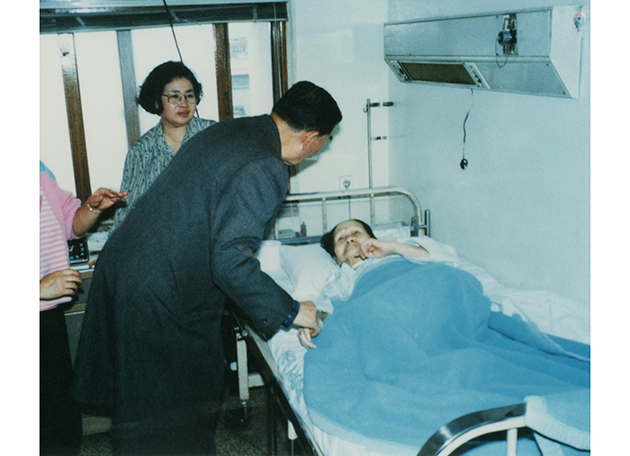 ▲ Ok Se-hyun was visited by Pak Chung-hwa and Eu Hyo-min in hospital in May 1993. [Moon Byeong-in is also in the photograph.]
She had completely recovered from her illness and was relatively healthy, so the hospital wanted her to be discharged, but she had nowhere to go after discharge and so was remaining in the hospital.
Thus Eu Hyo-min was prepared to put up the money to rent an apartment and have her discharged, but when the Unification Church side heard about this, they hurriedly rented a room themselves and discharged her.
Seeing that the old age of Ok Se-hyun, who had supported Sun Myung Moon throughout his entire life, had become so miserable was truly sad.
However, not only Ok Se-hyun, but there are still several hundred more people who have been sacrificed in this way.
121
Park Bong-shik and Oh Yeong-choon
A married couple devoted to Sun Myung Moon
The time when I went together with Sun Myung Moon to Yeongdo, Busan, to visit the home of Shin Seong-muk and Eu Shin-hee (husband and wife) was December 24, 1953.
Those who newly joined at that time were Eu Hyo-won, Eu Hyo-min, Eu Hyo-yeong, the couple Shin Seong-muk, Kim Gwan-seong, Deacon Choi, and others. Deacon Choi, who was running a textile factory, stopped coming to church after three months.
It was also around this time that the couple Song Do-uk and Park Bong-shik joined. They were originally people of deep faith, and the following spring, the Song couple went up to Seoul and became devoted workers for the church.
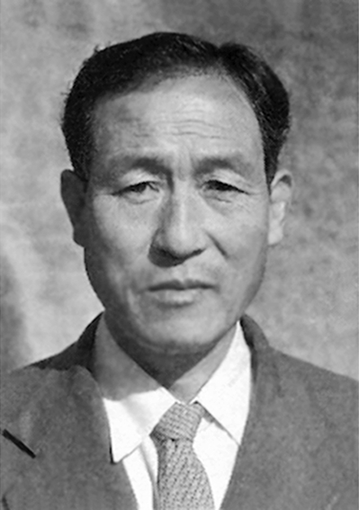 ▲ Song Do-uk
Deacon Song was not a highly educated man, but he was a large man with a sturdy build and had a temperament like split bamboo. He was someone who had done various things, including participating in the independence movement in Manchuria. After “liberation,” he returned to Korea and married Park Bong-shik in Busan.
They had a harmonious married life, and a daughter was born to them. In order for the three of them to make a living, Song Do-uk went from house to house selling insecticides and also spraying them. His wife, Park Bong-shik, was running a business at a market in Busan. After hearing the Principle teachings, she gave up the business she had been doing up to then, and the couple came to submit themselves to Sun Myung Moon.
The couple’s home was a small shanty house, and there was an empty room on the second floor where Kim Won-pil was living in seclusion. I would sometimes go there to visit Kim Won-pil. When traveling by train from Seoul to Busan, when passing through tunnels, coal smoke would come in and turn one’s suit completely black with soot. On one occasion, the spring coat I was wearing had been beige, but it ended up turning black. Park Bong-shik washed and dried that coat, which had become pitch-black overnight, and by the time I returned to Seoul in the morning, she made it so that I could wear it stiff and neat, just like a new garment. Even now, forty years later, I cannot forget that.
The daughter of Elder Song and his wife had a very lively personality, and Sun Myung Moon took a liking to her and bought her a gayageum so that she could learn to play it. And whenever there were church gatherings or members’ fellowship meetings, he had her play the gayageum and sing. Later, it was said that she was in a passionate romance with a certain young man. We all thought that we should give them our blessing, but it seems that the two ultimately did not go as far as marriage.
At that time, at first I traveled around together with Sun Myung Moon as his secretary, but after Eu Hyo-min joined, he became the secretary. After that, Sun Myung Moon changed the secretary role from Eu Hyo-min to Song Do-uk, and Deacon Song was promoted to elder.
122
Song Do-uk, the husband who had an affair
After coming up to Seoul, Park Bong-shik was active as an itinerant evangelist, preaching the Unification Church’s Principle in various places, including Geochang in Gyeongsangnam-do. Around that time, a major problem arose involving her husband, Elder Song.
At the time, I was at the Seojin Mine, and I went to Gunsan on some business. After explaining the situation to a certain Mr. Kim, I stayed for about a week at the house of another Mr. Kim in Wolmyeong-dong. This house was also being used as the church in Gunsan, and I had known Mr. Kim’s wife for some time.
On the fifth day, when I returned to Mr. Kim’s house after finishing some business outside, the wife, who until then had seemed perfectly normal, was in a somewhat mentally disturbed state and clung to me, saying, “Please restore me.”
Not only with me, but whenever she saw a man, she would mutter to anyone that she “wanted restoration.” When people became deeply absorbed in the Principle teachings, situations like this happened frequently. I had experienced such things many times in Seoul and in Busan as well, so I was not particularly alarmed. Even so, it was not something that could simply be left unattended, so as soon as I returned to the mine I contacted the (HSA) Association President Eu Hyo-won in Seoul.
As a result, Elder Song went down to Gunsan and brought the wife back to Seoul. There was a house in Noryangjin (the home of Park Cheong-sook, who had left the church), and it was decided that the wife’s illness would be treated there. Since Elder Song alone could not take care of her, it was decided that she would stay together with Oh Yeong-choon, who would help care for her.
In the meantime, Elder Song and Oh Yeong-choon ended up developing feelings for each other. The wife recovered, but Elder Song and Deacon Oh became a pair who could not be separated from each other, and in the end they received a blessing from Sun Myung Moon and began living together.
123
Park Bong-shik was a woman of outstanding character
I would like to write about Park Bong-shik. Let us consider this issue starting from the Principle. Song Do-uk and Park Bong-shik came to Sun Myung Moon as a married couple and became members. Elder Song became Sun Myung Moon’s secretary, and Deacon Park gave up all the household work she had been doing up to that point and devoted herself solely to evangelism.
If Sun Myung Moon were to give a blessing, then it would be natural, both by common sense and by the Principle, for Deacon Park and Elder Song to receive the blessing together.
Even so, the fact that Deacon Oh and Elder Song received the blessing means that their cohabitation was acknowledged, does it not? This is contradictory in many respects.
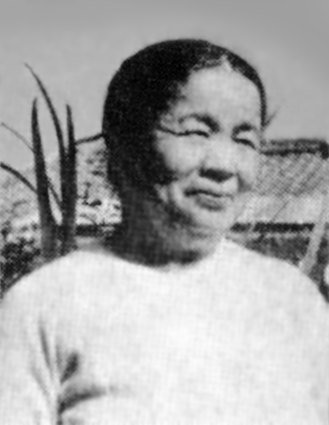
▲ Mrs Park Bong-shik the wife of Song Do-uk in Busan.
Since it was said that Sun Myung Moon had given the blessing, there was nothing else that could be said, but it was a matter that Deacon Park could not possibly accept. One can sense her state of mind as she stood there blankly, her shoulders slumped. After receiving the blessing, some time passed and Elder Song contracted liver cancer and lived a life of great suffering. He underwent surgery, but by the time they opened him up, the cancer had already progressed so far that they could not even stitch him up again, and he died.
Hearing that Deacon Park was at his side at the moment of his death, I cannot help but acknowledge her character. Elder Song had received the blessing with a younger woman and was living a dissipated life, yet to hear that she was beside him at the place of death makes it impossible to judge whether she should be called a virtuous woman or a faithful widow.
After Elder Song died, it is said that Deacon Oh, who had received the blessing together with him, also fell ill and groaned that Elder Song appeared in her dreams and tormented her. Hearing that Deacon Park then lived together with this sick Deacon Oh for several months and nursed her, all I could do was bow my head in respect.
124
Oh Yeong-choon contributed large sums of money to Moon
Sun Myung Moon moved houses four times in Busan together with Ok Se-hyun and others, and all of the expenses at that time were paid by Deacon Oh Yeong-choon. Deacon Oh also evangelized relatives of Dr. Jang Ri-uk and people such as Kim An-shil and brought them into the church, and she evangelized Kim Soon-cheol, Lee Deuk-sam and her daughters, Choi Soon-shil and Choi Soon-wha, and Yang Yun-shin as well. Most of the female leaders who were very important in the early days of the church were people evangelized by Deacon Oh.
Later, when Sun Myung Moon and Kim Soon-cheol were living together, saying it was Kim Soon-cheol’s restoration, they did not even have money to rent a house, but Deacon Oh gave money to her brother-in-law who lived in Sindang-dong and arranged a room where Sun Myung Moon could live.
❖ Photo substituted from the one in the book which was a head and shoulders of Oh Yeong-choon from the 1960s.
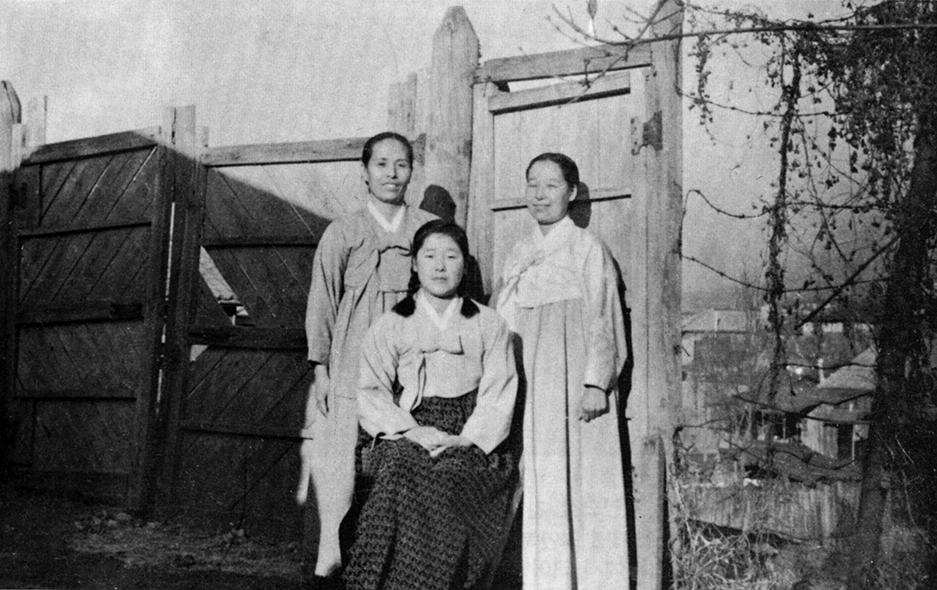 ▲ Hong Soon-ae, Han Hak-ja and, on the right, Oh Yeong-choon 呉永春 in 1960.
When the Ewha University incident broke out and Sun Myung Moon and the other leaders were arrested, it was Deacon Oh who took charge of supporting them behind the scenes.
As a result, she ended up selling her own house and handing over the entire proceeds of five million won directly to Sun Myung Moon. After Sun Myung Moon was arrested, in order to raise liaison and support funds, she opened a small shop on Wonhyo-ro and ran it together with Lee Deuk-sam and others. With the profits from that shop, she supported Sun Myung Moon and the leaders.
Whenever Sun Myung Moon or I needed money, it was always Deacon Oh who provided it. It was the same when we first went to Yeongdo in Busan.
At that time, Sun Myung Moon did not have a single penny and was in dire straits, so Deacon Oh raised the travel expenses and brought the money, which made it possible for us to go to Busan. From the point when the three Eu brothers and cousin joined the church, this became the opportunity for the foundation of the church to become solid.
Later, Oh Yeong-choon went to the United States and lived with her son, who had become a doctor. When she returned to Korea in 1983, she brought back a bear gallbladder to give to her daughter Jang Hye-suk. At the time, it was worth about 1.5 million won.
When she heard that I had collapsed from high blood pressure, she sent word through Eu Hyo-min for me to come to her daughter Jang Hye-suk’s house. When I went there, she handed me the bear gallbladder and said, “I can buy another one for my daughter later if there’s another opportunity, so for now please take this and restore your strength. Mr Pak, you are someone who is still needed even though you are ill, so I am giving this to you.”
Not only that, but since she knew well the relationship between Sun Myung Moon, the church, and myself, she said, “I think that Teacher Moon must cherish Mr Pak even more. Teacher Moon should be in Seoul now, so I will try to make it possible for the two of you to meet,” and she promised to try.
At no point did she mention that the five million won she had raised by selling her house long ago had not even had a single won repaid. At that time, five million won would amount to more than fifty million won in today’s terms.
I gratefully accepted the bear gallbladder, and after taking it, I was able to recover my health within a month. Oh Yeong-choon made various efforts, but of course there was not even a phone call from Sun Myung Moon.
In this way, since the earliest members of the church had gone through hardships together, they were able to help one another when difficulties arose.
However, Sun Myung Moon, who alone put on airs of superiority, ended up placing only the abstract doctrine of the Principle above all else, becoming someone in whom one could no longer find any trace of humanity.
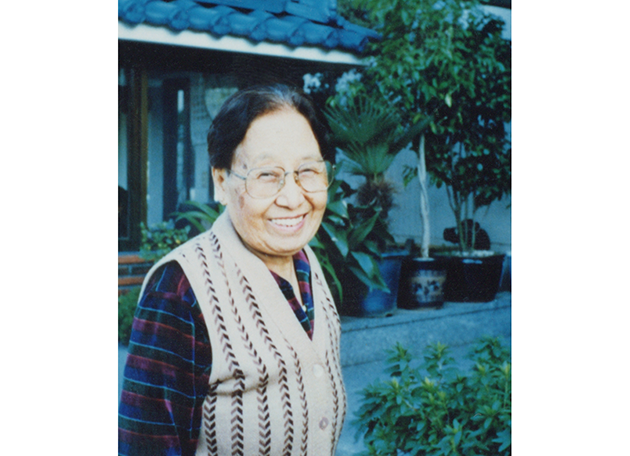
▲ Oh Yeong-choon in Korea in 1992
126
“Even if I have to work as a maid, I must live”
However, even though Ok Se-hyun’s whereabouts had surfaced, the headquarters church drove out Park Bong-shik. She had devoted her body and mind entirely to Sun Myung Moon and the church and then had neither money nor a house. After that, Park Bong-shik had nowhere to go and fell into a truly pitiable situation.
Park Bong-shik went to the Cheongpyeong Unification Church training center, pitched a tent in the mountains, and lived there while praying. But after only a few days, it is said that a training center manager found out and drove her out as well. With no other choice, Park Bong-shik returned to the city and decided to make a living by selling sesame oil.
So first she went to the homes of church leaders. She went around thinking that if Park Bong-shik, an original member, made a request, at least one person in each household would buy a bottle of sesame oil. First, she went to the Association president’s wife, set out a bottle of sesame oil, and asked her to buy just one bottle at the market price, saying it was genuine sesame oil.
But that woman said that it was far too shameful for a Unification Church member to be selling something like sesame oil, told her to stop, and drove Park Bong-shik out. Then she went to the former Association president’s house as well, but just like at the first house, she was turned away at the door.
Park Bong-shik sighed and said that among the leaders of the Unification Church there was not even a fragment of what could be called love, that they were truly cold-hearted people.
Seeing that even the Association president’s wives had both rejected her, she concluded that going anywhere else would only be futile, and she gave up on the sesame oil business. In order to survive, she said bleakly, she would have to stop expecting anything from the Unification Church and instead do whatever work she could, whether working as a maid or anything else.
128
The tears and anger of Kim Chong-hwa (金鍾和)
“I want to kill Moon Yong-myung”
Sun Myung Moon went to Pyongyang and tried to attract and recruit believers by preaching a half-baked and shoddy version of the Principle. Pitifully, Ok Se-hyun was one of the sacrifices from that time, but there is one more person who must be written about.
That is the case of the married woman Kim Chong-hwa, which became the cause of Sun Myung Moon’s imprisonment in 1948.
When I was released earlier than others [in August 1950] after completing my sentence in Heungnam Prison, Sun Myung Moon told me to go to Kim Chong-hwa’s house in Gyeongchang-ri, Pyongyang, convey that he was doing well, and tell Chong-hwa that it would be good for her to wait there. So as soon as I was released, I went straight there, but she had already set out on the road as a refugee and I could not find her.
She became a fervent believer of Sun Myung Moon, and despite having a husband and a son [and two daughters], she slept in the same room with Sun Myung Moon, and eventually caused an uproar by holding the so-called “Marriage Supper of the Lamb,” for which she was arrested and sentenced to one year in prison. [sentenced to 18 months but released after 12 months]
Even so, according to the theory of the Divine Principle, after restoring the six Marys (married women), the subsequent “Marriage Supper of the Lamb (formal marriage)” is supposed to be conducted with a partner who is a virgin, free from defilement.
Why, then, would a married woman with a husband and children be chosen? It cannot be explained. Moreover, Sun Myung Moon himself had a wife and a son whom he had left behind in Seoul.
When I finally managed to find Kim Chong-hwa in Seoul, she was living in Imun-dong and diligently attending a mainstream church as a deaconess. Her husband, Cheong Myeong-seon, was running a small rooming house called “Columbia” in front of Pagoda Park.
When I visited Kim Chong-hwa, she said that she regretted what had happened and that Satan had tempted her, causing her to commit a sin so great that even repentance until death would not earn forgiveness. She said that at the time she did not know that his name had been changed from Moon Yong-myung to Sun Myung Moon.
“Moon Yong-myung is a tremendous great Satan, and I was completely deceived,” she said. “He is a wicked man who has created many sinners like me. If you too, Mr. Pak, do not quit quickly, you will surely regret it later.” Saying this, she wept, shedding many tears.
She told me in detail about what had happened during the Pyongyang period.
“My husband only thought resentfully about my actions from the shadows, but why did he not become angry? Why did he say nothing while watching his wife and that man sleep together in the same room every night and have sex under the pretext of restoration?
Later, however, I came to realize that he truly loved me, and then I thought that I had committed an immeasurably great sin.”
I asked Deaconess Kim Chong-hwa once more: “You had a husband and children. Did you not feel a pang of conscience at the time about having sex every night with another man?”
“At that time I believed he was the Messiah of the Second Coming, and I was so obsessed with that man that when I had sex with him, I felt no pang of conscience whatsoever. It felt as though I were ascending to heaven.”
I asked whether she might be willing to meet Moon Yong-myung once more, since he was now in Seoul, but she snapped her head up and, with wide open eyes, she replied:
“Although I committed an enormous sin, now I know everything. Moon Yong-myung, that great Satan, seduces virgins and married women like me with clever words and casts many people into a pit of sin.
How could I ever meet such a person again?”
“And if I were to meet him again, I would want to make sure that he could never again commit the kinds of sins against us [women] that he has committed in this world. I resent him so much that I want to kill him.”
She was truly blazing with anger.
130
The tragedy of the Six Marys
Six married women snatched away
I, Pak Chung-hwa, ended my stay as a refugee in Gyeongju around May 15, 1953 and moved to Busan. At the church established there in Sujeong-dong I directly heard the Principle lectures from Sun Myung Moon. The content was a more concrete explanation of what Sun Myung Moon had told me in the Heungnam prison camp concerning the “The Garden of Peace and Harmony Ideal.” (圓和園理想)
What especially must not be overlooked was the part about the “Six Marys.”
Leaving aside the Pyongyang period, Sun Myung Moon said that among the members, those who had received restoration as the Six Marys were, in order: first Lee Deuk-sam, then Oh Yeong-choon, Kim Soon-cheol, Kim An-shil, Kang Hyun-shil, and Jeong Jeon-ok.
After some time passed, the faces of these Six Marys changed. The reason was that Kang Hyun-shil and Jeong Jeon-ok did not have husbands, and it was said that if one was not a married woman with a husband, one could not become one of the Six Marys.
Sun Myung Moon selected Eu Shin-hee and Park Cheong-sook as replacements for these two as the Six Marys. He said that the qualification for being one of the Six Marys was that one must be a married woman.
God, who has no physical form, was to return as Adam, a physical human being, and when Eve matured in the Garden of Eden, Adam and Eve were to marry. Then undefiled children could be born into this world, and through the multiplication of their descendants, this world would develop into a good, sinless society. This was called the ideal of creation.
However, because the archangel, Lucifer, learned God’s will and seduced Eve, this world was claimed by Satan and became a sinful world.
Sun Myung Moon explained, therefore, that by taking away married women, who were the objects of the fallen angel’s love, the ritual of the pikareum providence of restoration was established, by which the blood defiled by Satan would be cleansed by ritual sex.
Sun Myung Moon even taught me in detail the method of restoration. The method of restoration was as follows: in the satanic world up to now, when having sex, the man was on top and the woman below, but in restoration, for the first two times the woman would be on top and the man below, and on the third time the man would be on top. In this way, restoration must be carried out over three times, corresponding to formation, growth, and completion.
In particular, he told me that I must be restored by having sex first with a woman who had already been restored through ritual sex with Sun Myung Moon. By doing so, he said, I would become the disciple whom Sun Myung Moon trusted the most.
Let us trace what happened afterward to the Six Marys of that time.
131
Lee Deuk-sam
❖ Two photos added:
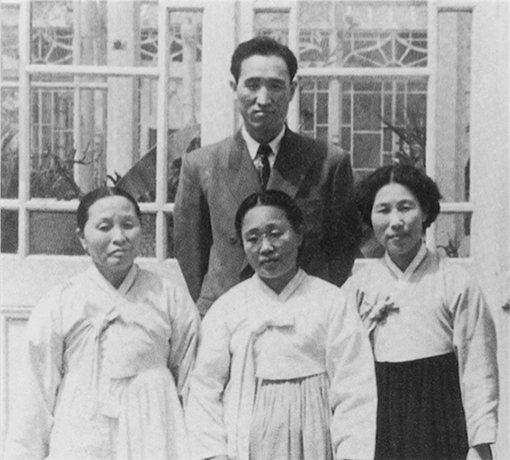
▲ Lee Deuk-sam is standing in front of Sun Myung Moon. Ok Se-hyun is on the left and Mrs Kim Soon-hwa is on the right. Both Lee and Ok had abandoned their husbands and children to follow Moon. Photo mid 1950s.
Lee Deuk-sam, who was the wife of the wealthy man, Choi Seong-mo, had been diligently attending church, bringing her two sons, ever since the time I went to the Sujeong-dong church in Busan on May 15, 1953.

▲ Choi Seong-mo
When Sun Myung Moon went to the Yeongdo meeting in Busan on December 24 of the same year in order to give Principle lectures in person, there was a time when he told me, “Chung-hwa, in the future you must become an ideal match (husband and wife) with Lee Deuk-sam and solve the economic problems of our church.”
However, Sun Myung Moon said that Choi Soon-shil, Lee Deuk-sam’s eldest daughter, who was a virgin, would in the future become Eve, the True Mother, and he violated her. That lie was exposed by the Kim Myung-hee incident [when Moon got her pregnant in 1954].
Also, the second daughter, Choi Soon-wha, received restoration from Sun Myung Moon and even ended up bearing him a child [Sam Park, born in January 1966]. Lee Deuk-sam thought that by becoming one of the Six Marys, she would live a peaceful life forever at Sun Myung Moon’s side.
So she sold the house she had in Choryang-dong, Busan, and offered it to Sun Myung Moon. It was also Lee Deuk-sam who provided the funds when I started the straw-rope business in Busan. However, the fact that the mother and her two daughters [Soon-shil and Soon-wha], the three women, had sex with Sun Myung Moon was something that tormented Lee Deuk-sam.
So that became the cause of her developing uterine cancer, and died a few years later.
How would Lee Deuk-sam, now in the next world, view Sun Myung Moon today?
❖ Three photos added:
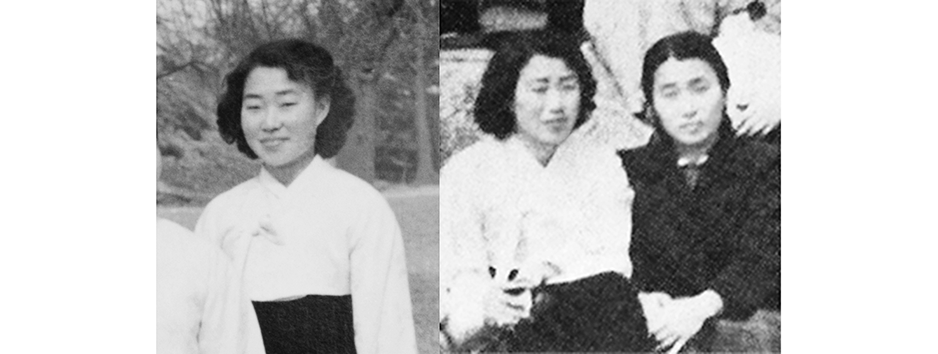
▲ Choi Soon-wha is on the right. Her sister, Choi Soon-shil, is probably next to her but her identity has not been confirmed.
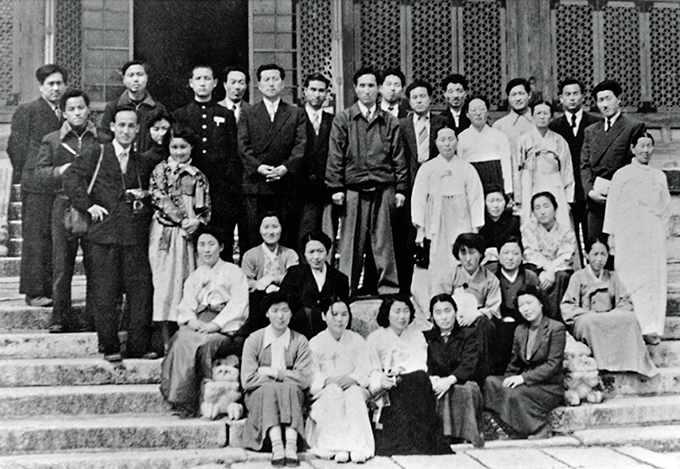
▲ The two young women are sitting in the front row. Sun Myung Moon wanted to have Leah and Rachel wives as he claimed to be following Jacob’s course. The son of Choi Soon-wha, Sam Park, explained about the relationship between his mother and Sun Myung Moon. LINK
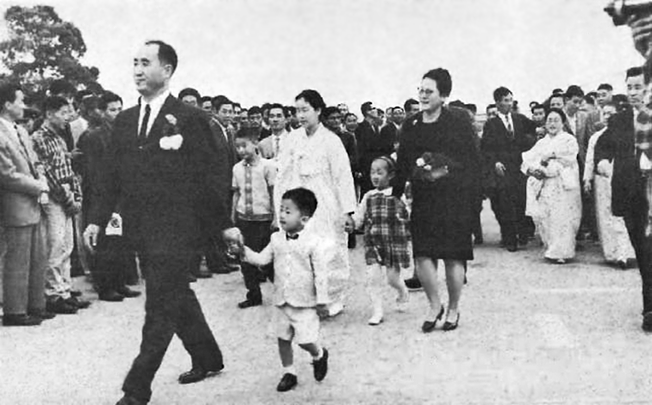
▲ Sun Myung Moon’s triumphal return from his 1965 first world tour. Lee Deuk-sam, in the background, is carrying baby In-jin Moon. At this time her daughter, Soon-wha “Annie”, was six-months pregnant with Sam Park. Moon did not leave Washington, DC, until he was sure that he had made her pregnant. Kim Myung-hee’s son, Hee-jin aged 10, can be seen walking behind Moon.
❖ Additional information
Testimony from the son of Lee Deuk-sam. Choi Soon-yeong was interviewed in 1993 by Takeshi Oobayashi. Full interview HERE
Lee Deuk-sam met Sun Myung Moon and the Unification Church when she was 40 years old. Since then she devoted herself to the church for a long time. Twenty years ago she was diagnosed with uterine cancer. The doctor recommended surgery, saying “You have a greater than 50% chance of recovery.”
She went to consult with the Sun Myung Moon. He then said: “I’ll heal you. There’s no need for surgery.” But Choi Soon-yeong said the outcome was the worst possible.
“My mother followed the instructions of Sun Myung Moon. Her medical condition deteriorated and she eventually died. At the last moment before she died, my mother finally realised that it had been a mistake to have believed in the Unification Church.”
Soon-yeong and his wife were at the hospital bed of his mother, Lee Deuk-sam. One day, three officials of the Unification Church came and put a tape recorder in front of the dying patient. They wanted her to leave a will saying she desired to have her funeral at the Unification Church. They even wanted her to talk about inheritance, persisting for several hours. Lee Deuk-sam remained silent.
“They were in my mother’s room, located at the furthest end of the ground floor. They put a recording machine right in the center of the room. We found it unbearable and eventually said to them, ‘She is our mother, not yours,’ and I threw them out.”
Back then, Choi Soon-yeong says, his mother, Lee Deuk-sam left a will with the pastor of her church, the Seong-eun Church. His name is Rev. Suh Jae-seung. Rev. Suh was away in Canada at the time [of my interview] and could not be reached. But Rev. Suh’s close friend Rev. Kim Sang-bok, said this:
“Recently vicious rumors were circulated about Chairman Choi. I called Rev. Suh in Canada and confirmed the will of Ms. Lee.
This is what happened in January 1972 in a hospital room in Seoul: just before she died, Ms. Lee spoke into Rev. Suh’s ear. She said her belief in the Unification Church was a mistake. “Only those who believe in Jesus go to heaven. I too will believe in him and him only, and go to heaven.”
However, at the death of Lee Deuk-sam, his mother, the Unification Church again put out its tentacles to reach his father, Choi Seong-mo. Choi Soon-yeong sighed and explained:
“Before my mother died, the Unification Church made a woman [Park Cheong-sook] approach my father, with the intention of getting his money. This person became my [step-]mother. The Unification Church will go for any kind of means or method. Before my mother died, my father detested the Unification Church. However, he ended up marrying this woman. He fell for a Unification Church ‘honey trap’ ploy.”
[Park Cheong-sook is named in the obituary of Choi Seong-mo. LINK ]
❖ End of Added information
132
Kim Soon-cheol
Around the time when I wrapped up my life in Gyeongju and went to the Sujeong-dong church in Busan, Kim Soon-cheol joined through Oh Yeong-choon’s evangelism, and after receiving restoration from Sun Myung Moon, followed him around like a shadow.
Kim Soon-cheol’s husband at the time was an executive in the Customs Office.
Without her husband’s knowledge, she donated much of her property to Sun Myung Moon.
As already described, there was a time when Sun Myung Moon was extremely zealous and the three of us traveled around to places such as Anyang and Busan.

▲ Sun Myung Moon with Kim Soon-cheol
Let me speak about what happened to Kim Soon-cheol after that.
One day, Noh Dong-hwi came to find me and urged me to go to the morning service. When I went to worship at the Cheongpa-dong church, Sun Myung Moon happened to come out and was preaching.
At that time, Sun Myung Moon suddenly issued an order: “We are building an arms factory in Sutak-ri (located near Guri in Gyeonggi Province). Complete that arms factory by tonight.”
Since it was so sudden, gathering construction workers was a major task. Fortunately, I was engaged in building housing in Cheonho-dong, so I loaded eighteen construction workers onto a truck, brought them over, worked through the night, and forced the job to completion.
When the work was finished and I was about to return, Kim Soon-cheol suddenly came to me and told me to come with her to the house where she was living. When I followed her there, I found that she was renting a room not far from the main gate of Tongil Industries Co., Ltd. Inside the room there were only a few household items: worn-out old bedding and wrinkled clothes, all shabby. I wondered why Kim Soon-cheol, who had lived such a glamorous life, had come to live in such misery, and when I asked her why she was living here like this, she said, “I want to meet Teacher Moon, but even when I go to the church they won’t let me meet him. After thinking of every possible way, I had no choice: they say Teacher Moon comes to Tongil Industries at least once a day, so I moved here.”
She said, “Every day I wait along the road where Teacher Moon comes, thinking that at least from afar I want to see his face even once. But because Teacher Moon comes by car, whenever he sees me standing there, he turns in another direction and goes off by a different route.”
She must not have been able to tell this sorrowful situation to anyone.
She said that she had come to find me after hearing that I was there.
Photo from the first printing:
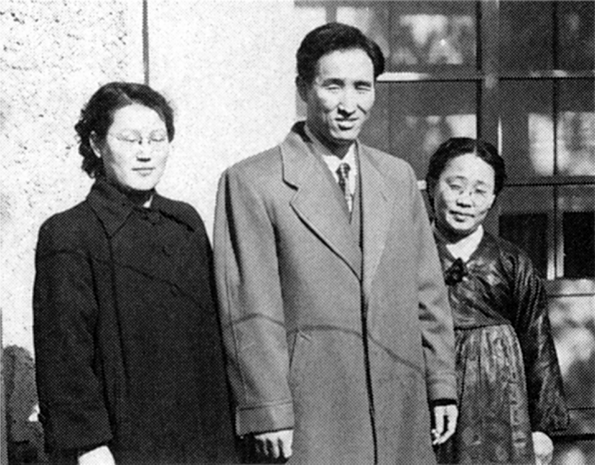
▲ Sun Myung Moon with Kim Soon-cheol (left) Lee Deuk-sam (right)
Photo from the fourth printing:
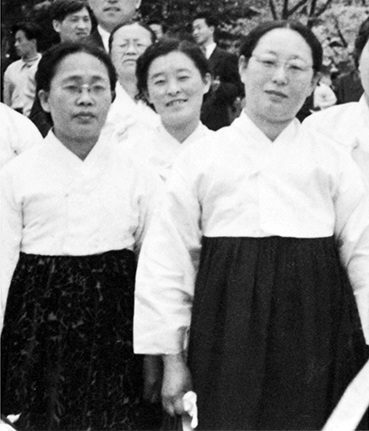
▲ From the left: Lee Deuk-sam, Kang Hyun-shil and Kim Soon-cheol
Kim Soon-cheol, who spoke while shedding tears for as long as three hours, said that she had offered both her property and her body to Sun Myung Moon. She had been divorced by her husband, her children had gone to live with their father, and she was living a lonely life, yet was still living there because she wanted to meet Sun Myung Moon.
And yet, how could Sun Myung Moon betray her so coldly? Is this something a man who calls himself the Messiah of the Second Coming can do?
We held hands and cried without end.
About a month after that day, I received contact from Deacon Oh Yeong-choon. She said that while Oh Yeong-choon was watching alone, Kim Soon-cheol brought that resentment-filled life to an end and disappeared from this world.
In the old days, Sun Myung Moon used to act as if he could not live day or night without Kim Soon-cheol, yet now Kim Soon-cheol had even moved near the Sutak-ri main factory in order to meet Sun Myung Moon and waited for him, but ended up going to the other world without even once meeting him face to face…
From the other world, how much resentment must Kim Soon-cheol be feeling as she looks down on Sun Myung Moon?
❖ Additional information
Oh Yeong-choon’s testimony about Kim Soon-cheol.
On September 17, 1953, Father moved to Seoul [from Pusan] with Pak Chung-hwa to begin developing a foundation there. I went to Seoul with other members in October and looked for the remains of my burnt house. The members that had moved to Seoul first were [Kim] Soon-cheol, [Choi] Soon-shil and [Choi] Soon-hwa, all of whom I had brought into the church. My first priority though was to meet Father. Soon-cheol could not carry out activities because of her husband; the remaining two were still students. I was the only one who was free.
One day, I decided to visit Soon-cheol quite early in the day to discuss this. Before I could even say a few words, her husband rushed at me, dragged me to their living room and pointed a gun at my neck. He ordered me to tell him where Rev. Moon was. My heart remained composed. I was ready to die. I said, “Shoot me if I am guilty of a crime. I do not know where he is.” On hearing that, he lunged toward me, spewing all types of profane language.
I did not say a word. Soon after, his driver rushed in and took away the gun. “What the heck are you doing, director?” he asked.
The director had schemed with a young housemaid, instructing her to call him when Deaconess Oh came to the house. Once signaled, he came rushing in. That was not all. He made me ride in his car to my house, where he wrote down the address. He then ordered me to show him the way to [Choi] Soon-shil’s house. Soon-shil suffered greatly as a result and had to withdraw from the church.
https://www.tparents.org/Library/Unification/Talks/Oh/Oh-130501.htm
134
Oh Yeong-choon
❖ Photo added:
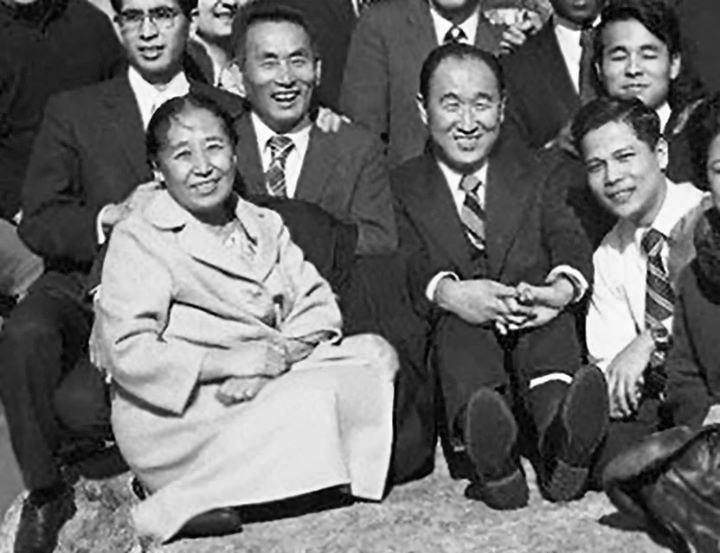
▲ Oh Yeong-choon with Kamiyama Takeru, Kim David SC, Sun Myung Moon and others on the rock at the Belvedere estate in the US in the early 1970s.
Oh Yeong-choon (born in 1914) was a devout Christian who attended church diligently even while living as a refugee on Jeju Island [during the Korean War].
She was deeply moved on hearing Sun Myung Moon’s Principle in Busan and she received pikareum restoration. Whenever Sun Myung Moon encountered difficulties, it was this Deacon Oh Yeong-choon who resolved everything for him.
She offered the entire five million won proceeds from selling her house to Sun Myung Moon, divorced her husband, and her [six] children went to live with their father, so she lived alone solely for the sake of Sun Myung Moon.
Since I have already written in detail about Deacon Oh Yeong-choon earlier, I will only write a few words here.
After Deacon Oh Yeong-choon could no longer remain at the church, [she reluctantly went to the United States and lived there with her son. When she could no longer remain there] she went to the Philippines to find her son who was living there.
Her daughter who lives in Seoul was also in a mass marriage, blessed by Sun Myung Moon. However, the couple were not compatible and divorced. When Eu Hyo-min and I went to visit Oh Yeong-choon this spring, we were told that even her daughter had asked her to leave. Now, there is no one who would particularly welcome her returning to their own home.
What kind of old age might she now be spending in a foreign land?
Eu Hyo-min and I promised each other that we would do whatever we could to help such people spend the remainder of their lives in peace.
135
Kim An-shil [probably an alias]
Kim An-shil joined the church after being evangelized by Deacon Oh Yeong-choon when I was at the Sujeong-dong church in Busan.
After hearing the Principle from Sun Myung Moon and receiving pikareum restoration, she became one of the people who, together with Lee Deuk-sam, zealously evangelized Eu Hyo-won and others.
Kim An-shil was the daughter-in-law of Mr. Jang Ri-uk (張利郁); her husband was a doctor and was studying for a doctoral degree in the United States.
While her husband was abroad, Kim An-shil lived together with her children and cared for her mother-in-law.
During that time, she attended church diligently. Kim An-shil loved Sun Myung Moon the most.
Later, Kim An-shil’s husband returned from the United States and opened a hospital in Cheongnyangni, Seoul. She lived with her husband for a while, but saying that she could not forget Sun Myung Moon, she returned to the church.
At the time she received pikareum restoration from Sun Myung Moon, Kim An-shil was a beautiful woman of about thirty years of age.
Sun Myung Moon took a liking to the young An-shil, and every time I went from Seoul to Busan, he would made it a point to write her a letter and entrust me with the responsibility of delivering it.
Now that she is old, Sun Myung Moon does not even look back at her.
She can no longer return to her husband either, so she rents a room alone, teaches piano to children, and makes a living almost as a profession by arranging marriages, herself living a lonely life.
Eu Hyo-min and I resolved to take responsibility and make efforts so that people like these, who were betrayed by Sun Myung Moon and the Unification Church, can spend the rest of their lives in peace.
136
Eu Shin-hee
Since the story of Eu Shin-hee has already been revealed earlier, here I will briefly state only her present situation.
❖ Photo added:
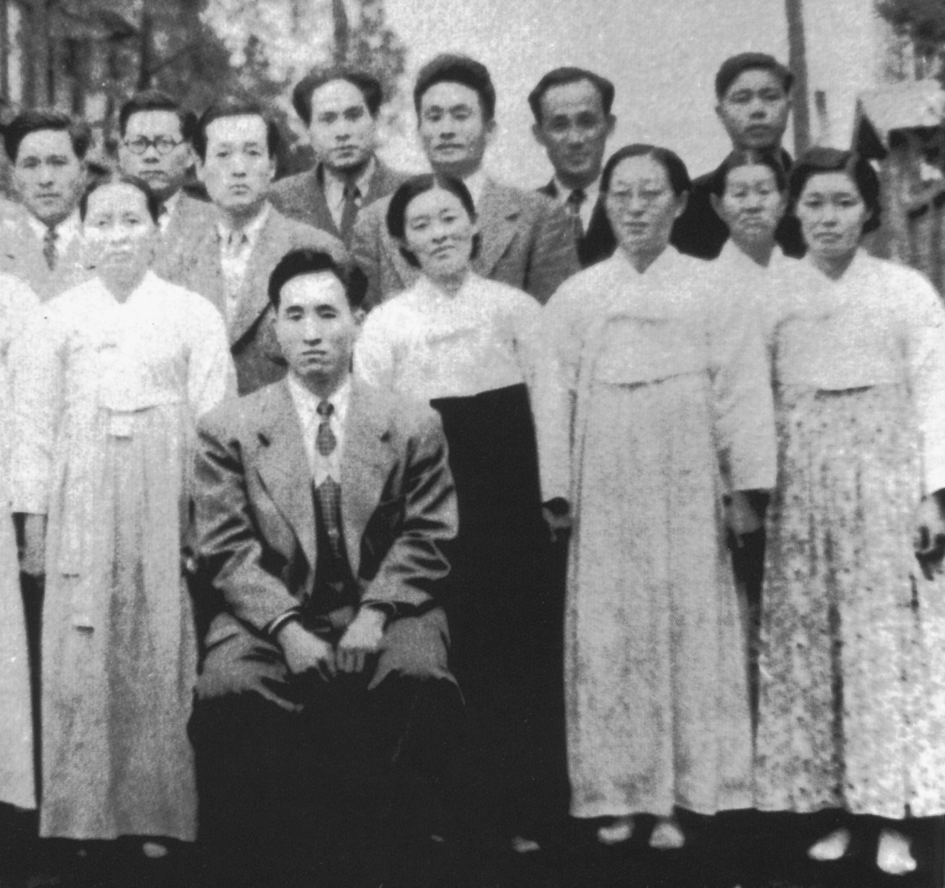
▲ Eu Shin-hee is standing on the right in this May 1954 photo with Moon.
The children whom she had entrusted to an orphanage all graduated from high school through the orphanage. They have secured their own homes, faithfully serve as church deacons, and their businesses are doing well, so they belong to the exemplary young adult class of society.
❖ Photo added:
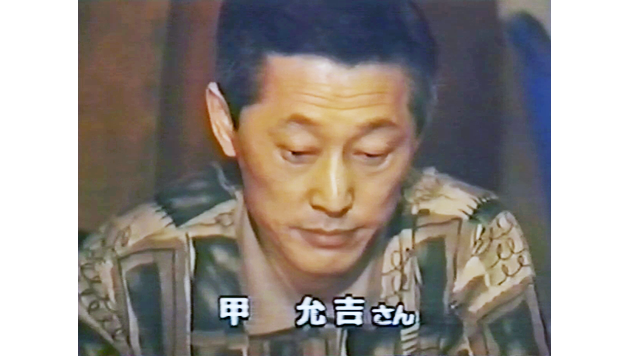
▲ 甲允吉 Gap Yun-gil, her son, was interviewed on Japanese national TV
However, Mrs Eu Shin-hee feels unable to live in her sons’ homes without a sense of shame, and the children themselves feel awkward about taking their mother in, so she rents two small rooms in Guro-dong and barely gets by while doing sewing work.
She lives day-to-day, enduring hardship with a repentant heart, lamenting that she was blinded in the past and deceived by Moon.
Regarding this person as well, Eu Hyo-min and I promised to help her.
(See Chapter 7 for an interview with Eu Shin-hee and a testimony from her brother, Eu Hyo-min.)
136
Park Cheong-sook
Around the time when the Holy Spirit Association for the Unification of World Christianity was founded at the Bukhak-dong church in Seoul in May 1954, Lee Deuk-sam informed us of Park Cheong-sook’s home. Eu Hyo-min happened to meet her while he was out on business in the city. He then proselytized Park Cheong-sook and she came to join the Unification Church.
Park Cheong-sook had one daughter about five years old, and since she was living alone, she was able to easily attend church without any issues. Even in the cold of winter she diligently helped by washing bromide photographs with well water at night. And during the day she helped prepare meals for the members. She also received more love than anyone else from Sun Myung Moon. [The two of them did not want to be apart, even for a moment. It seems that Moon had a long term strategy aimed at getting the property of Lee Deuk-sam’s rich husband, Choi Seong-mo.]
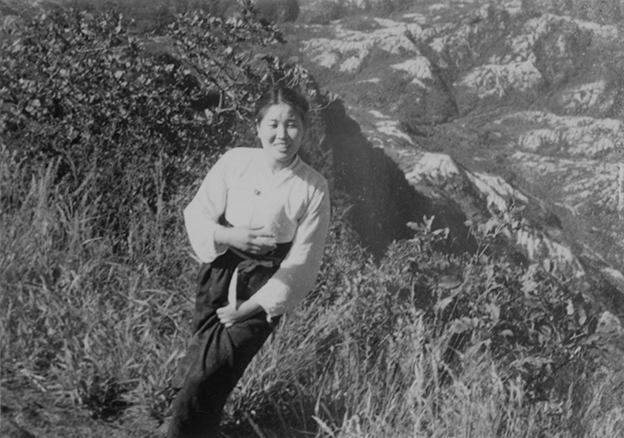
▲ Park Cheong-sook 朴貞淑
As the church grew, it moved several times, and during the Cheongpa-dong period in Yongsan-gu, Sun Myung Moon was strongly emphasizing sermons about ideal male-female partners. The church members, understanding without words, realized that Park Cheong-sook’s dream of being Moon’s ideal partner had been shattered, and she ended up leaving the church.
❖ Lee Deuk-sam had left her husband and joined Moon’s church in Busan in 1953.
❖ Photo added:
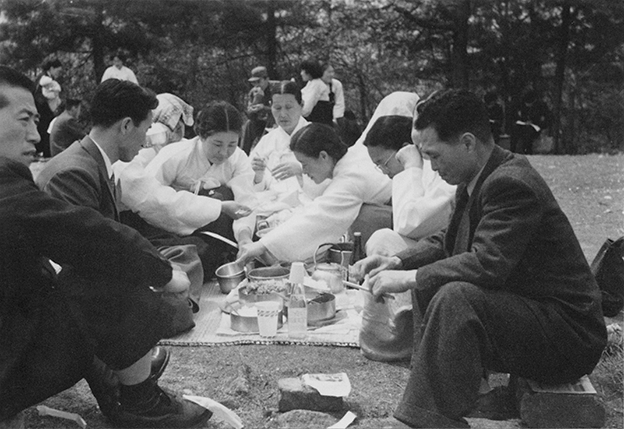
▲ Moon is second from the left. Park Cheong-sook, next to him, is attending him, together with other women. Korea, 1950s.
Thereafter, while living alone somewhere in the city, through a connection with a daughter whom she had known well at church, and after the persistent courtship of that daughter’s father, the wealthy man Choi Seong-mo, she resumed married life and prospered again, entering the ranks of the very wealthy.
That husband later died of cancer on June 26, 1976 after having one son with her, and she again became a widow. After becoming a widow, she passed many businesses on to the eldest son from the husband’s previous marriage. But that son did not take care of Park Cheong-sook at all. She then lived alone for a while, raising her one son.
Some time later, for a while she was married to an entertainer, but she divorced that person and became single again, now living together as a housekeeper with her own father.
Even the son she herself gave birth to does not try to take care of his mother.
During the period of her marriage to Choi Seong-mo, with whom she had been so close, Sun Myung Moon would quietly call her out and meet her whenever he had time, but toward Park Cheong-sook when she was living alone he showed no concern at all. Now she rents a single room and lives a lonely life.
Eu Hyo-min and I met her together, and her living conditions were so poor that she did not even have money to buy rice.
Sun Myung Moon, under the pretext of “restoration,” not only violated her but also stripped her of all her property, and ultimately abandoned her.
❖ Photo added:

▲ Kang Hyun-shil, an unhappy Park Cheong-sook and unknown. (Probably taken at the Cheongpadong Church.)
❖ Information added:
Extract from an interview which was given by Mrs. Eu Shin-hee in the early 1990s. See chapter 7. It was not done by Pak Chung-hwa.
Eu Shin-hee – One of the Six Marys
Eu Shin-hee: There were many women who were better looking or had a better situation than me. There were always about three women sticking close to Sun Myung Moon. I thought those people were of a different class compared to me.
Question: Who were those three women?
Eu Shin-hee: They were Lee Deuk-sam, Yang Yun-shin (an alias) and Kim Soon-cheol. It was later that Park Cheong-sook 朴貞淑, joined the crowd around Sun Myung Moon. She was then married to the owner of a chaebol [a Korean conglomerate] who joined us. Moon was just eyeing his property. LINK
❖ Information added:
His name was Choi Seong-mo.
Obituary of Choi Seong-mo
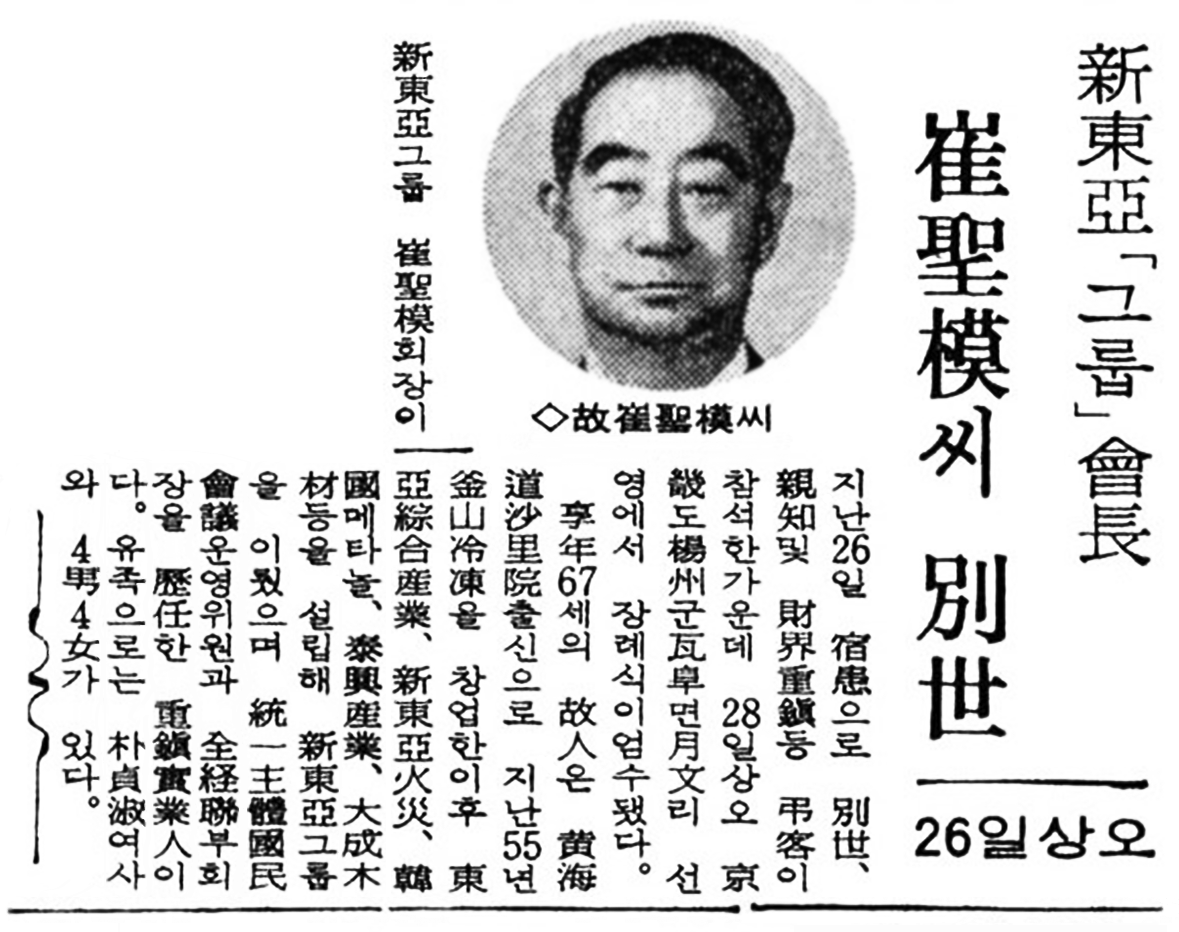
韓国・毎日新聞1976年6月28日記事
崔聖模씨別世
新東亜「그룹」會長
26일상오
◇ 故崔聖模씨
新東亞그룹 崔聖模회장이
지난26일 宿患으로 別世、親知및 財界重鎭등 弔客이참석한가운데 28일상오 京畿도楊州군瓦阜면月文리 선영에서 장례식이엄수됐다。 享年67세의 故人은 黄海道沙里院출신으로 지난55년釜山冷凍을 창업한이후 東亞綜合産業、新東亞火災、韓國메타놀、泰興産業、大成木材등을 설립해 新東亞그룹을 이뤘으며 統 一主體國民會議운영위원과 全経聯부회장을 歷任한 重鎮實業人이다。 유족으로는朴貞淑여사와 4男 4女가 있다。
Korea · Mainichi Shimbun, June 28, 1976 article
Mr. Choi Seong-mo passed away on the morning of the 26th
Chairman of the Shin Dong-A Group
◇ The late Mr. Choi Seong-mo
Mr. Choi Seong-mo, chairman of the Shindong-A Group, passed away on the 26th due to a long-standing illness. His funeral was held with due solemnity on the morning of the 28th at the family burial site in Wolmun-ri, Wabu-myeon, Yangju-gun, Gyeonggi Province, attended by relatives, close acquaintances, and leading figures from the business community.
The deceased, who was 67 years old, was a native of Sariwon, Hwanghae Province. After founding Busan Refrigeration in 1955, he went on to establish Dong-A General Industries, Shindong-A Fire & Marine Insurance, Korea Methanol, Taehung Industries, Daesung Timber, and other companies, thereby building the Shindong-A Group. He also served as an operating committee member of the National Conference for Unification and as vice chairman of the Federation of Korean Industries, and was regarded as a leading figure in the business world.
He is survived by his wife, Mrs. Park Cheong-sook 朴貞淑, and eight children, consisting of four sons and four daughters.
Choi Soon-yeong was one of his sons:
Moon used a ‘Honey Trap’ – Choi Soon-yeong interviewed
Sun Myung Moon also speaks about Park Cheong-sook in his own words as follows:
“All of that northern foundation was completely ruined by the Choi family, by Choi. Choi! Choi Seong-mo. Choi and Park. Among the women of the Unification Church, there was Park Cheong-sook who came to me and lived with me, wasn’t there? Didn’t she live together with Choi Seong-mo? She even gave birth to five sons. (‘She is now in a difficult position.’) If I were to help her (Park Cheong-sook), a path could be opened….”
(From Collected Sermons of Rev. Sun Myung Moon, vol. 327)
“Women are like that as well. In the Unification Church, do you know Aunt Park… Park Cheong-sook? (‘Yes.’) Hyun-shil (Kang Hyun-shil)! You know Park Cheong-sook, don’t you? (‘I know her well.’) Ah… you don’t need to say ‘well.’ (laughs) If you say you know her, what exactly do you know well? (‘We lived together for several years.’) I see. Park Cheong-sook, Park Cheong-hwa! I regarded the Park family as important.”
(From Collected Sermons of Rev. Sun Myung Moon, vol. 412)
(From a complaint addressed to the Seoul Court dated March 25, 1978, by Kim Myung-hee; cited in Ryo Hagiwara, The Messiah of a Licentious Religion: A Biography of Sun Myung Moon [Banseisha].)
Regarding the passage, “In fact, the defendant Moon frequently indulged himself by exchanging women with his followers; one example is that the defendant Moon took Lee Deuk-sam, who was the wife of Mr. Choi, and in exchange handed over Park Cheong-sook, who had been his own woman, to Mr. Choi,”
It can be determined from Leader Moon’s own statements and from newspaper reports that “Mr. Choi” refers to Choi Seong-mo, who was both the husband of Lee Deuk-sam and the husband of Park Cheong-sook.
(Both of Choi Seong-mo’s wives—his first wife, Lee Deuk-sam, and his second wife, Park Cheong-sook—are said to be among the “Six Marys” who had sexual relations with Leader Moon.)
❖ End of added information

▲ A replacement ‘Mary’, Kang Hyun-shil.
137
Not six Marys but sixty Marys
Sun Myung Moon carried out the “Marriage Supper of the Lamb” ritual with Hak-ja Han and made a great show of calling Hak-ja the True Mother, but apart from these representative Six Marys, there are also several dozens more women who were toyed with by Sun Myung Moon and even had their property stolen.
The women who were betrayed and discarded by Sun Myung Moon, are now grandmothers in their sixties to eighties. Their lives were ruined; they are living miserable lives while harboring deep resentment.
Such excessive acts are absolutely unforgivable, whether viewed from the standpoint of ordinary human common sense or from the standpoint of a religious person, and I believe it is inevitable that they will certainly bring about collapse in the near future.
And I believe that Sun Myung Moon himself is truly the great Satan.
The reason is that all of those he selected as the so-called Six Marys were wives of wealthy men; not a single poor person was among them.
When one considers this fact, Sun Myung Moon’s claims that Jesus, two thousand years ago, died because he could not have sex with fleshly women such as the adulterous woman or the woman with the perfume, and that restoring married women of the flesh is the fundamental principle of the doctrine, and so on—these stories appear to have been traps created by arbitrarily interpreting and abusing the Bible.
In reality, they became captives of Sun Myung Moon’s lustful sexuality, went mad, abandoned their husbands and children, and ran to Sun Myung Moon, while their money and property steadily fell into Sun Myung Moon’s grasp.
And after sucking one woman dry as much as he possibly could, he sought out another woman with money and lured her under the name of the Six Marys.
Those women who had once lived abundant lives were all reduced to empty scarecrows, stripped bare. There was neither God’s providence nor love there. Only the deaths of pitiful victims of Sun Myung Moon’s sex and hypocrisy remain.
Moreover, every year he replaced women with new Marys, discarding the Marys who had served their purpose. He never looked after any of the used Marys.
The term “Six Marys” became a fearful symbol for women who fell into this trap, and behind it lay, in truth, a reserve force of several dozens, even hundreds, of victims.
Had it not been for their money and property, the Unification Church could never have been founded or developed as it did. I, who know those times, am the first witness to this fact.
For example, a middle-aged woman surnamed Hwang, whose family registry was in North Korea, was broad-minded and bold, offering up everything she had and even skillfully drawing in other people’s money. Because she was favored, was that not inevitable? After her own money was exhausted, she asked Moon for money for an abortion, but he coldly refused, angrily denying her request. In fear, weeping and declaring her withdrawal from the church, she appealed to Director Eu, who spoke to the church leader and managed to obtain the surgery expenses for her.
After that, she never returned to the church.
140
A lover stolen and murdered
A man named Kim Won-deok (金元德)
Kim Won-deok, who rescued Sun Myung Moon from Mrs. Choi Seon-gil, and who was raging mad with anger at the church in Busan, had graduated from the artillery department of the Imperial Japanese Army Academy during the Japanese colonial period and was serving in the Japanese army when liberation came, as an artillery second lieutenant.
Afterward, he enlisted in the North Korean People’s Army and, while serving as the right-hand man of the artillery commander Mu Jeong, passed North Korean secrets to the South on several occasions.
This fact was exposed while Commander Mu Jeong was away in China attending a military conference. At first, he was sentenced to death and was merely waiting for the day of execution. Kim Won-deok had a cheerful personality and was an honest man, so he decided that if he was simply going to wait for execution, it would be better to die, and he attempted suicide in prison.
Fortunately, his attempt failed, and he was placed in solitary confinement with handcuffs on.
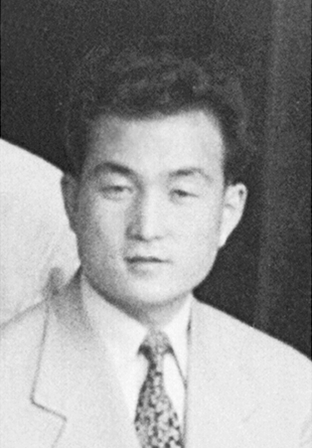
▲ Kim Won-deok
When General Mu Jeong returned to the country after a long absence, he learned that his subordinate, who had been like his right arm, had been sentenced to death and imprisoned. General Mu Jeong exerted his influence on high-ranking military authorities, and on the condition that he would personally guarantee him, Kim Won-deok’s death sentence was commuted to a term of four years and eight months in prison. After receiving notice of the commutation, Kim Won-deok was transferred from Pyongyang Prison to the Heungnam Labor Camp.
I came to know Kim Won-deok, who had narrowly escaped execution by firing squad, after I became the chief trustee at the Heungnam camp. I was introduced to him by Sun Myung Moon. From then on, the three of us, like real brothers, discussed everything centered on Sun Myung Moon and overcame many bitter circumstances together. Moreover, Kim Won-deok and I were both from Yongyeon-myeon, Daedong-gun, South Pyongan Province, so we felt an even stronger sense of closeness as natives of neighboring villages.
After being released from prison, Kim Won-deok fled to the South and worked as a police officer in the Foreign Affairs Division of the National Police Agency. And when the Unification Church was placed in a difficult situation, Kim Won-deok would appear and pull Sun Myung Moon out. Choi Seon-gil, who knew the circumstances, could not bring herself to oppose it.
141
A mystical romance
One day, Kim Won-deok told me this story. It was a love romance of his, one that made me feel a bit envious.
A few days earlier, Kim Won-deok had business in Busan and boarded a night train at Yongsan Station. He was seated in a first-class seat when a refined-looking woman, surrounded by several police officers, was about to board the same train. Judging from her clothing and the people who had come to see her off, she somehow looked like the wife of a high-ranking official going on a journey.
By coincidence, the woman sat in the seat directly opposite him. The train passed Suwon Station and then Daejeon Station. The two of them did not speak to each other at all, merely exchanging occasional glances at one another’s faces as the train continued on toward Busan.
After some time had passed, the woman softly murmured, while looking at the side of Kim Won-deok’s face, a song containing the famous Korean poetic line: “The mountains are the old mountains, yet the waters are not the old waters. They keep flowing, so the old waters cannot remain. People are the same; once they have flowed away, they can never return again.”
Her voice sounded as if a celestial maiden were singing. When he looked at the woman once more, her appearance was solemn and dignified…
… she appeared dignified, yet at the same time seemed to overflow with warmth and affection, so for a while he could not casually strike up a conversation and was simply left dumbfounded.
However, Kim Won-deok was also a man who had experienced all the ups and downs of life. Thinking that he should not remain intimidated like this, and having confidence in his own looks, he gathered his courage and spoke to her.
‘Excuse me. I saw you at Yongsan Station, but are you traveling to Busan?’ he asked.
The woman replied, ‘I run a factory manufacturing aluminum products near Yongsan Station. I’m on my way to Busan because I have some business to attend to.’
There were still three hours left until they arrived at Busan Station, but they became so absorbed in conversation that they lost all sense of time. Kim Won-deok and the woman he had met on the night train were completely in sync, and they promised to meet again somewhere that day before parting at Busan Station.
When they met at the agreed place, the two of them had dinner together, and the woman behaved toward him as if she were treating a lover. Her manner and behavior overflowed with a sociable, almost Japanese-style femininity, making her extremely attractive.
Kim Won-deok, intoxicated by her attitude and actions, could only feel bewildered.
After that, the two went to see a movie, and when it ended, without either one saying anything, they moved together as if by mutual understanding to a hotel. He said that the love they shared that day was something utterly beyond words.
Kim Won-deok had planned to finish his business in Busan and return to Seoul on the night train the following day, but because he stayed with the woman, an entire week passed in what felt like a fleeting dream, and before he knew it, he had returned to Seoul just yesterday.
143
A beautiful lady and a lavish feast
And today, he said, he had an appointment to go to her home, but it felt awkward to go alone, so he asked if I would go along with him.
Listening to his story stirred my curiosity, so I went with Kim Won-deok to Yongsan Market at noon. After crossing the railway tracks, there was an open area; to the west stood what used to be the Morinaga Confectionery factory, and to the southeast was a single-story house.
It was an old house that had once been lived in by Japanese people, so it was not particularly clean. When we went to the entrance, there was a nameplate that read “Yoon Cheong-jeong-shim (尹淸淨心).”
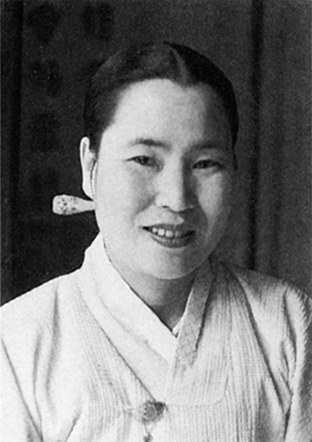
▲ 尹 清淨心 Yoon Cheong-jeong-shim
As the two of us entered the entryway, two young women, about twenty years old, came out and guided us inside.
The first room had a large Buddhist altar, and at its center stood a golden-colored Buddha statue, whether of solid gold or merely gilded I could not tell. On the brass candlesticks placed to the left and right, candles were lit even though it was broad daylight.
The next room was large enough to lay out more than ten mats, and it appeared to be a guest room.
While we were sitting there waiting, after quite some time a woman politely brought tea and served it to us.
As I was looking around at the layout of the house, a door to the side opened and a scent like perfume wafted out.
It was an exceptionally fine fragrance, unlike anything I had smelled before. A middle-aged woman entered and sat down; she slightly lowered her face, smiled, and greeted us.
“I told Mr. Kim ( 선생 seon-saeng) to come alone, but for you as well to come all the way to such a humble place truly feels like an honor,” she said. Her voice was bright and remarkably clear. She appeared to be in her late forties and was a very dignified and beautiful woman.
I was introduced through Kim Won-deok and greeted her without really knowing what was what. There was an atmosphere that felt as though it pierced straight through one’s heart.
After calming myself and looking at the woman again, I saw that her hair was combed up and tied in a bun, adorned with a long jade hairpin. From golden ornaments that looked as though they might have been worn in an old palace hung red ribbons. She wore a dark blue jacket and a pale jade-colored skirt, an elegant and proper example of our traditional formal dress.
She looked like a bride awaiting her groom on the first night.
Guided by the woman, we went into the adjoining room, where a Korean dining table was set as if in a high-class restaurant. In a silver kettle there was yellow-colored liquor, and she said, “Please have a drink,” handing us a cup in a silver goblet. The drink I received truly brought the greatest fluttering of the heart.
The Chinese poet Li Bai once wrote, while drinking beneath the great waterfall of the Yangtze River, ‘The water falling straight down from three thousand feet is like water falling from the heavens.’ I drank the liquor and ate the dishes in just such a mood.
144
Strange precognitive abilities
The woman said that she had trained for ten years at Mount Geumgang and could therefore foresee all matters of this world, enabling her to divine people’s destinies.
She claimed that by looking at a person’s face she could judge that person’s lifespan; that during National Assembly elections she could predict who would be elected; and that during university entrance examinations she could know whether a person would pass or fail.
Because of this, it was said that the aluminum-ware manufacturing factory she operated seemed, for her, not to be her main occupation but rather a side business. She said that her true purpose was to raise poor orphans, especially female orphans, educate them all the way through university, and then send them out into society. She said that all the girls she had raised so far had graduated from Ewha Womans University, and that the number of orphans she was currently caring for was seventeen.
As I listened to this story, I could hardly dare to lift my face and look at her directly. Whenever National Assembly elections came around, people reportedly flocked to this woman’s house in waves. The same was said to happen during university entrance examination periods.
We enjoyed the delicious feast, listened to the strange stories of this woman, and then, being told “Please come again,” we left her house.
She hinted that she had taken Kim Won-deok as her lover, and said quite casually that it did not matter even if he had a wife. As long as he loved her, that was enough; if both of them were happy, there was no problem at all. Hearing her say this, I thought she was a person far removed from ordinary worldly sensibilities.
From then on, Kim Won-deok and I were able to freely come and go to that house. Thanks to Kim Won-deok, I was able to partake of the feast whenever I wished, and for a time lived quite comfortably. As we became closer, I even grew familiar enough that it was no discourtesy to casually take and eat the fresh fruit placed on the altar.
Saying that since we were together with Teacher, the Returning Messiah, there was no need to leave such things in front of a lifeless altar, I ate them with relish. Only later did I realize that the woman seemed always to be listening carefully to what we were saying.
After that, Madam Yoon, with another woman named Madam Kim acting as an intermediary, established a civil engineering and construction company and installed Kim Won-deok as its president.
The company was named “Unheung Construction” by Madam Yoon, meaning “rising like clouds.” Since Kim Won-deok had no experience in civil engineering or construction, management did not go well, and before long the company had to take down its signboard. After that, Kim Won-deok and Madam Yoon cooperated on various other ventures, but perhaps due to bad luck, none of them went particularly well.
After some time, Madam Yoon asked about the meaning of the remark I had made when eating the fruit from the altar, so I explained it to her. Then she said that she very much wanted to meet that teacher at least once.
After discussing it with Kim Won-deok, I explained the situation to Sun Myung Moon, and he said it would be fine to meet her. It was decided that they would meet at 6 p.m. on October 25, 1954, at the home of Madam Yang Yun-yeong in Sindang-dong.
When I conveyed this to Madam Yoon the next day, she was extremely pleased.

▲ Yang Yun-yeong (梁允永) taught music at both Ewha and Yonsei Universities.
146
Sun Myung Moon stole his own disciple’s lover
On the appointed day, Kim Won-deok and I escorted Madam Yoon to Madam Yang’s residence. Yang Yun-yeong, Lee Deuk-sam, Oh Yeong-choon, Ok Se-hyun, Chi Seung-do, Lee Soon-cheon, Lee Gi-hwan, Yang Yun-shin, and other female members gathered there, along with Eu Hyo-won, Eu Hyo-min, Lee Soo-kyung, Kim Won-tae, and others.
That day, Madam Yoon was dressed in the finest Korean formal attire, looking exactly like a bride entering the groom’s house to welcome her first wedding night. The members who witnessed this sight, especially the women, were utterly transfixed and lost in astonishment.
After exchanging greetings, Madam Yoon boldly offered her first words, astonishing everyone present, saying:
“When I behold the Teacher with my spiritual eyes, I see that you are troubled because there is no woman who can become the True Mother. I have come as a bride to welcome you, the bridegroom, Teacher.”
That day took on an atmosphere like the moment when Jesus went up Mount Tabor with his three disciples, and Sun Myung Moon spoke all night, expounding the Principle.
Madam Yoon also sang poems and performed chang (traditional vocal music). Her voice was so remarkable that even the homeowner, Madam Yang Yun-yeong, a music professor at Ewha Womans University, was astonished.
At that time, surveillance on Sun Myung Moon was very strict. A curfew went into effect at midnight, so they promised to meet again on another occasion and dispersed for the night.
About a week later, Sun Myung Moon suddenly visited Madam Yoon’s house together with Eu Hyo-min. Kim Won-deok and I were completely unaware that Sun Myung Moon was coming, and we were greatly surprised. Madam Yoon prepared elaborate and delicious food to entertain Sun Myung Moon. Sun Myung Moon sat with Madam Yoon in an attitude as though a groom had gone to his bride’s home.
Madam Yoon, too, seemed to embody the atmosphere of a bride who had prepared oil in anticipation of going out to meet the bridegroom described in the Bible.
They ate, drank, and sang, and since it had grown late, Kim Won-deok and I left Sun Myung Moon and Eu Hyo-min behind and returned. It is said that that night Sun Myung Moon performed “restoration” (sexual relations) with Madam Yoon.
When Sun Myung Moon had fled from the North and come south with nowhere to live, Kim Won-deok had allowed him to stay in his rented room for some time. When Sun Myung Moon was in dire straits in Busan, Kim Won-deok had stood at the forefront and resolved matters for him on several occaisions.
Kim Won-deok, betrayed by Sun Myung Moon with his beloved lover Yoon Cheong-jeong-shim, felt such anguish that thereafter he avoided Sun Myung Moon.
After Sun Myung Moon appointed Song Do-uk as his secretary, he frequently visited Madam Yoon’s residence.
After Sun Myung Moon was arrested by the police on July 4, 1955, Madam Yoon also severed ties with our Unification Church for a time.
Kim Won-deok later met with me several times and spoke of his resentment and anger toward Sun Myung Moon. I earnestly tried to explain the restoration principle to defend Sun Myung Moon, but Kim Won-deok would not listen.
“Among so many women, how could he knowingly steal the lover whom his own disciple loved? Does the Teacher think I am a fool?
How can one obey a teacher who does such things? No matter how excellent the Principle of the Unification Church may be, I no longer feel any desire to believe.
I cannot forgive the Teacher, no, Sun Myung Moon. Sun Myung Moon is a swindler who deceives women under the name of religion.”
Kim Won-deok, being a former soldier, had a single-minded temperament, and like myself, he was truly enraged. He hurled insults from the depths of his gut, saying that Sun Myung Moon was “a dog in heat” and “a lecher.”
Because I understood Kim Won-deok’s sense of injustice so well, I had nothing further to say in response.
Several years later, a major incident occurred in which Madam Yoon, her housemaid, and her adopted daughter (a university student) were murdered by someone, causing a great uproar. The police apparently investigated desperately, but the case fell into mystery.
Up until shortly before that, the relationship between Sun Myung Moon and Madam Yoon had continued, and the two had been jointly preparing a film praising how the Korean War turned favorable following the UN forces’ landing at Incheon, titled “Oh, Incheon.” However, with Madam Yoon’s sudden death, funding dried up and the project was abandoned.
There were voices suspecting Kim Won-deok of the murders, and I myself was questioned by the police at the time and asked about his whereabouts.
Later, I had several opportunities to meet Kim Won-deok again, and I discreetly observed him, but he himself was deeply shocked by the incident, and the two of us even played a kind of speculative game trying to guess who the real culprit might be.
Kim Won-deok showed no change at all, and I became convinced that he was not the perpetrator.
He has now been dead for three years.