
Updated February 8, 2026
The Tragedy of the Six Marys – Sun Myung Moon is the real Satan!!
The Man I Met in Prison
This chapter has been translated from Korean. The Japanese can be found HERE. Korean text HERE.
Two photos of the fertilizer factory at Heungnam have been added.

▲ I vowed until death to accept both joys and sorrows with Sun Myung Moon.
The author, Pak Chung-hwa, is on the right.
17
Believing him to be the Returning Messiah
I was serving as the commander of the 3rd Company, 1st Battalion, 2nd Brigade of the North Korean Ministry of Internal Affairs, and from May 1947 I was assigned to Haeju in Hwanghae Province, where I was responsible for railway security duties. On December 1 of that year, I was promoted and appointed as the commander of the 2nd Battalion of the same brigade, and I was transferred to a large base in Sariwon, Hwanghae Province.
Having graduated from the civil engineering department of an industrial technical school in Shinkyō, Manchuria (present-day China) during the period of Japanese rule over Korea, I had gone on to work in official residences of Manchukuo (Jilin Province) and also had experience serving as a first lieutenant and company commander in the Japanese Army’s engineering corps. In North Korea, I was regarded, so to speak, as an elite with a promising future.
However, not long after taking up my new post, an unexpected incident occurred on May 7. A man named Heo Jeong, who was serving as the commander of the 3rd Company of the same 2nd Battalion and was stationed in Sinmak, Hwanghae Province, was discovered to have committed serious wrongdoing. He had used military vehicles to transport merchants’ goods in exchange for money and had also collaborated with black-market traders who sold northern goods, such as women’s hair, to the South Korean side.
Heo Jeong was arrested and, on February 2, was sentenced to ten years in prison. As for me, the battalion commander, I was held responsible on the grounds of insufficient supervision of my subordinate’s misconduct and was convicted of dereliction of duty, receiving a sentence of three years’ imprisonment. Initially, I was incarcerated in Pyongyang Prison, but I was later transferred to the Heungnam Special Labor Camp. This took place on February 2, 1949, when I was 35 years old.
17
Heungnam Special Labor Detention Center
When we were transferred to the Heungnam Special Labor Camp, about one hundred prisoners were bound in pairs at the wrists to prevent escape and were herded into freight trains, packed in like cattle or pigs.
From that point on, the freight train alternated between stopping and running for twenty-four hours. Without eating or drinking anything, and without sleeping even for a moment, we finally arrived around four o’clock at dawn, as day was breaking, at a wide open space like a school playground. When we were dragged down and had a chance to look around, we saw armed guards and police officers surrounding the area on all sides, with such tight security that not even an ant could slip out.
We soon realized that this place was the Heungnam Special Labor Camp, commonly known as Heungnam Prison. It was a hell of forced labor, a place said to make even a crying child stop crying. Together with prisoners who had arrived before us, we were herded into cramped rooms, thirty-two people to a room, according to an assigned headcount.
At seven o’clock, breakfast was served. It was a small fist-sized rice ball made of beans, millet, barley, and corn pressed together, so loosely formed that it looked as if it might fall apart at any moment. Soup was served in a chipped bowl with teeth broken all around the rim; it was slightly salty, with two or three small pieces of seaweed floating in it. Since the day before, not a single drop of water had touched my lips, and my body, shaken endlessly during transport, was utterly exhausted. Though my stomach was empty, I had no appetite. As I sat there in a daze, thinking about what lay ahead, the man next to me said, “You look worn out. If you can’t eat, I’ll eat it,” and reached for my food, devouring it in an instant before I could even react. I keenly felt the harshness of prison life.
At eight o’clock, driven out by a guard’s loud shout of “All prisoners to labor!”, we were pushed out into the yard. About 1,500 prisoners were assembled there, lined up facing the main gate and ordered to sit at attention. The camp warden, wearing the insignia of a second lieutenant, addressed the newly transferred prisoners, explaining the platoon rules and giving instructions and warnings about the camp labor. Then came the order: everyone was to depart.
The prisoners had their hands bound in pairs and began to move out from the front in four columns. Guards were lined up on both the left and right sides at the front, and a man wearing an armband, called the “chief overseer,” inspected and took charge of the prisoners. Binding the prisoners’ hands in pairs was, of course, to prevent escape.
The distance from the camp to the Heungnam plant of Chosun Nitrogen Fertilizer Co., Ltd. (formerly Japan Nitrogen) was about four kilometers. From that day on, whether it rained or snow piled up, we walked back and forth every day between the prison and the factory.
At a place where white ammonium fertilizer powder was piled up like mountains, we were organized into teams of ten and assigned a daily quota of filling 1,300 sacks of fertilizer into straw bags. In front of the fertilizer piled high like a mountain, a scale was set up, and a factory weighmaster sat there to measure the weight.
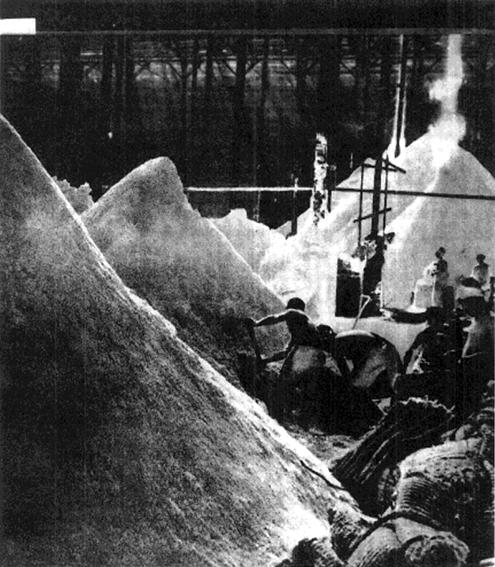
▲ Working in the fertilizer factory at Heungnam.
The sequence of the work was as follows. First, one person held an empty sack and opened its mouth, while two others shoveled fertilizer into it two or three times. When it reached the weight of 40 kilograms, another person lifted the sack off the scale, and the remaining six carried it away and tied it up with straw rope to package it. Since the work was done in teams of ten, if even one person was negligent or clumsy, the entire team would fail to meet its assigned quota. When that happened, everyone would be severely scolded by the foreman, so the ten people both encouraged and kept watch on one another. There was no room even to blink; one had to work nonstop.
20
Work began at 8 a.m., with a 30-minute break at midday, and ended at 5 p.m., amounting to eight and a half hours of labor each day. I had never done such extreme labor before, and having been detained in Pyongyang for six months, my body and mind were extremely weakened, so enduring this heavy labor was no small matter.
Even so, what was unbearable in this prison life was the various horrific acts of brutality inflicted by other prisoners. Because I struggled desperately to endure it, by the time a day’s work was finished, I would fall into a state where it was difficult even to distinguish whether it was a dream or reality. Still, by my own will, I made every effort to maintain a clear state of mind. Thus, in the evening, after inspecting the day’s work output and checking attendance, just as in the morning, we had our hands bound in pairs, lined up in four columns, and walked the four-kilometer road back to the camp.
At that time, I could hardly tell whether I was walking on my own feet or not. After another roll call and headcount at the main gate, we were lined up and organized in the exercise yard, and then more instructions were given. Only after those who had been granted visits went to the visiting room were we allowed to return to our respective cells. But in a cramped room of barely about four tsubo, as many as thirty-two people were crammed together. After a full day of labor, our bodies were drenched in sweat, yet we could not wash, and we were so exhausted that we could not even lie down properly. We had no choice but to remain sitting there as we were. It was then that I truly realized what prison life really meant.
Dinner, like breakfast, consisted of a single rice ball made of various mixed grains and one bowl of salty broth. I had no appetite at all, but thinking of the next day’s work, there was no choice but to force myself to eat. The cellmates in the same room also seemed utterly worn out, their faces all grim and harsh. Their crimes, too, were varied. Lights-out was at 10 p.m., but in the narrow room we slept with our heads and legs interlocked in opposite directions. Sometimes one person’s legs would rest on another person’s head or stomach, yet somehow all thirty-two managed to lie down sideways. The toilet was placed in a corner of the room, and in the morning everyone rushed to use it at once, causing complete chaos.
In this way, I gradually grew accustomed even to the heavy labor, and resolved to do my utmost until the day of my safe release. Before I knew it, thick calluses had formed on my hands and feet. However, I could never quite master the technique of tying fertilizer sacks with straw rope, and I suffered greatly because of it. While others could tie two sacks, there were times when I could not properly tie even one. Feeling the cold stares of my fellow workers, the most painful moments were when I failed to meet the assigned quota and caused trouble for everyone.
And what was even more unbearable was the hunger, so severe it felt as if I might die from it. In the loft of the cell there was wheat flour that had been brought in by those who had received visits, and there were times when I even thought of stealing and eating it. But no matter how hungry I was, I restrained myself, thinking that it would be wrong to resort to theft after coming all this way.
There were many nights when I could not sleep from hunger and spent the entire night staring at the bag of wheat flour. Then one morning, when we woke up, everyone was in an uproar, saying that the wheat flour had been stolen during the night. If the thief was discovered, everyone in the room would surround him and beat him in turn with clubs. This scene made me think that it was not so much prison life as it was a hell of ravenous demons.
In a room where more than thirty people were crammed together, something truly serious would happen every few days. It was the final moment of a human being reduced to the extreme. There were people so emaciated that only their bellies stuck out, so weakened that they could hardly breathe, who would die at the very moment they clutched a precious handful of rice, picking out the beans inside it to put into their mouths. There is an old saying that something even more sorrowful and merciless than the death of one’s child or the passing of one’s parents is hunger. I experienced firsthand just how precious the act of eating truly is.
A single mal of wheat flour was so valuable that it could be exchanged for a suit of clothes. [A mal is a traditional unit of measurement used for rice and other grains. It is roughly equivalent to 8 kilograms, about 17.6 pounds.] Those who received visits and supplies from home each month somehow managed to endure, but for those who had no visits or provisions at all, they were constantly face to face with death.
22
Prisoner Number 596 – Moon Yong Myung (文龍明)
My work was still clumsy, so much so that it was painful to watch. The squad leader reassigned me to tasks such as holding open the mouth of the fertilizer sack or shoveling fertilizer into the sack, but I could not properly master any of them.
Then one day, as I was struggling desperately to bundle a sack containing forty kilograms of fertilizer, a man of about thirty years of age, who looked far sturdier than the other ten members of our group, came over and said, “Let me teach you.” With practiced skill, he easily finished his own work while instructing me. I resolved to become more proficient at the job and do it properly, and fortunately I was healthy and had the strength. After several days of his continued instruction, I was finally able, somehow, to carry out the full work quota of one person. This was an immensely joyful thing.
He seemed to have been transferred to the Heungnam Prison about half a year earlier than I had, and he taught me various things, such as the conditions inside the camp and the wisdom needed to survive through barter.
To meet a Buddha in hell must be like this. Amid the painful and exhausting forced labor of prison life, I encountered for the first time the warmth of human kindness, and within despair I felt as though a faint glimmer of hope was appearing.
Because we were assigned to different rooms, when work ended and I returned to my overcrowded cell, the torment of hunger and the misery of never getting enough sleep awaited me. Still, when morning came and we went out to the fertilizer factory, I could work alongside him. Even in a place like hell, we were able to share our hearts with one another, and so I found myself eagerly waiting for the time to go out to the worksite, even if only an hour sooner.
When we went out to the exercise yard at eight in the morning, I would hastily look for him and sit behind him. After the roll call was finished, I could form a two-man pair with him, our hands bound together, and walk to the fertilizer factory. Until then, on rainy days in particular, the march on foot had made me keenly feel the utter misery of prison life, but before I knew it, meeting him every morning and working together had become, even in prison, a small pleasure for me.
About twenty days passed like this, and then one night a white-haired old man wearing a gray robe and a traditional hat appeared in my dream, called my name, and asked, “Do you know who the person is who helps you and looks after you every day?”
I replied, “He is a very kind and good person, so I stay with him and work together with him.” Then the old man said, “That person is the one whom the Bible you have learned since childhood teaches will come into this world in the future, the Returning Lord (the Messiah),” and he disappeared.
I sprang up in alarm and looked all around, but there were only my fellow inmates lying in deep sleep; the old man was nowhere to be seen.
I thought of the story in Acts (1:10-11) After Jesus prayed his final prayer in the Garden of Gethsemane he was crucified and died on the hill of Golgotha. Jesus was resurrected three days later and appeared here and there for forty days. Then, as he ascended into heaven on a cloud from the Mount of Olives, while many disciples watched, Jesus said, “Why do you stand looking up at the sky? Just as you see me go up into heaven, I will come again in the same way before long.”
The dream in which I was told he was the Returning Lord weighed on my mind, and I could not sleep. I lay thinking until morning, and with a confused heart finished breakfast. As usual, I went out to the exercise yard and sat behind him. I intended to tell him about the dream from the night before and ask what it meant.
But before I could speak, he suddenly turned around and asked, “You had a dream last night, didn’t you? In the dream, did someone tell you who I am?”
It was strange to me how he could know, but I answered, “They said you are the Returning Lord.”
From that time on, although he was twenty-nine years old and thus seven years younger than me, I always addressed him respectfully as “Teacher,” and he in turn called me by my name, “Chung-hwa.” As we grew closer, we came to live and work together in increasing familiarity. That man was Moon Yong-myung (Sun Myung Moon), who bore prisoner number 596.
24
Appointed as Chief Prison Trustee
About fifteen days after that, one morning during assembly, an order was called out: “Prisoner 919, report to the warden’s office.”
Prisoner number 919 was my number. What could this be about? Trembling with fear, I went, and the warden looked at me and said, “Yesterday the chief trusty completed his sentence and was released, so from now on you will serve as the chief trusty over all the prisoners.”
There were 1,500 prisoners confined here. For every ten prisoners there was one squad leader; a section leader supervised eighteen squad leaders; and the chief trusty oversaw fifteen section leaders, bearing the great responsibility of representing all the prisoners, including autonomously deciding daily work assignments and task allocations.
After reviewing the backgrounds and records of all the prisoners, the warden chose me, saying that as a graduate of a technical school who had served as a battalion commander in the military, “there is no one but you to succeed.” I hesitated over whether to accept this heavy role, but at Moon’s recommendation I decided to take it on.
After becoming chief trusty, I came to understand many things. The job prisoners most desired was kitchen duty, followed by miscellaneous work inside the camp, then lathe work in the machine shop, and lastly the fertilizer factory. Lathe work was also hard labor, but it had the advantage of allowing one to acquire metalworking skills while working. However, the sack-filling work at the fertilizer factory was nothing but exhausting and offered no benefit at all, the lowest and worst form of hard labor.
Even so, with three meals a day consisting of nothing more than a small rice ball and a bowl of salty soup, the body could not endure. Because of the poor food, cases of malnutrition were rampant. About one hundred people died each month from overwork and starvation.
If calculated simply, it meant that within just over a year everyone would be wiped out. Therefore, to replenish the numbers at the Heungnam camp, about one hundred prisoners were transferred each month from prisons in various regions. Once I became chief trusty, I was granted a fair amount of freedom inside the camp, so I would look for opportunities to visit Teacher Moon, engage in small talk, and, whenever possible, maneuver things so that he could be assigned to easier work.
In any case, having received a revelation from the old man in my dream, and being astonished that Teacher Moon already knew what I had seen in the dream, I came to believe that Teacher Moon truly was the Returning Messiah.
Then one day, a section leader named Joo Heung-sik came back with a strange story. A prisoner under his charge had fallen ill and was in such critical condition that it was unclear whether he would survive until the next day, and this prisoner had confided the following story to Section Leader Joo.
The prisoner had been a captain of a large cargo ship during the period of Japanese colonial rule and had sailed all over the world. After the war ended, he lived in his hometown of Yeosu. However, when he visited relatives in North Korea, he happened to commit a crime and was arrested and imprisoned.
Just before dying, this man handed Section Leader Joo a silk cloth on which a map was drawn, along with a slip of paper on which something was written in English. Shortly thereafter, he died. Because Section Leader Joo could not read English, he later asked Pastor Kim Jin-soo, a prisoner with anti-communist views who could read English, to translate it for him. According to the translation he received, the slip of paper contained the following content.
26
“Among the cemeteries behind Yeosu, there is a grave belonging to people like these. In the third child’s grave in front of it, I buried a box containing jewels worth several hundred million won. It seems that my life has now reached its end, so I am entrusting this to Section Leader Joo. If you ever have a chance to go to the South, be sure to find it.”
After telling me this story, Section Leader Joo said, “Chief Trusty, you will be released before I am, so why don’t you go down to Yeosu in the South and find it for us?” I found it an interesting story, so I conveyed it just as it was to Teacher Moon.
After that, I came to live in South Korea, but I never once went to Yeosu, and I completely forgot about the story.
However, two years later, during the Busan period, Teacher Moon, together with a friend, apparently took a passenger boat from Busan to Yeosu and searched for it as if by destiny. They seem to have located the cemetery itself, but were unable to find the most important grave, the child’s grave.
For that reason, Teacher Moon never even mentioned to me that he had gone to Yeosu.
Only much later, when I learned of this fact, I thought that if he truly were the genuine Returning Messiah, he should at least have been able to discover a box of jewels. This became one of the pieces of evidence that led me to harbor new doubts about the true identity of Teacher Moon.
“The identity of the Returning Messiah, Sun Myung Moon…” That alone is the core subject of this book and the central focus of my confession. But at that time, in my ignorance, I simply revered and believed Moon Yong-myung without reservation.
26
Why did Eve cover the lower part of her body?
Wearing the armband of the chief prisoner representative, after inspecting the prisoners going to the worksite and determining their work assignments, I had little of consequence to do and could spend my time freely. So I called Teacher Moon out to the warehouse where empty fertilizer sacks were piled and listened to him talk about religious matters.
However, Teacher Moon’s words contained many things that, even for me—who had received infant baptism, had served as a church deacon in my younger days, and could be said to have some knowledge of the Bible—were not merely hard to understand but provoked strong resistance.
For example, it is written that John the Baptist lived an ascetic life in the wilderness, wearing clothes of animal skins and eating locusts and wild honey, and that he proclaimed, “Repent, for the kingdom of heaven is at hand.” But Teacher Moon said that in fact John did not fulfill his share of responsibility, and therefore had his head cut off and died. Since Christianity up to now has taught John the Baptist was a truly admirable figure, I received a great shock.
Moreover, he said things such as, “Even Mary, the mother of Jesus, was unable to fulfill her responsibility,” and “Jesus was not originally meant to be nailed to the cross and die,” and so on.
What shocked me even more was something I heard on a day I can never forget, Saturday, March 29, 1950.
That day it had been raining since morning, and as usual 1,500 prisoners, their hands bound in pairs, hurried toward the fertilizer factory, soaked through like drowned rats, looking only at the ground. After arriving, as chief representative, I spent about ten minutes inspecting everyone and assigning the work.
Around that time, Teacher Moon was being assigned an easy task suitable for the sick or elderly, stuffing straw into empty fertilizer sacks. I went there and called him out, saying, “As the chief representative, I have some business, so please come for a moment,” and then we climbed up onto a pile of empty sacks stacked like a mountain inside a quiet warehouse and sat facing each other.
As chief representative, such freedom was permitted even at the worksite, and there was not a single guard or prisoner who raised an objection. Thus, it was possible for us to talk for several hours.
Moon Yong-myung, serving a five-year sentence for the crime of disturbing social order, was prisoner number 596; I, serving a three-year sentence for dereliction of duty due to my responsibility for a subordinate’s wrongdoing, was prisoner number 919. The two prisoners sat facing each other: 596 spoke, and 919 listened intently, asking questions and making notes at important points.
28
The topic of that day’s discussion was the Book of Genesis in the Bible.
The gist of Genesis is that 6,000 years ago God formed a human figure from the dust of the ground and breathed into its nostrils the breath of life, enabling it to move as a human being. He called him “Adam” and had him live in the Garden of Eden. Then, in order to make a suitable companion, while Adam was sleeping God took one of Adam’s ribs and made a woman. That was “Eve.”
God commanded the two of them not to eat the fruit of the tree in the center of the Garden of Eden, but because the serpent tempted Eve, Eve finally ate the fruit of the forbidden tree and also urged her husband Adam to eat it.
After betraying God, they hid themselves in the shade of the forbidden tree, and when they were discovered, they appeared ashamed and covered their lower bodies with fig leaves. God created Adam and made Eve with the purpose that, once Eve matured, they would propagate sinless descendants in this world. However, the two who betrayed God were soon expelled from the Garden of Eden and were never able to return.
Adam, having committed sin and become defiled, could no longer live unless he labored by the sweat of his brow, and Eve had to endure the pain of childbirth.
Between the two were born the brothers Cain and Abel, and before long the elder brother Cain killed his younger brother Abel, thus becoming the first sinner in this world.
This is what is written in the Bible and the interpretation that has been taught to us.
However, Teacher Moon says that “this interpretation of the Bible is fundamentally wrong.” He says that Christians all over the world are mistaken.
Teacher Moon’s interpretation is as follows. The serpent who tempted Eve was the archangel named Lucifer, and Lucifer, knowing God’s providence, used sweet words to seduce the immature Eve and led her to eat the fruit of the forbidden tree. In other words, Lucifer had sex with Eve.
And Eve, whose virginity had been violated, before being discovered by God, also had sexual intercourse with her husband Adam while her body was still defiled with Satan’s blood.
Up to now, it was taught that the sin was eating the forbidden fruit. But if that were so, then why, when they were discovered by God, did Eve cover her lower body with fig leaves?
When a person is wounded, they put something like a bandage on the wound so it can heal. By the same logic, Adam and Eve committed the sexual act that God had forbidden, and because a wound was inflicted on what had been a pure lower body, they covered that part with fig leaves. Until then, even though Eve was naked, did she not feel shame?
In other words, because the sexual act was committed with the sexual organs of the lower body, sin resided in that part, and therefore the lower body was covered.
Even today, when a man strives to have sexual relations with a woman and the act is completed with satisfaction, people express it by saying “he plucked such-and-such a virgin (or married woman),” and this expression originates from there.
Even when a bride and groom hold a wedding ceremony and spend their first night together openly and legitimately, it is common that, when they appear before their family the next day, they feel an inexplicable sense of shame deep in their hearts.
This is because, six thousand years ago, when the archangel Lucifer had sexual relations with Eve, who was still an immature virgin, the sensation of “tartness” was felt, and this too was because the immature Eve had sexual relations with the archangel Lucifer.
Just as picking and eating unripe fruit produces a tart taste, the feeling of “tartness” likewise arose because the immature Eve engaged in sexual relations with the archangel Lucifer.
God intended to propagate sinless human beings in the world, but because of the archangel Lucifer, that purpose was thwarted.
And when Cain killed his younger brother Abel, the propagation of sinners in this world began. God could not possibly leave this unattended.
Thus, Sodom and Gomorrah, which were filled with sin, were judged with fire, and in the time of Noah they were judged with a flood. Even so, humanity filled with sin could not be saved, and therefore, two thousand years ago in the land of Judea, God caused Jesus to be born through the body of the virgin Mary.
The reason God caused Jesus to be born into this world was that, four thousand years earlier, He had failed to establish God’s ideal human world through Adam, and therefore He caused Jesus to be born as the Second Adam in order to realize, through him, the original purpose He had intended to achieve through the First Adam.
30
Jesus and six women
Jesus lived in Joseph’s house for 30 years and worked as a carpenter. When he turned 30, he began to walk the path of a savior. Jesus then chose 12 disciples.
To serve as the second Adam and fulfill God’s purpose of creation, he first must have pikareum sexual intercourse with his mother, Mary, to regain what was taken from the first Adam by the Archangel Lucifer. Jesus would then achieve the providence of restoration.
Mary, the mother of Jesus, did not know about heaven’s providence and did not give Jesus the opportunity to have sexual intercourse with her because she thought of him only as as her physical son.
Among the miracles that Jesus performed was turning water into wine at a wedding in Cana of Galilee. Jesus’ mother, Mary, was there and he and his disciples had been invited. When the house ran out of wine, his mother Mary said to him, “They have no more wine.” In other words, Mother Mary, who knew that Jesus could make wine from water, asked Jesus to do it.
Then Jesus said to Mary, “Woman, what have you to do with me?” Jesus spoke to his mother Mary with the thought that he could not truly forgive her because she had no intention of having sex with him and only wanted him to make wine at a neighbor’s banquet.
The fact that the Virgin Mary should have sexual intercourse with Jesus is the principle of restoration, which is to bring back Eve, who was taken away by the archangel Lucifer.
In other words, because Mary did not cooperate as mother and son (pikareum sexual intercourse between mother and son), Jesus could not inherit pure blood and restore the first Adam.
After that, Jesus loved Mary Magdalene very much, and since she was also following him, he married Mary Magdalene and tried to achieve God’s purpose of creation. However, this Mary Magdalene was the lover of Judas, one of Jesus’ disciples. Judas and Mary Magdalene were engaged to be married. So Judas was jealous because Jesus, his teacher, loved Mary Magdalene.
Jesus planned for Judas to marry Martha, Mary Magdalene’s sister-in-law, and he intended to marry Mary Magdalene himself.
Judas rebelled against Jesus and secretly sold him to a Roman soldier for 30 pieces of silver. In fact, he sold Jesus not because he was greedy for money, but because he was jealous that his woman was taken away by Jesus.
While Jesus was touring various places with his disciples, the group came to a village called Sychar in Samaria. They were looking for food while, Jesus who was tired was sitting by a well to rest when a Samaritan woman came to draw water.
Jesus said to this woman, “Bring your husband.”
Since the woman did not answer, Jesus said, “You cannot answer because you have five husbands,” and asked for a drink of water.
“If I drink the water you give me, I will become thirsty again. The water I give you will flow forever inside you like living water.” (Note: This is the reverse of the Bible story in John chapter 4, but is only according to Sun Myung Moon) Jesus tried to realize the providence of restoration by having sexual intercourse with this Samaritan woman, but he could not realize it because the disciples, who did not know Jesus’ intention, and did not cooperate.
32
At another time, people from among the tax collectors and Pharisees (who in the Bible seem to be portrayed as the greatest sinners) brought before Jesus a woman who had committed adultery. If Jesus were to say, “Forgive this woman,” then it would contradict the Law of Moses, which commanded that an adulterous woman be stoned to death. But if he were to say, “Stone her to death,” then it would contradict Jesus’ own teaching that one should forgive even seventy times seven. It was truly an awkward dilemma, one that was difficult to answer. At that moment, Jesus said nothing and instead wrote something on the ground. When people came closer to look, it was written:
“Let whoever among you is without sin throw the first stone at this woman.”
All the many people who were gathered there each had something weighing on their conscience, so one by one they all left, until only Jesus and the woman remained. Then Jesus said to the woman,
“Neither do I condemn you; go, and from now on do not sin again.” [This story is from John chapter 8.]
At this moment as well, Jesus should have engaged in sexual intercourse with this woman according to the providence of restoration, yet he was unable to carry it out.
Next is the incident when Jesus went with his disciples to the house of Simon, where there was a leper. While everyone was eating, a woman came carrying a jar of precious perfume, and with tears of deep emotion she wet Jesus’ feet. The woman wiped the tears from his feet with her hair and then poured the oil on Jesus’ feet.
The disciples criticized the woman, saying, “Why is such precious oil being wasted like this? If it were sold for a large sum of money, it could be used to help the poor.”
Jesus said, “Stop rebuking this woman. She has done something very important for me.”
Jesus intended to realize the providence of restoration by having sexual intercourse with this woman, but even at this time the disciples did not cooperate, and so he was unable to accomplish that purpose.
Although everyone believes that because Jesus bore humanity’s sins and died on the cross, sinners are cleansed and saved through the price of his blood, this belief exists because God’s purpose of creation and the ideal of creation are not correctly understood.
God caused Jesus to be born into this world as the second Adam in order to recover Eve, who had been taken away from the first Adam by the archangel Lucifer, and to restore Eve to her original state; in other words, to fulfill the mission of realizing the providence of restoration.
However, because Jesus’s mother Mary did not know that Jesus had been born into this world for the sake of the providence of restoration, she did not give Jesus the opportunity for the important rite through which sinless blood would be transmitted, namely, the first sexual union with the Virgin Mary, which was to be carried out for the providence of restoration.
Because the first necessary “mother-son cooperation” was not accomplished, although Jesus was born into this world, he was unable to fulfill the providence of restoration, and without even being able to marry, he was nailed to the cross on the hill of Golgotha, died, and ascended to heaven.
At the time of his final prayer, in which he promised his return, Jesus prayed, “If it be possible, let this cup pass from me; nevertheless, I will follow the Father’s will.” This was not because he feared death, but because, having come into this world as the second Adam, it was empty and regretful for him to die without recovering the Eve who had been taken away, and without being able to practice the providence of restoration (sexual union) with his mother.
If the interpretation were correct that people who believe in Jesus are saved by the price of his blood through his death on the cross, then he would not have prayed such a prayer.
Jesus failed physically, but achieved victory spiritually, and thus left behind the task of the Second Coming.
If that is so, where, then, will the returning Lord (the Messiah) come, and how will he save humanity? Will he come riding on the clouds through the Mount of Olives?
No, that is not so. He will come to a country in the East, a country where people wear white clothes, a country with four distinct seasons, a country where the sun rises in the east. That country is our Republic of Korea, and it has been determined that the Second Coming will take place in this land.
The returning Lord will be born into this world as the third Adam. By practicing in this world the providence of restoration that Jesus was unable to accomplish, he will completely cleanse the six-thousand-year history of human sin, and by exchanging the blood of humanity, which has been defiled by Satan’s blood, with the sacred blood of God, he will make this world a world eternally unrelated to sin, thereby fulfilling God’s true will.
This is the mission of the returning Lord: to recover the lost purity of Eve, to conduct the “Marriage Supper of the Lamb” with a virgin before all people, and, through the True Parents, a True Adam and a True Eve, to cause the blood of all humanity throughout the world to be exchanged for blood that is undefiled.
34
“Blood purification” through a pikareum sex relay (血代交換)
I was born into a family in which my parents were Christians of the same faith, received infant baptism, and even had experience serving as a church deacon, so I could not help but doubt Moon’s interpretation of the Bible and feel my head tilt in disbelief.
Yet at the same time, I had received a revelation in a dream saying, “Moon is truly the Messiah of the Second Coming,” and so, while harboring both belief and doubt, I was gradually being drawn into his words.
So I asked, “From now on, what kind of work will you do, and how will you go about completing the ideal heavenly kingdom?”
That is the pikareum sexual restoration with women that Jesus was unable to accomplish after being born into this world.
First, what was taken away through sexual intercourse with the archangel Lucifer must be restored by taking back the six wives, the six Marys, through a similar method.
It is a task that must be done inevitably for the providence of restoration, a serious mission that must be accomplished even at the risk of one’s life.
I asked the question, feeling both surprised and repulsed. “Teacher, having sex with a married woman, especially six married women, carries a high risk of being killed by the husband. Even if the husbands are unaware, adultery is clearly defined in the Ten Commandments, the teachings of God: ‘Do not commit adultery.’ Furthermore, under the laws of this country, having sex with a married woman constitutes adultery. How could such a thing be done?”
Teacher Moon replied, No, there’s no need to worry. Soon, the world will become extremely sexually depraved. Men and women will be having sex naturally on the street, and passersby will see it as nothing more than a handshake, and nothing will be strange.
Also, around that time, human psychology will change. Even if their wives or lovers have sex with other men, they will no longer be angry or jealous.
Then, women who have heard about the Principle of Restoration will come willingly, desiring pikareum sexual restoration. When that time comes, the Second Coming Messiah will come to the six people. To purify the defiled blood of Satan, which was stolen from a married woman as Mary, and “blood exchange” must be performed.
This “blood exchange” is called pikareum. (Note: “blood sharing”; see below). Unlike Satan’s world today, sexual intercourse, which is a ritual of restoration, has certain rules.
To purify the defiled blood of a married woman and achieve womb cleansing, the Messiah must perform sexual intercourse as a ritual of restoration three times.
This carries the meaning of revival, growth, and completion. In other words, through sexual intercourse with the six Marys, a total of eighteen times, the married women are reborn as Marys.
After the six Marys are restored, the Messiah will then select a virgin who has never had sexual intercourse, designate her as a new Eve, and conduct the “Marriage Supper of the Lamb” (official marriage). Adam’s representative, the Messiah and Eve, are the True Father and True Mother, and the offspring born from them will forever be good beings, without sin.
36
Therefore, this world can be restored to the ideal starting point that God intended to create 6,000 years ago.
“But Teacher, there are 5 billion people in this world who have received the blood of Satan, poisoned by the Archangel Lucifer. Is it possible to have pikareum sex with all of them?”
Teacher Moon replied, The woman who was initially restored by the Second Coming Messiah can restore another male church member by doing pikareum three times: twice from above and once from below, representing formation, growth and completion.
[The Unification Church documentation for the “Three Day Ceremony” gives a more detailed explanation of the theory of restoration through sex.]
That male member of the church is now restored and can restore female church members by having sexual intercourse, twice from above and once from below. Then, those female church members can restore other male church members by having sexual intercourse, twice from above and once from below [in a sex relay].
In this way it will expand.
However, once one receives restoration, for the first seven years one must practice “seongbyeol” (a period of not engaging in sexual intercourse). Only then does one become qualified to receive restoration. But now, because of the times, it is possible with only seven months of seongbyeol, and afterward it will become much shorter, so that with only seven days of seongbyeol men and women will be given the qualification to receive restoration from each other.
At that point I asked, “In this world there are different nationalities, languages, skin colors, and ideals. There are so many people. Even if it were only Korea it might be possible, but how could it work like that?”
Teacher Moon said, “If only the conditions of the providence of restoration are put in place, it can be carried out regardless of nationality, ethnicity, language, and the like,” and he continued.
People from all over the world will gather, from every nation, to worship under the Messiah who has returned in the land of four seasons, where the sun rises in the east and people wear white clothes.
When that time comes, under the True Parents, all humanity throughout the world will become like one family, and the whole world will become close, regardless of nationality or language. When Koreans wish to go to Africa, they will be able to go anywhere in Africa, visit any home, and stay in that house for a day or for several days.
He can also use everything in that house as if it were their own belongings. He may eat as much as he wants and drink happily, and no one will interferes. Likewise, even if a black person from Africa comes to Korea, they can stay for several days, use our things as if they were their own, and eat and drink as they please, and there will be no one who complains.
In the satanic world up to now, all materials and money were being used by Satan, and therefore the way they were used was wrong.
It is natural that church members who live together with the True Parents can freely use all the things of this world. Even if the members who are together with the True Parents were to steal and use all the goods or money that exist in the satanic world, even if that were to violate secular laws, in reality it would amount to nothing.
This is because those materials and money originally belonged to God, but Satan seized them and used them. If that happens, great economic suffering will disappear, and all means of transportation can be freely used, making it possible to go anywhere in the world.
At present, even the amount of work that 1,500 of us prisoners must labor at all day long to barely accomplish will, when that time comes, be doable by one person working for just three hours. People of the world will not work in order to eat, but will only need to work for about three hours as a form of play.
And members living in cold regions such as Alaska, if they wish, can come year-round to warm and beautiful places like Hawaii, where they can freely eat, drink, and love one another. If they grow tired of that, they can come to a country like Korea, where the four seasons are distinct, and enjoy themselves. They can also go to culturally advanced countries like Japan, freely sightseeing, living, and loving. Such a time will surely come.
38
Moon teaches that all the people of the world becoming the children of the two parents called the True Adam and the True Eve, and building an ideal society, is called the “The Garden of Peace and Harmony Ideal” (圓和園理想).
From my situation at that time, suffering inside a prison, it sounded like a dream within a dream, so I merely listened in silence. In prison, I made use of my position as chief inmate to buy time and listened to Moon speak over the course of several weeks.Thinking back now, for him it was a favorable form of evangelism and proselytizing. And much later I came to realize that the creation principle and restoration principle he spoke of were in fact nothing more than copies of the theories of Kim Baek-Moon and Lee Yong-do that he had been taught, and amounted to little more than wholesale resale.
Furthermore, I must reveal in this book how many women Moon made unhappy through sexual acts carried out under the name of “restoration,” and how lascivious and unrestrained his own sexual desire was. On the other hand, this can be called a social evil. As for myself, who is exposing the truth of restoration, the fact is that I too, following Moon’s orders, carried out restoration with many women.
In any case, please read about the relationship between Moon and myself during that period, when I was ignorant for a time.
39
The heretic who caused an uproar in Pyongyang
That day as well, I went out to the work site with the prisoners, and after assigning the work duties, I went with Mr. Moon to a quiet warehouse and sat facing each other in a place where empty sacks were piled up, and we spoke at length.
Today I heard about the motive that brought him from Seoul to Pyongyang, what he did after coming to Pyongyang, and for what reason he had been sentenced to five years in prison under the charge called “crime of disrupting social order” and had come to serve that sentence.
In my dream, I had clearly received a revelation that Mr. Moon was the returning Messiah. In my interpretation, the returning Messiah is the one who comes to carry out judgment on the last day of the end of this world. And just as, at harvest time, well-ripened grain is carefully gathered in, while that which did not ripen in time or is like chaff is burned in fire, so, according to the judgment of the returning Messiah, true believers are lifted up to heaven, and those who did not believe are cast down into hell.
Scripture teaches that this is the mission of the returning Messiah. Therefore, I asked Mr. Moon for what reason he was enduring such suffering in this kind of prison. He explained in detail over a long period of time.
39
The first arrest and detention
When Mr. Moon was living in Sangdo-dong, Yeongdeungpo-gu, Seoul, he attended the Israel Monastery, which was led by a man named Kim Baek-moon. As he studied Kim Baek-moon’s interpretation of biblical principles, he became deeply absorbed in those principles.
In the midst of this, he said that he received a revelation from God telling him to go to North Korea. According to Mr. Moon, this occurred on June 6, 1946.
At that time, Soviet troops were stationed in North Korea, and the entire region was rapidly being permeated by communism. In such circumstances, Mr. Moon left his wife and child behind in Seoul, carried only a single backpack, crossed the 38th parallel, and went to Pyongyang.
After arriving in Pyongyang, the first person he met was a woman named Chong Deuk-eun (丁得恩). As they found themselves in close agreement and talked together, they agreed to cooperate in making Pyongyang, which they believed God had revealed to them, into the Second Jerusalem. At that time, Mr. Moon was 26 years old, and Chong Deuk-eun was about 40 years old.
The two decided to preach the principles at Chong Deuk-eun’s house, which was located at Geomundari in Sangsu-guri, Pyongyang. Within just a few days, more than ten fervent believers gathered at this house. It was here that Mr. Moon gave his first lectures on the Principle of Creation.
He taught about how the archangel Lucifer realized God’s purpose of creation and tempted Eve, causing the Fall; how Mary, the mother of Jesus, did not engage in mother-son cooperation (sexual intercourse), and therefore Jesus ended up dying on the cross.
He further explained that Jesus had not come into the world in order to die, but because his physical body died on the cross and only his spirit ascended to heaven, he promised that he would return again at the Second Coming, and so on.
At that time, the believers who had gathered were women such as Chong Deuk-eun, Ok Se-hyun, Chi Seung-do, Jeong Seon-ok*, Kim In-ju, Kim Chong-hwa, and men such as Kim Won-pil, Cheong Myeong-seon [the husband of Kim Chong-hwa], and Cha Sang-sun.
It is said that when Mr. Moon held meetings and lectured on his principles of biblical interpretation, the women in particular began to cry loudly. Seeing this, the people living nearby seemed to think it was strange. A young man who had come from Seoul would gather about ten people and give speeches, and everyone in the room would either cry out loudly or shout. However, when one asked Mr. Moon about it, he said that when listening to lectures on the Principle of Creation, the Principle of the Fall, and the lectures on Restoration, it was only natural that anyone would pray while crying in order to resolve God’s anger, which had continued for six thousand years.
There was no way such gatherings could be permitted under a communist system. Nearby residents and members of established churches, especially pastors and elders, regarded Mr. Moon’s activities as heretical.
Because these strange meetings were reported to the police, Mr. Moon was arrested at the Daedong Security Office on August 2, 1946, two months after coming to Pyongyang, and was detained for about 100 days. During that time, he was subjected to harsh torture, such as being prevented from sleeping even for a moment or being denied food for two days at a time, and suffered abuse. However, because there was no specific crime, he was released. At that time, Mr. Moon was quite weakened, but it is said that he recovered through the help of believers and the benefits of herbal medicine.
41
Sentenced to five years in prison for a marriage scandal with a married woman [who had three children]
After that, Mr. Moon stayed at the home of a fervent female believer named Kim Chong-hwa (金鍾和) in Gyeongchang-ri. She had a husband, Cheong Myeong-seon, and three children.
At this house, Mr. Moon claimed that he had carried out the principle of restoration. Just as the archangel Lucifer seized Eve and had sexual relations with her, he seized a married woman who already had a husband and began living with Kim Chong-hwa as husband and wife, sleeping with her in the very house where her husband and children were present in the adjacent room.
Moreover, Mr. Moon said that he had received a revelation from God and decided to hold an “Marriage Supper of the Lamb” (a formal marriage) with Kim Chong-hwa. The believers gathered rice to make rice cakes and prepared suits and bedding, making abundant preparations for the ceremony. [They also prepared crowns.]
A young man who had come from Seoul gathered people every day, praying in tears and then singing hymns loudly, creating a great commotion late into the night. On top of that, despite the husband and children being present, they were all living together under the same roof. And now they were causing an even greater uproar by announcing that they were going to hold a wedding ceremony. The villagers who were witnessing this disturbance could not possibly remain silent.
The villagers [and her husband] reported the matter to the police, and on February 22, 1948, Mr. Moon and everyone involved [Chi Seung-do, Ok Se-hyeon, and the woman Kim In-ju] were arrested [by the Internal Security Office]. As a result of this incident, Mr. Moon was sentenced to five years in prison for disturbing public order and was sent to the Heungnam Special Labor Camp on June 20, 1948.
I later heard that Kim Chong-hwa served a one-year prison sentence, while Ok Sang-hyeon, whose family was quite wealthy, was released after only two months. Several years later, I had the opportunity to visit Kim Chong-hwa, who was taking refuge in Seoul in South Korea, and to speak with her personally, and I heard the true details of what had happened at that time.
The story that came from her own mouth, after she had lost her faith and was living quietly, was different from Mr. Moon’s account, and it was a highly compelling one.
42
The Korean War and the great air raid
As 1950 began, conditions inside the prison became even more severe. For some reason, the ammonium fertilizer at the fertilizer factory worksite had hardened like stone, so work efficiency was poor. Yet the assigned quota kept increasing day by day, creating a situation in which, no matter how hard one worked to the point of death, it could not be met. Moreover, the working hours were extended by one hour, with work ending at 6 o’clock. It truly felt like being told, “Die.”
Out of the 1,500 prisoners, about 100 died each month, collapsing one after another, and the factory workers ended each day’s work by holding funerals every day. And for each person who died, prisoners were reliably sent in from Pyongyang Prison to replenish the numbers.
I noticed around May that the number of young guards had greatly decreased.
Somehow, I once overheard employees whispering among themselves, saying, “This is a secret, but… when ships that transport fertilizer to the Soviet side return, they come back loaded with weapons like anti-aircraft guns. Perhaps a war will begin soon.”
Security within the camp and surveillance at the work sites became even stricter, and an atmosphere prevailed in which prisoners could not speak loudly. Then, on June 25, the war finally began.
It was said that the North Korean People’s Army crossed the 38th parallel and advanced south, and that three days later Seoul fell. When rumors spread that prisoners might be divided by age and sent into the army, possibly dispatched to dangerous front-line positions, anxiety caused great commotion inside the camp. Amid this, on August 1 at 11 a.m., United Nations aircraft conducted reconnaissance over the fertilizer factory for about 30 minutes and then departed.
Based on my experience from my time in the military, I advised the guard in charge of discipline, saying, “This place will definitely be bombed. The prison camp should be safer, so wouldn’t it be better to withdraw the prisoners?” But this did not get through to the guard, who knew nothing about war. There was no choice but to continue working, and just as expected, an air-raid warning siren suddenly sounded.
UN forces’ B-29 bombers carried out an air raid, and from around noon for about four hours the fertilizer factory was subjected to a fierce rain of bombs. The guards, who were farmers from mountain villages in North Korea who had grown corn, were stunned and ran about in confusion, not knowing what to do.
So I said that even if there were further bombings, under international law prisons and detention camps would not be bombed. I urged them to hurry back to the camp without worry. The guards shouted loudly, ordering that the prisoners be supervised from behind to make sure everyone followed, and then they ran at the front back to the camp.
The total number of people working at the fertilizer factory was about 8,000, of whom 1,500 were prisoners. When we returned and checked, the number of prisoners who had died was only 70, whereas across the entire factory some 3,700 people had been killed.
It was truly a terrifying major air raid. After returning to the camp, I hurried to find Teacher Moon, worried whether he had been injured in the bombing, but he was completely unharmed, without a single injury.
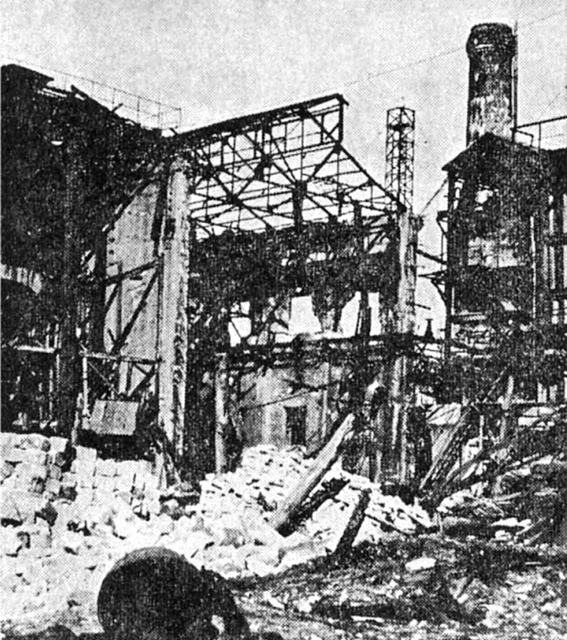
▲ The fertilizer factory at Heungnam after the August 1950 bombing.
44
Kim Il-sung’s clemency
After North Korea established the “Democratic People’s Republic of Korea” under the Kim Il-sung regime (1948), I, whose sentence had been reduced to one year and six months by an amnesty, barely completed my term the day after the major air raid (August 2, 1950) and was released from the hellish camp, becoming a free man.
Although it was under the same sky, I looked up at the heavens with tears welling in my eyes, thinking how utterly different it was inside the factory and outside it. It was around 10 a.m. When I passed by the fertilizer factory, the miserable sight of the bombing damage was beyond imagination. From large craters here and there, scattered pieces of corpses were being pulled out.
Thinking that Teacher Moon might still be undergoing forced labor in this factory even today, I felt ashamed that I alone had been released first. When I went to bid farewell upon my release, Teacher Moon said, “When you go to Pyongyang, please find Kim Chong-hwa, who lives in Gyeongchang-ri, and tell her that I am doing well, so she can be at ease.”
The woman Kim Chong-hwa was precisely the married woman who had been the cause of Teacher Moon’s imprisonment when he had tried to marry her.
On the roads of Heungnam many trucks were running, carrying military supplies for the People’s Army. It seemed that the People’s Army had won through a preemptive attack and occupied Seoul. It was now wartime. I stopped a military truck heading for Pyongyang and explained my situation, and they agreed to take me as far as Pyongyang.